
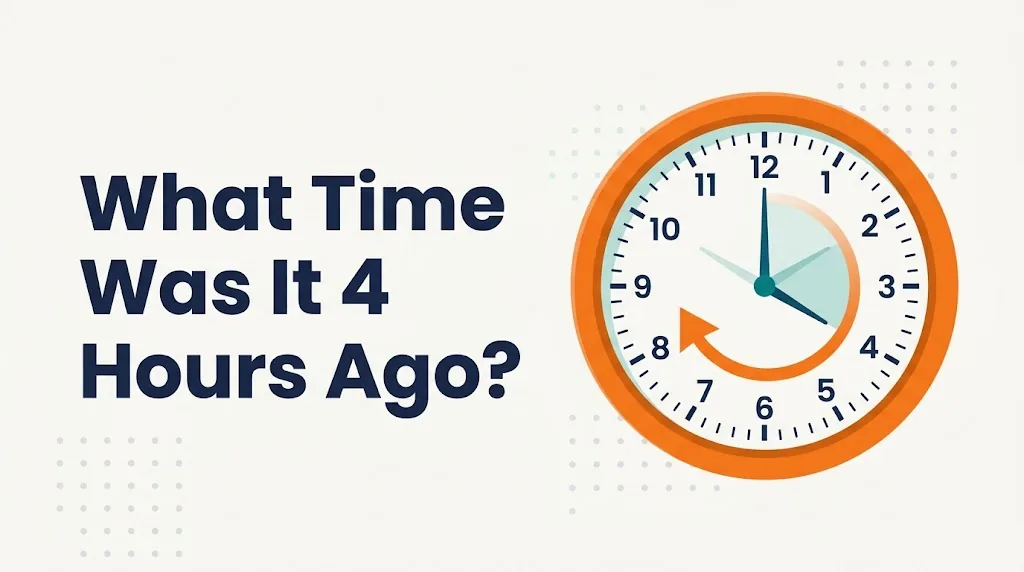
What time was it 4 hours ago? Take four away from the current hour and leave the minutes untouched. If it is 1:50 PM right now, four hours earlier was 9:50 AM the same day. That is the whole idea in one sentence.
Four hours is short enough to picture without much effort, yet it still trips people up around midnight and across AM and PM. Below you get a live answer for your own clock, a full chart for every hour of the day, and a method you can run in your head in a few seconds.
Quick answer
Right now it is your current time.
4 hours ago it was that time minus 4 hours (1:50 PM → 9:50 AM)
Rule of thumb: keep the minutes, take 4 off the hour, and flip AM/PM only if you cross noon or midnight.
- 4 hours ago = current time − 4 hours. Minutes and seconds never change.
- 4 hours equals 240 minutes, 14,400 seconds, or exactly one sixth of a day.
- Any current time between 12:00 AM and 3:59 AM lands on yesterday’s date.
- “Ago” always means subtract; “from now” always means add.
Understanding What Time Was It 4 Hours Ago
“4 hours ago” is one exact moment, not a rough window. It is four hours earlier than the second you ask, measured backward from right now.
The formula stays short:
Time 4 hours ago = Current time − 4 hours
Picture it in practice:
- Clock right now: 4:15 PM
- Count back 4 hours
- Answer: 12:15 PM
Minutes and seconds ride along unchanged. Say it is 6:37:42 PM. Four hours earlier was 2:37:42 PM. The “:37:42” part stays fixed the whole time.
The one thing to watch is the date. If subtracting four hours pushes you past midnight, the answer belongs to the day before. Step 3 below covers exactly when that happens.
How to Calculate 4 Hours Ago
You rarely need a calculator for a four-hour gap. Three short steps get you there every time, including across midnight.

Step 1: Check the Current Time
Start from an exact reading on your phone, watch or computer. Note the AM or PM. A wrong start time throws off everything that follows, so give this step a second look.
Example: current time = 1:50 PM.
Step 2: Subtract Four Hours
Take 4 away from the hour and leave the minutes alone.
1:50 PM − 4 hours = 9:50 AM
Notice the swap: counting back from early afternoon passes noon, so PM turns into AM. If that feels awkward, go back 12 hours first and then move forward 8. From 1:50 PM, 12 hours back is 1:50 AM, and 8 hours forward from there is 9:50 AM. Same answer, different route.
Step 3: Check Whether the Date Changes
If the result crosses midnight, move the date back one day. That happens whenever the current time sits between 12:00 AM and 3:59 AM.
Example: 3:10 AM on a Wednesday − 4 hours = 11:10 PM on Tuesday.
This step is the one people forget. The clock reading is only half the answer; for a log, a form or a message thread, the date is the other half.
Why People Search “What Was 4 Hours Ago From Now”
Apps rarely display a plain clock time. Instead you get relative labels:
- “Delivered 4 hours ago” on a parcel tracker
- “Active 4h ago” under a contact’s name
- “Posted 4 hours ago” on a marketplace listing
- “Last synced 4h” in a fitness app
- “Replied 4 hours ago” on a support ticket
These labels tell you how much time passed, not the exact clock time. To turn one into a real time, subtract. If it is 6:30 PM and a listing “posted 4 hours ago,” it went live around 2:30 PM.
Remember that most apps round down. “4 hours ago” can mean anywhere from four hours to four hours and fifty-nine minutes earlier. That is fine for a casual glance. For a dispute or a receipt, open the item and find the exact timestamp.
Everyday Situations Where Time Four Hours Earlier Matters
Four hours shows up constantly in ordinary routines, from work to travel to study.
Half a Work Shift
A lot of retail and hospitality shifts run in four-hour blocks, often split into two halves of an eight-hour day. If a cashier clocks out at 4:00 PM after a four-hour shift, they started at 12:00 PM. Payroll teams use this same backward step to check break times and shift swaps.
Flight Layovers
A four-hour layover is long enough to leave the gate area but short enough that timing matters. If a connecting flight boards at 5:45 PM and the layover started four hours earlier, the first plane landed at 1:45 PM. Travelers often work this backward to plan a meal or a quick nap.
Study and Exam Sessions
Many students block out four hours for a single revision session before a big exam. If a student finishes at 8:00 PM, they sat down at 4:00 PM. Counting backward helps you rebuild a study log even without a timer running.
Long Meeting Blocks
Workshops, training days and planning offsites often run for four hours straight. If a workshop wraps up at 1:00 PM, it opened at 9:00 AM. Managers use the same subtraction to check whether a room booking matches the actual meeting length.
Medication Windows
Some over-the-counter instructions say “every 4 hours.” If the last dose was at 3:00 PM, the next one lines up around 7:00 PM. Working backward tells you when the previous dose was due. Always follow the label or your pharmacist’s advice rather than a general guide.
Streaming and Notifications
Video platforms and news apps often stamp content “4 hours ago.” If a livestream started “4h ago” and it is 9:15 PM, the broadcast began close to 5:15 PM. That quick check helps you decide whether it is worth catching the replay.
Time Arithmetic Made Simple
Four hours is exactly one sixth of a 24-hour day. Six four-hour blocks fill a full day, which makes the number easy to hold in your head.

| Unit | Equal to 4 hours |
|---|---|
| Hours | 4 |
| Minutes | 240 |
| Seconds | 14,400 |
| Milliseconds | 14,400,000 |
| Days | 0.1667 (one sixth) |
| Weeks | ≈ 0.0238 |
The minute count is the one you will reach for most. 4 × 60 = 240, so four hours ago is exactly 240 minutes ago. Meeting apps and parking timers often show minutes rather than hours, so this figure is handy to remember.
The sixth-of-a-day idea also works as a mental checkpoint. Picture six four-hour slices around the clock: midnight to 4, 4 to 8, 8 to noon, and so on. Counting back one slice always lands you exactly four hours earlier.
Read also: What Time Was It 7 Hours Ago? Live Answer & Full Chart
Examples Using Both 12-Hour and 24-Hour Clock
Some people think in AM and PM, others prefer the 24-hour clock used at work or by the military. The chart below covers every hour of the day in both formats.
12-Hour Clock
The 12-hour clock uses AM for the morning and PM for the afternoon and evening. Rows marked “yesterday” cross midnight.
| Current time | 4 hours ago | 24-hour format |
|---|---|---|
| 12:00 AM (midnight) | 8:00 PM yesterday | 00:00 → 20:00 |
| 1:00 AM | 9:00 PM yesterday | 01:00 → 21:00 |
| 2:00 AM | 10:00 PM yesterday | 02:00 → 22:00 |
| 3:00 AM | 11:00 PM yesterday | 03:00 → 23:00 |
| 4:00 AM | 12:00 AM (midnight) | 04:00 → 00:00 |
| 5:00 AM | 1:00 AM | 05:00 → 01:00 |
| 6:00 AM | 2:00 AM | 06:00 → 02:00 |
| 7:00 AM | 3:00 AM | 07:00 → 03:00 |
| 8:00 AM | 4:00 AM | 08:00 → 04:00 |
| 9:00 AM | 5:00 AM | 09:00 → 05:00 |
| 10:00 AM | 6:00 AM | 10:00 → 06:00 |
| 11:00 AM | 7:00 AM | 11:00 → 07:00 |
| 12:00 PM (noon) | 8:00 AM | 12:00 → 08:00 |
| 1:00 PM | 9:00 AM | 13:00 → 09:00 |
| 2:00 PM | 10:00 AM | 14:00 → 10:00 |
| 3:00 PM | 11:00 AM | 15:00 → 11:00 |
| 4:00 PM | 12:00 PM (noon) | 16:00 → 12:00 |
| 5:00 PM | 1:00 PM | 17:00 → 13:00 |
| 6:00 PM | 2:00 PM | 18:00 → 14:00 |
| 7:00 PM | 3:00 PM | 19:00 → 15:00 |
| 8:00 PM | 4:00 PM | 20:00 → 16:00 |
| 9:00 PM | 5:00 PM | 21:00 → 17:00 |
| 10:00 PM | 6:00 PM | 22:00 → 18:00 |
| 11:00 PM | 7:00 PM | 23:00 → 19:00 |
Only the first four rows send you back a day. Every start time from 4:00 AM onward keeps you on today’s date.
24-Hour Clock
The 24-hour clock drops AM and PM, which makes subtraction cleaner. Just take 4 from the hour.
22:20 − 4 hours = 18:20
When the hour is smaller than 4, the result goes below zero. Add 24 and move to the previous day.
01:35 − 4 = −2:25 → add 24 → 21:35 yesterday
This “add 24” rule works for any hours-ago sum. It is the same trick computers use under the hood.
What Time Will It Be in 4 Hours?
The opposite question comes up just as often. Instead of subtracting, you add:
Time 4 hours from now = Current time + 4 hours

- 10:05 AM + 4 hours = 2:05 PM
- 10:40 PM + 4 hours = 2:40 AM the next day
Here is a useful pattern. Four hours ago and four hours from now are always exactly 8 hours apart. At 1:50 PM, one is 9:50 AM and the other is 5:50 PM. That gap makes it easy to double-check either answer.
Read also: What Time Is 8 Hours From Now?
Time Zones Can Change Everything
Four hours ago on your clock is not four hours ago on someone else’s clock. The moment itself never moves, but the label attached to it changes with the time zone.

Many systems store events in UTC while your phone shows local time. Subtract four hours from a UTC timestamp and read it as local time, and you can be off by several hours.
Here is the same moment, “4 hours ago from 10:00 AM UTC,” in four cities (standard time):
| City | Offset | Now | 4 hours ago |
|---|---|---|---|
| New York | UTC−5 | 5:00 AM | 1:00 AM |
| London | UTC+0 | 10:00 AM | 6:00 AM |
| Dubai | UTC+4 | 2:00 PM | 10:00 AM |
| Tokyo | UTC+9 | 7:00 PM | 3:00 PM |
Before trusting a cross-time-zone answer, confirm these five things:
- The current local time
- The correct date
- Your own time zone
- Whether the original timestamp is UTC or local
- Whether daylight saving time is in effect
For everyday questions, your device’s local clock is all you need. Time zones only matter once people, servers or events sit in different places.
Technology Depends on Accurate Time Calculation
Phones and computers do not count hours the way we do on a clock face. They store time as one long running number, usually the seconds since January 1, 1970, in UTC. That count is a Unix timestamp.
To find four hours ago, a device subtracts 14,400 seconds from that number, then converts the result back into your local date and time. Because the math runs on one continuous number, midnight, month ends and leap years never cause errors.
Browser-based tools read your device clock, so their answers match your own time zone automatically. This approach handles the tricky parts for you:
- Crossing midnight
- Rolling over to a new date, month or year
- Exact minutes and seconds
- 12-hour and 24-hour formats
- Time-zone and daylight-saving differences
Using a 4 Hours Ago Calculator
A calculator is the fastest route to an exact answer with no mental math. Try the one below. It reads your device clock by default, but you can change the start time and the number of hours.
Hours Ago Calculator
Most hours-ago calculators follow the same five steps:
- Read the current date and time.
- Take the number of hours you enter.
- Subtract that duration.
- Adjust the date if the result passes midnight.
- Show the result in a clear format.
Good calculators also let you pick a custom start time, show both clock formats, and give the “from now” answer next to the “ago” answer. That saves a few seconds and cuts out the most common errors.
Common Mistakes People Make
Subtracting four hours looks easy, yet the same slips come up again and again.
Forgetting the Date
If you start between midnight and 3:59 AM, the answer sits on yesterday’s date. Writing “11:10 PM” without “yesterday” can throw a record off by a whole day.
Mixing Up AM and PM
Counting back past noon or midnight flips AM and PM. 2:20 PM − 4 hours = 10:20 AM, not 10:20 PM. Use the 12-back, 8-forward trick if you are ever unsure.
Changing the Minutes
When you subtract whole hours, the minutes stay put. 7:35 PM − 4 hours = 3:35 PM. If your minutes shifted, something went wrong along the way.
Ignoring Time Zones
A timestamp saved in UTC or another city’s local time will not match your own clock. Convert the zone first, then subtract four hours.
Confusing Four Hours Ago With Four Hours From Now
“Ago” looks backward, so you subtract. “From now” looks forward, so you add. Saying the rule out loud once usually stops the mix-up before it happens.
Why Relative Time Feels Different From Exact Time
Our brains process relative time faster than clock time. “Four hours ago” tells you at a glance that something is fairly recent. “9:50 AM” makes you stop and compare it with the current time.
The catch is that relative time keeps moving. Something that happened four hours ago will read as four hours and one minute ago a minute from now. The label is only accurate at the moment you read it.
That is why apps refresh their labels constantly, and why a written record should always carry an exact timestamp. Use relative time for a quick sense of “how long,” and exact time for anything you need to prove or share later.
Frequently Asked Questions
What time was it 4 hours ago?
Subtract four hours from your current time and keep the minutes the same. If it is 1:50 PM now, it was 9:50 AM four hours ago. The live box at the top of this page shows the exact answer for your own clock.
How many minutes are in 4 hours?
There are 240 minutes in 4 hours, because 4 × 60 = 240. So “4 hours ago” and “240 minutes ago” describe the same moment.
How many seconds are in 4 hours?
Four hours contain 14,400 seconds, which is 4 hours × 60 minutes × 60 seconds.
Is 4 hours ago always today’s date?
No. If the current time falls between 12:00 AM and 3:59 AM, four hours ago lands on the previous day. At any other time, it stays on today.
What is the formula for finding the time 4 hours ago?
The formula is: time 4 hours ago = current time − 4 hours. On a 24-hour clock, if the result drops below zero, add 24 and move back one day.
How do I work out 4 hours ago in military (24-hour) time?
Subtract 4 from the hour. For example, 19:15 becomes 15:15 and 08:40 becomes 04:40. Starting at 02:00, the answer is 22:00 the previous day.
How is 4 hours ago different from 4 hours from now?
Four hours ago is in the past, so you subtract. Four hours from now is in the future, so you add. The two times always sit exactly 8 hours apart.
Do time zones change the result?
Yes. The moment stays the same everywhere, but the clock reading depends on the time zone. Convert a UTC timestamp to your local time before subtracting.
What is a fast way to find 4 hours ago in my head?
Go back 12 hours, which only flips AM and PM, then move forward 8. From 1:50 PM that gives 1:50 AM, then 9:50 AM. It takes only a few seconds.
Why does the answer to 4 hours ago keep changing?
Because it is measured from the present moment, and the present never stops moving. Each minute that passes shifts the “4 hours ago” time forward by one minute too.
What time was it 4 hours ago if it is midnight now?
If it is 12:00 AM now, four hours ago it was 8:00 PM on the previous day. In 24-hour time, that is 20:00 yesterday.
Is 4 hours ago the same as half of an 8-hour shift?
It matches the length of half a standard eight-hour workday, which is why so many shift and layover examples in this guide use four-hour blocks.
Conclusion
Working out what time it was 4 hours ago takes one move: subtract four hours from the current time. Keep the minutes and seconds fixed, flip AM or PM when you pass noon or midnight, and roll the date back one day if you started before 4:00 AM.
For a fast mental check, the 12-back, 8-forward trick works well. For records, time zones or a custom start time, use the calculator above. It gives you the exact date and time in both formats in a second.
Read also: What Time Was It 8 Hours Ago? Live Answer & Full Chart

Liam Joseph Miller is an experienced writer with 6 years of expertise in creating clear, informative, and reader-friendly content. He specializes in words, phrases, slang, definitions, names, and everyday meanings, helping readers understand language in a simple and practical way.