
Planning something exactly a year out? 52 weeks from today is 364 days away, since 52 × 7 = 364. That’s one day short of a full 365-day year. That is a detail worth knowing before you write “52 weeks” on anything meant to say “one year.”
Below, a live box reads your device clock and names the exact date. A calculator lets you test any start date or week count. A full chart lists every week from 1 through 52. We also walk through exactly why “52 weeks from today” and “one year from today” are usually one or two days apart. They’re never the same date.
Quick answer
Today is your device’s current date.
52 weeks from today is today’s date plus 364 days
Rule of thumb: multiply 52 by 7 to get 364, then count 364 days forward — one day short of a full year.
- 52 weeks from today = today’s date + 364 days, in any month, in any year.
- 364 is a multiple of 7, so the resulting date always lands on your same starting weekday.
- 52 weeks is not the same as “1 year from today.” A calendar year is 365 days, or 366 in a leap year. The anniversary date lands 1 or 2 days after your 52-week mark.
- 52 weeks also equals 8,736 hours, 524,160 minutes, or 31,449,600 seconds.
What Date Is 52 Weeks From Today? The Quick Answer Explained
The live box above already worked this out from your device clock. Here’s the logic behind it. Fifty-two weeks from today means moving your calendar forward by 52 × 7 = 364 days. One multiplication carries the whole calculation, with no need to track how long each month in between happens to run.
| Detail | Value |
|---|---|
| Starting point. | Today, whatever date you open this page. |
| Time period. | 52 weeks. |
| Equivalent days. | 364 days. |
| Resulting weekday. | Same weekday as today. |
| Calendar type. | Every day counted, weekends included. |
This is a full calendar-day count. Every weekend and holiday sitting inside those 364 days is included. If you only need working days, see the business-day tip further down.
How to Calculate 52 Weeks From Today by Hand
No app is required for this. Counting week by week works, but the shortcut below is far faster and still easy to verify by hand.
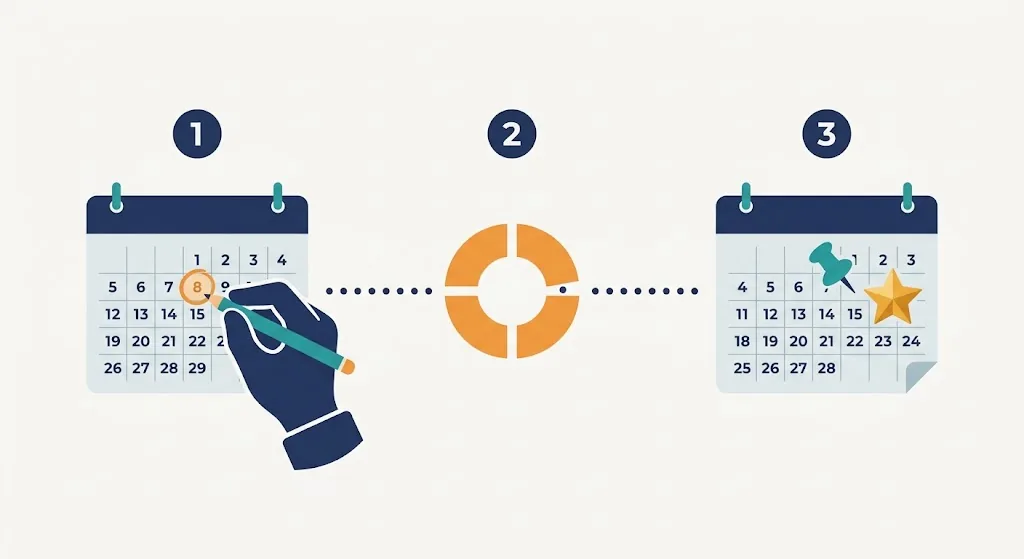
Step 1: Fix Today’s Date.
Take today’s exact date from your phone or a wall calendar. This is your anchor point, so get it right before anything else.
Step 2: Count Forward in Four 13-Week Blocks.
Fifty-two divides evenly into four 13-week quarters. Count one quarter at a time, 91 days each. That’s a good way to picture a full year in four matching stages.
Step 3: Or Use the Faster Shortcut.
Skip the four-stage count and multiply directly:
52 weeks × 7 days = 364 days.
Add 364 days to today in one move, using a calendar app, a paper planner, or the calculator further down this page.
Understanding 52 Weeks From Now Through Time Conversion
Fifty-two weeks converts cleanly into other units. This helps when a deadline you’re comparing is written in hours or days rather than weeks.
| Time unit | Equivalent to 52 weeks |
|---|---|
| Weeks. | 52. |
| Days. | 364. |
| Hours. | 8,736. |
| Minutes. | 524,160. |
| Seconds. | 31,449,600. |
If a policy document quotes “364 days” for a term length, that’s the same span as “52 weeks.” Spotting the match instantly saves you from re-running the math. This matters whenever paperwork switches units on you.
Why People Search for a Date 52 Weeks From Today
A full year feels like a long, fuzzy stretch of time until you need one exact target date to plan around. Common reasons people look this date up:
- Tracking a one-year work anniversary, service milestone, or annual review.
- Checking when an annual subscription, domain, or membership renews.
- Marking the end of a 52-week savings challenge or payment plan.
- Setting the finish date for a full-year fitness or habit-tracking streak.
- Scheduling an annual medical check-up or vehicle inspection.
- Planning a first wedding anniversary or year-long lease renewal.
- Setting a tax-year or fiscal-year checkpoint.
Once the exact date is nailed down, it’s far easier to build a real four-quarter plan instead of working off a vague “in about a year” guess.
Is 52 Weeks the Same as 1 Year?
No — and this is the detail most calculators quietly get wrong. 52 weeks is always exactly 364 days. A calendar year is 365 days, or 366 days in a leap year. That means 52 weeks from today lands one calendar day before your actual same-date anniversary in a normal year. It lands two days before it if a February 29 falls inside the span.
| Period | Meaning |
|---|---|
| 52 weeks. | Exactly 364 days, every time. |
| 1 calendar year (non-leap). | 365 days — 1 day more than 52 weeks. |
| 1 calendar year (leap year crossed). | 366 days — 2 days more than 52 weeks. |
| 364 days. | Exactly 52 weeks. |
The gap is small, but it matters for legal notices, warranty terms, and “one year to the day” promises. If your goal really is the exact same date next year, add 365 or 366 days rather than 52 weeks. If your goal is exactly 52 seven-day cycles, use the 364-day count instead — they are two different targets that happen to sit right next to each other.
Read also: What Time Was It 15 Hours Ago? Live Calculator, Chart & Easy Steps.
Tools That Make Future Date Calculation Easier
A calculator earns its keep once you’re tracking several deadlines at once, or once your span crosses a leap year. Date tools like this one all follow the same basic sequence:
- Grab the starting date.
- Multiply the week count by seven.
- Add the result onto that starting date.
- Report back the weekday and the full date.
Target date = Starting date + (weeks x 7 days).
Use the Live 52-Weeks-From-Today Calculator.
The tool below opens already set to today’s date and 52 weeks. Change either field and it updates instantly — useful for comparing against a true 365-day anniversary date.
Weeks-From-Date Calculator.
Comparing Dates Before and After 52 Weeks
Seeing nearby weeks side by side makes the one-year mark far easier to place. The chart below runs the full year, from week 1 out to week 52. That way you can see exactly how close each week sits to the true anniversary date.
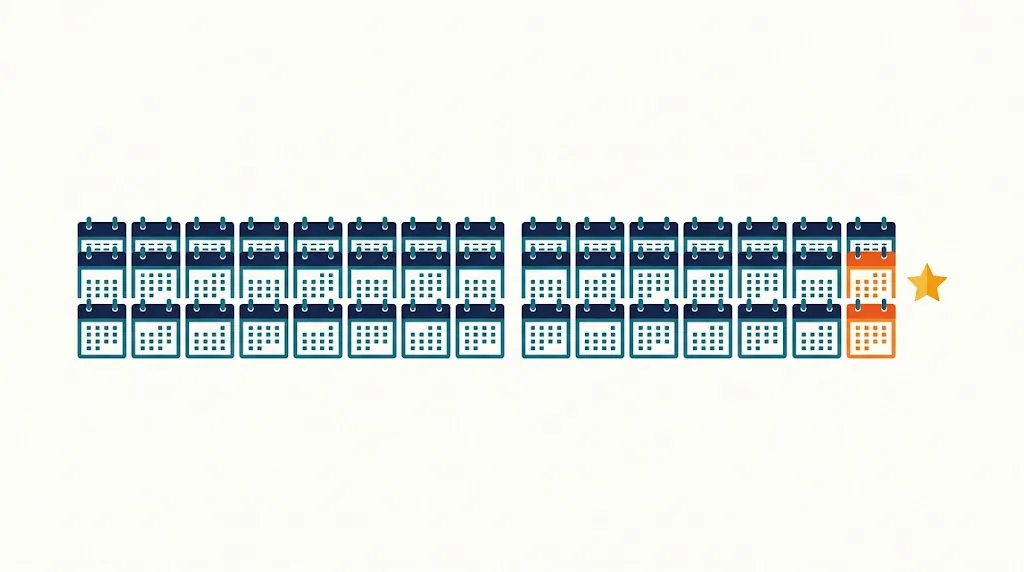
Full Chart: Weeks 1–52 From Today.
| Weeks from today | Days added | Resulting date | Weekday |
|---|---|---|---|
| Loading your live dates… | |||
Once the table loads, you’ll notice every row shares your starting weekday. Only the month, day and year climb — the day-of-week never drifts, because each step is a clean multiple of seven.
Practical Ways to Use Your 52-Week Date
A full year is long enough to see a genuine transformation, and structured enough to plan in clear stages. Here’s how people commonly put that window to work.
Work and Career Milestones
A one-year work anniversary is a natural point for a performance review, a raise conversation, or an updated resume. Marking the exact 52-week date keeps that conversation from sneaking up on you.
Financial Planning
A 52-week savings challenge — often adding a little more each week — divides neatly into four 13-week quarters, each with its own mini-checkpoint.
Subscription and Renewal Tracking
Annual subscriptions, domain names, and insurance policies typically renew on the same calendar date each year, not the 52-week mark. Knowing both dates helps you catch a renewal before it auto-bills.
Health and Fitness Streaks
A full-year training block or habit streak usually gets reviewed in quarters, with the 52-week finish line treated as the big milestone day.
Education and Certification
Many professional certifications require renewal or continuing education roughly every year. Tracking the 52-week point alongside the true anniversary date avoids letting either one lapse.
Personal Milestones
First anniversaries, one-year sobriety milestones, and long-term goals often get marked on the true calendar date. The 52-week point is still useful, though, as an early check-in exactly one week before it.
Why Does the Weekday Stay the Same After 52 Weeks?
The weekday repeats because a week is exactly seven days, by definition. Add any whole number of weeks — 52, 26, or 9 — and you land back on the same weekday you started with.
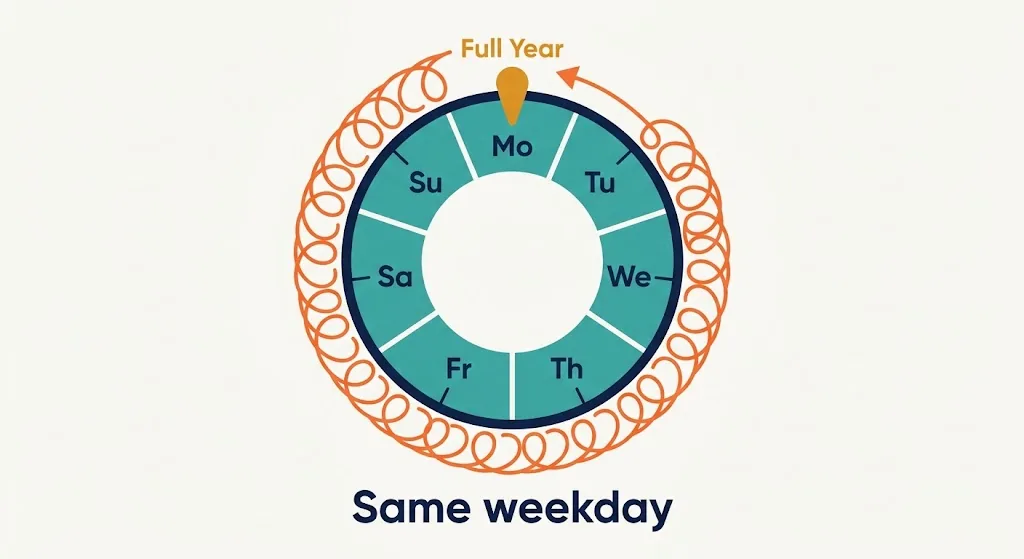
Today's weekday + 364 days (a multiple of 7) = same weekday.
If today is a Sunday, 52 weeks from today is also a Sunday. But the true one-year anniversary date, 365 days out, falls on a Monday instead. This one-day shift is exactly why the two dates aren’t interchangeable.
What Happens When 52 Weeks Crosses a Leap Year?
Whether or not your 52-week span crosses February 29 in a leap year, the week math itself never changes — you’re still counting exactly 364 days. What does change is the size of the gap between your 52-week date and the true same-date anniversary.
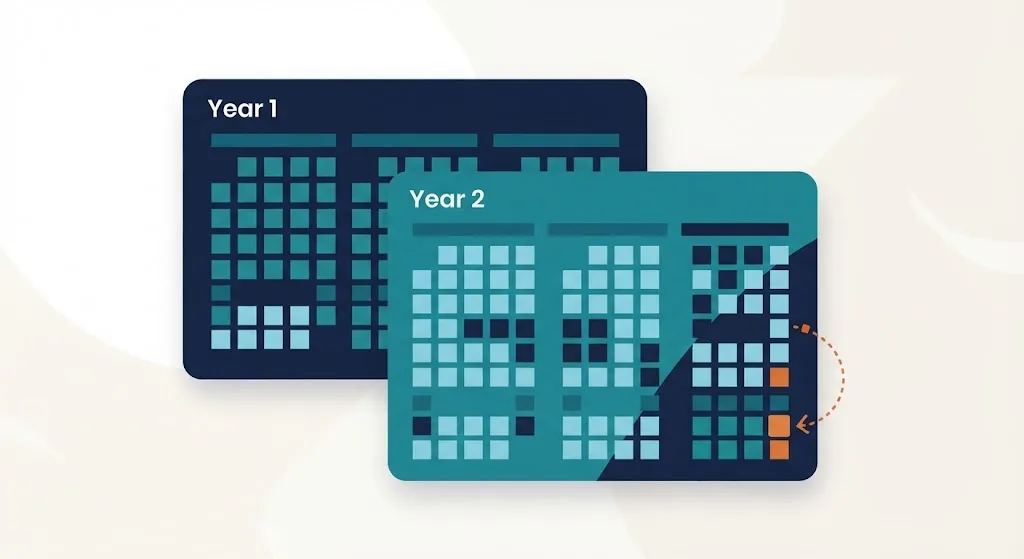
Here’s the breakdown:
- No leap day crossed: the true anniversary is 365 days out — 1 day after your 52-week date.
- A February 29 falls inside the span: the true anniversary is 366 days out — 2 days after your 52-week date.
Either way, 52 weeks from today is never the same as “one year from today.” Use 364 days when you specifically mean 52 seven-day cycles. Use the calendar year — 365 or 366 days — when you mean the same date next year.
Read also: What Time Is 10 Hours From Now? Live Calculator & Chart.
Tips for Accurate 52-Week Date Calculations
- Remember the shortcut: 52 weeks always equals 364 days.
- Double-check your starting date before counting forward.
- Decide up front whether weekends and holidays count, or only business days.
- If the weekday doesn’t line up at the end, that’s your cue to recount.
- Never treat “52 weeks from today” as identical to “1 year from today” — they usually differ by 1 or 2 days.
- For anything meant to land on the exact same calendar date next year, add 365 (or 366 in a leap year) instead.
- Reach for a calculator, such as the one on this page, whenever several dates need checking at once.
Frequently Asked Questions
What date is 52 weeks from today?
Take today’s date and add 364 days (52 weeks × 7 days). The live box near the top of this page reads your own clock and shows that exact date for you.
How many days does 52 weeks add up to?
Fifty-two weeks always adds up to exactly 364 days, since each week is 7 days and 52 × 7 = 364.
Is 52 weeks from today the same as 1 year from today?
No. Fifty-two weeks is always 364 days. A calendar year is 365 days, or 366 in a leap year, so the true one-year anniversary date lands 1 or 2 days after your 52-week mark.
Which weekday lands 52 weeks from today?
The same weekday you are on today. Since 364 days is an exact multiple of 7, the weekday never shifts.
How many hours make up a 52-week span?
A 52-week span contains 8,736 hours (52 × 7 × 24).
How many minutes pass in 52 weeks?
Fifty-two weeks contain 524,160 minutes (8,736 hours × 60).
How many seconds are inside 52 weeks?
Fifty-two weeks contain 31,449,600 seconds (524,160 minutes × 60).
What date lands exactly 51 weeks from today?
Fifty-one weeks from today is 7 calendar days earlier than the 52-week date above — subtract one week from your 52-week result, or set the calculator to 51 weeks.
How do I find the exact date 1 year from today instead?
Add 365 days for a normal year, or 366 days if a leap-year February 29 falls between today and that date — not 364 days, which is only 52 weeks.
Can I count 52 weeks from today using only business days?
Yes, but the total is different: 52 weeks of business days only (Monday through Friday) is 260 working days, not 364 calendar days. Decide which one your deadline means before you set a date.
What’s a fast way to check my 52-week date without a calculator?
Multiply 52 by 7 to get 364, then count forward in four chunks of thirteen weeks (91 days) each. Checking that the final weekday matches today’s weekday confirms your count is right.
Conclusion
Here’s the short version: add 364 days to today’s date, and you land on the date 52 weeks away — one day short of a full calendar year. The tools above already worked that out for you, straight from your own device clock. Fifty-two is a whole number of weeks, so your result always falls on the same weekday you started on. But it will almost never match the exact same date next year.
Whether you’re tracking a work anniversary, a renewal, or a full-year savings goal, one thing matters most. Know the difference between “52 weeks” and “1 year,” and you won’t miss a deadline by a day or two.
Read also: What Date Is 24 Weeks From Today? Live Calculator & Full Chart.

Liam Joseph Miller is an experienced writer with 6 years of expertise in creating clear, informative, and reader-friendly content. He specializes in words, phrases, slang, definitions, names, and everyday meanings, helping readers understand language in a simple and practical way.