

What time was it 11 hours ago? Move the hour on your clock back by eleven and leave the minutes untouched. At 6:15 PM, that gives 7:15 AM the same morning. The tricky part is the date, because eleven hours is long enough to reach back across midnight for almost half of the day.
Eleven hours sits close to the halfway mark of a full day. It is roughly the length of a long-haul flight, a full school-and-homework day, or a long night shift. That is why so many people search for an exact answer instead of guessing. Below you will find a live result for your own clock, a chart for every hour, a free calculator and clear rules for the date.
Quick answer
It is now your current time.
Eleven hours ago it was now minus 11 hours (6:15 PM → 7:15 AM)
Mental trick: jump back 12 hours (swap AM/PM), then move forward 1.
- 11 hours ago = the time now − 11 hours. The minutes stay exactly the same.
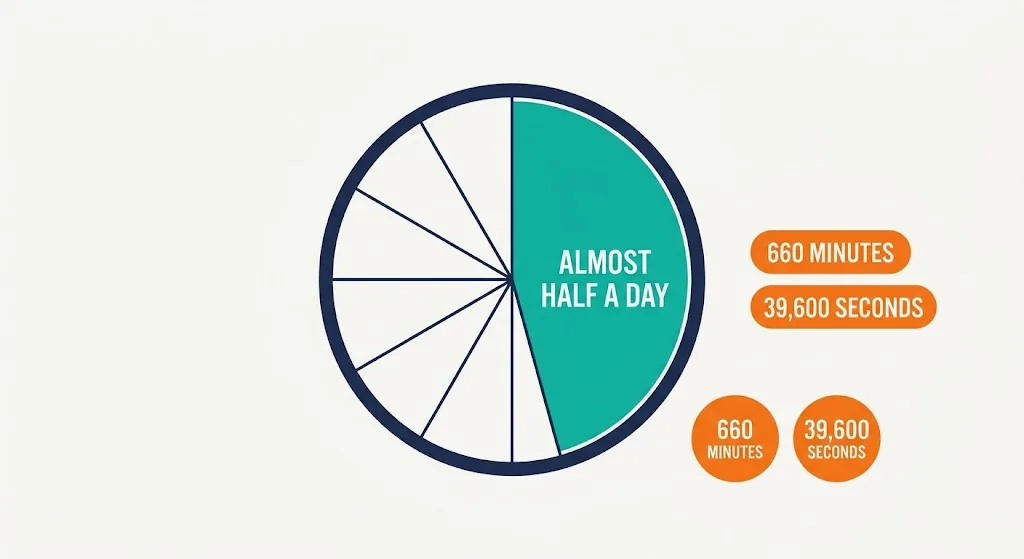
- Eleven hours equals 660 minutes, 39,600 seconds, or close to half a day (11/24).
- If it is earlier than 11:00 AM, the answer falls on the day before.
- At exactly 11:00 AM, eleven hours ago was midnight at the very start of today.
Why People Ask “What Time Was It 11 Hours Ago”
Apps rarely show a clock time. They show a gap instead. You might see “11h” on a photo, “11 hours ago” on a delivery update, or “active 11h ago” on a friend’s profile. That gap tells you how long, but it does not tell you when.
People turn that gap back into a real time for plenty of everyday reasons:
- Working out when an overnight flight actually took off
- Checking when a long shift or on-call block began
- Matching a bank alert with a purchase from earlier in the day
- Finding out when a message from a distant colleague was sent
- Rebuilding a study session or exam-prep timeline
- Confirming when a server error first appeared in a log
For example, if it is 9:40 AM and an app says a payment posted “11h” ago, it happened close to 10:40 PM the night before. Same label, but the date quietly moved back a day.
Understanding Time Subtraction and the Clock
A clock does not count like a ruler. Minutes and seconds run in sixties, and the whole day resets every 24 hours. Subtracting eleven whole hours is still simple, though, because the minutes never move. Only the hour changes, and sometimes the date follows it.
Time 11 hours ago = Current time − 11 hours
Try it with 8:12 PM. Take 11 from 8 and you pass through midnight in your head, landing on 9. The minutes stay at 12. The answer is 9:12 AM, the same day, since 8 PM is late enough that the subtraction never crosses into yesterday.
Now try 9:40 AM. Take 11 from 9 and you get a negative number, which is the signal that the clock has rolled back past midnight. The answer is 10:40 PM the day before. The next section gives you a clean method for handling that roll-back every time.
How to Calculate What Time It Was 11 Hours Ago Manually
This three-step method works for every start time, including the awkward early-morning hours when the date is easy to miss.
Step 1: Note the Current Time
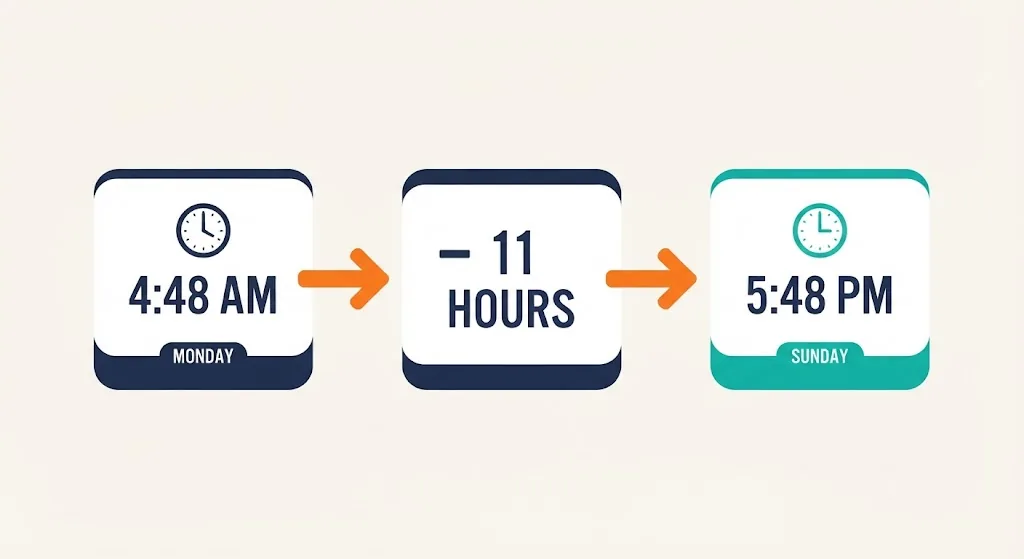
Read the exact time and switch it to 24-hour form if that helps. Morning hours stay as they are; for afternoon and evening hours, add 12. Say it is 4:48 AM on Monday. In 24-hour time that is 04:48.
Step 2: Subtract Eleven Hours
Take 11 away from the hour only: 4 − 11 = −7. Set the 48 minutes aside. A result of zero or more is your answer right away. A negative result means you have gone past midnight, so move to step 3.
Step 3: Check the Date
Add 24 to the negative hour: −7 + 24 = 17. Put the minutes back to get 17:48, which is 5:48 PM. Because the sum crossed midnight, the date moves back too. The full answer is 5:48 PM on Sunday.
Adding 24 is not a shortcut trick, it is basic arithmetic. A day holds 24 hours, so stepping back 11 hours from early morning is the same as stepping forward 13 hours from the same time the day before.
Why the Date Sometimes Changes
With eleven hours, a date change is common, not rare. It happens for every start time from 12:00 AM to 10:59 AM, which covers the whole night and most of the morning.
Picture a real case. You check your phone at 8:12 PM on a Thursday and want to know when a note came in “11 hours ago.” The answer is 9:12 AM, still Thursday, because 8:12 PM is late enough in the day that the sum never touches midnight.
Now flip it. At 3:05 AM on a Friday, eleven hours earlier was 4:05 PM on Thursday. Writing just “4:05 PM” without the day would leave anyone reading your notes a full day off.
The date can also roll across a month or a year. At 9:00 AM on March 1, eleven hours ago was 10:00 PM on the last day of February. At 6:00 AM on January 1, eleven hours ago was 7:00 PM on New Year’s Eve.
What Time Was It 11 Hours Ago Using the 12-Hour Clock
The quickest shortcut is back 12, forward 1. Stepping back 12 hours only swaps AM and PM and keeps the digits the same. Then step forward 1, because 12 − 11 = 1. From 6:15 PM: back 12 gives 6:15 AM, forward 1 gives 7:15 AM. Done in two moves.
Here is the full chart for all 24 hours. “Yesterday” marks the rows where the answer belongs to the day before.
| Current time | 11 hours ago | 24-hour format |
|---|---|---|
| 12:00 AM (midnight) | 1:00 PM yesterday | 00:00 → 13:00 |
| 1:00 AM | 2:00 PM yesterday | 01:00 → 14:00 |
| 2:00 AM | 3:00 PM yesterday | 02:00 → 15:00 |
| 3:00 AM | 4:00 PM yesterday | 03:00 → 16:00 |
| 4:00 AM | 5:00 PM yesterday | 04:00 → 17:00 |
| 5:00 AM | 6:00 PM yesterday | 05:00 → 18:00 |
| 6:00 AM | 7:00 PM yesterday | 06:00 → 19:00 |
| 7:00 AM | 8:00 PM yesterday | 07:00 → 20:00 |
| 8:00 AM | 9:00 PM yesterday | 08:00 → 21:00 |
| 9:00 AM | 10:00 PM yesterday | 09:00 → 22:00 |
| 10:00 AM | 11:00 PM yesterday | 10:00 → 23:00 |
| 11:00 AM | 12:00 AM (midnight) | 11:00 → 00:00 |
| 12:00 PM (noon) | 1:00 AM | 12:00 → 01:00 |
| 1:00 PM | 2:00 AM | 13:00 → 02:00 |
| 2:00 PM | 3:00 AM | 14:00 → 03:00 |
| 3:00 PM | 4:00 AM | 15:00 → 04:00 |
| 4:00 PM | 5:00 AM | 16:00 → 05:00 |
| 5:00 PM | 6:00 AM | 17:00 → 06:00 |
| 6:00 PM | 7:00 AM | 18:00 → 07:00 |
| 7:00 PM | 8:00 AM | 19:00 → 08:00 |
| 8:00 PM | 9:00 AM | 20:00 → 09:00 |
| 9:00 PM | 10:00 AM | 21:00 → 10:00 |
| 10:00 PM | 11:00 AM | 22:00 → 11:00 |
| 11:00 PM | 12:00 PM (noon) | 23:00 → 12:00 |
Count the “yesterday” rows and you get eleven of them, out of 24. That means almost half of the day sends the answer back to the previous date, more than with shorter gaps like five or six hours.
What Time Was It 11 Hours Ago Across Different Time Zones
The length of eleven hours never changes. What changes is the label each clock puts on the start and the end. Two people looking back eleven hours at the same instant point to the same moment, but they read different numbers off their own clocks.

Take one instant, 20:00 UTC in winter, and look back eleven hours in four cities:
| City | Offset | Now | 11 hours ago |
|---|---|---|---|
| Los Angeles | UTC−8 | 12:00 PM (noon) | 1:00 AM |
| London | UTC+0 | 8:00 PM | 9:00 AM |
| Nairobi | UTC+3 | 11:00 PM | 12:00 PM (noon) |
| Seoul | UTC+9 | 5:00 AM (next day) | 6:00 PM (previous day) |
Notice Seoul. Its “now” already sits on the next calendar day, so its “11 hours ago” reads as the evening before that, two dates back from where Los Angeles stands at the very same instant. Whenever a moment spans two places, always confirm whose clock the time belongs to before you calculate.
When you calculate across time zones, keep these four things in mind:
- The current local time and date on both sides
- The time-zone offset between the two places
- Whether the original time is stored in UTC or in local time
- Whether either place is currently observing daylight saving time
Using a Time Calculator
The box below does the full job for you. It starts from your device’s clock and time zone, so the answer matches the clock on your wall. You can also type in any date, time and number of hours.
Hours Ago Calculator
A calculator earns its place when:
- You need the date as well as the clock time
- The starting point is not “now,” such as a time pulled from a receipt or log
- You want the seconds to stay exact
- You need to repeat the same sum for several different times
- You want the “from now” answer sitting next to the “ago” answer
Read also: What Time Was It 5 Hours Ago? Live Answer, Full Chart & Examples
Converting Eleven Hours Into Different Units
Eleven hours breaks down neatly into smaller units, which is handy when you are working with spreadsheets, code, or a countdown timer.
| Unit | Equal to 11 hours |
|---|---|
| Hours | 11 |
| Minutes | 660 |
| Seconds | 39,600 |
| Milliseconds | 39,600,000 |
| Days | ≈ 0.4583 (11/24) |
| Weeks | ≈ 0.0655 |
The minutes figure is the one you will reach for most: 11 × 60 = 660. So “660 minutes ago” and “11 hours ago” name the same exact moment. Keep 39,600 in mind too, since logs, spreadsheets and code often store time in seconds rather than hours.
Why Computers Handle Time Better Than Humans
People trip over AM/PM flips, midnight and shifting dates. Computers skip the clock face entirely. Most systems store time as one steady count, usually the seconds since January 1, 1970, in UTC. To find eleven hours ago, a program simply takes away 39,600 from that count and formats the result as a local date and time.
You can copy the same method yourself in common tools:
- Excel or Google Sheets:
=NOW()-11/24(a full day equals 1, so 11 hours is 11/24) - JavaScript:
new Date(Date.now() - 11*3600*1000) - Python:
datetime.now() - timedelta(hours=11)
Because the math runs on one continuous number, midnight, month ends and leap years never trip it up. The only thing a program still needs from you is the correct time zone for the result.
What Time Was It 11 Hours Ago Versus Hours From Now
These two questions use the same eleven-hour gap but point in opposite directions.
Looking Back
To look back, subtract eleven hours from the current time.
Time 11 hours ago = Current time − 11 hours
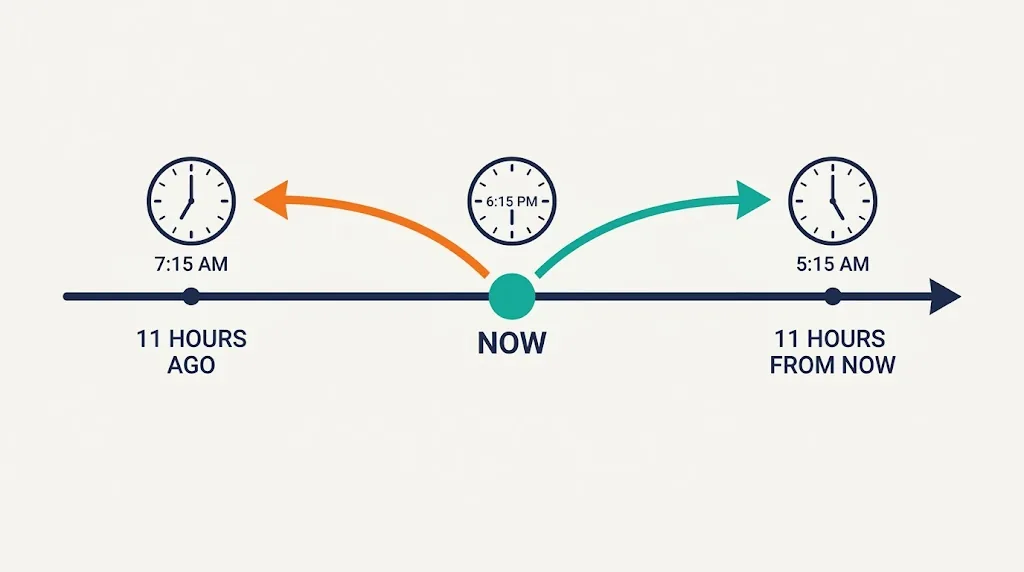
Example: 6:15 PM − 11 hours = 7:15 AM, the same day.
Looking Forward
To look forward, add eleven hours instead.
Time 11 hours from now = Current time + 11 hours
Example: 6:15 PM + 11 hours = 5:15 AM, the next day.
Eleven hours ago and eleven hours from now are always 22 hours apart. At 6:15 PM, one answer is 7:15 AM today and the other is 5:15 AM tomorrow. If your two results are not 22 hours apart, check your subtraction again.
Common Mistakes When Calculating Eleven Hours Ago
The math itself is short. Most errors come from rushing through it. Watch for these four.
Forgetting the Date Change
At 1:35 PM, eleven hours ago was 2:35 AM the same day, but at 2:27 PM it was still 3:27 AM today too. The slip shows up earlier in the morning: at 12:40 AM, eleven hours ago was 1:40 PM the day before, and writing just “1:40 PM” leaves the date out entirely.
Mixing Up AM and PM
Because eleven hours is close to twelve, the AM/PM label flips for almost every start time. Only times from 11:00 to 11:59, morning or evening, keep the same label after the jump.
Ignoring the Time Zone of the Original Timestamp
A server log stamped in UTC, or a message sent from a colleague’s city, will not line up with your own wall clock. Convert it to your local time zone first, then subtract the eleven hours.
Rounding the Start Time First
Some people round the current time before subtracting, which throws the answer off. At 3:52 PM, rounding up to 4:00 PM gives 5:00 AM, but the true answer, keeping the minutes, is 4:52 AM.
Everyday Situations Where This Calculation Matters
Eleven hours lines up with a surprising number of real situations, mostly because it sits so close to half a day.
Long-Haul Flights
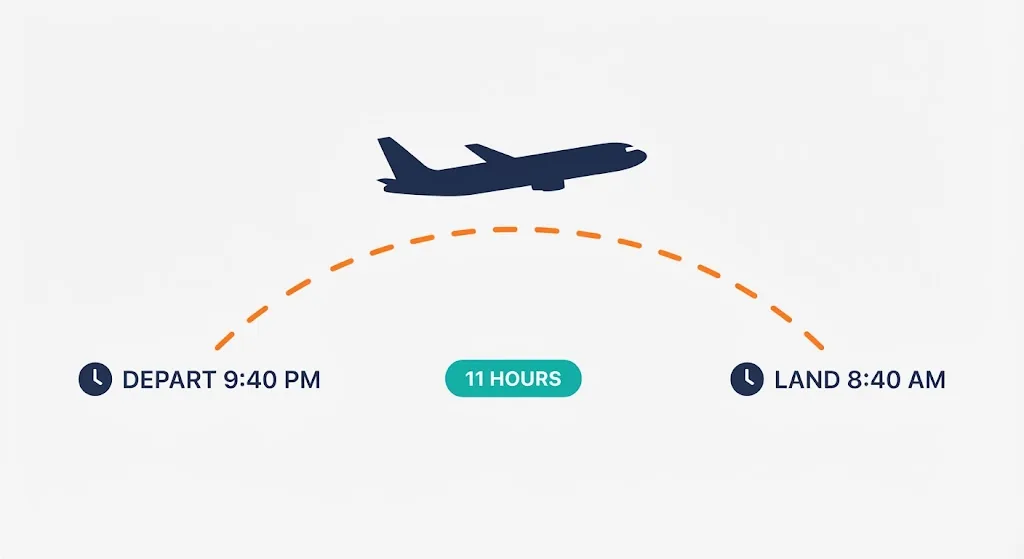
Many transoceanic routes take close to eleven hours in the air. If a flight departs at 9:40 PM and the trip lasts eleven hours, it lands at 8:40 AM the next morning. Looking at it from the other direction, if you landed at 8:40 AM, your plane left the gate eleven hours earlier, at 9:40 PM the night before.
Long Shifts and On-Call Blocks
An eleven-hour shift with a short unpaid break is common in hospitals, warehouses and kitchens. If a worker clocks out at 9:26 PM after eleven hours on site, they clocked in at 10:26 AM. That quick check is handy when filling in a timesheet from memory.
Studying or Working Overnight
If you wake at 3:05 AM to finish an assignment, eleven hours earlier was 4:05 PM the afternoon before, roughly when the study session began. Working backward from the clock is often easier than trying to remember how the hours felt.
Comparing Notes With Someone Far Away
If a friend on the other side of the world says they messaged you “11 hours ago,” and it is 7:50 PM where you are, their message landed at about 8:50 AM your time. Because eleven hours is close to half a day, this kind of gap often means you were both asleep when the message actually arrived.
Read also: What Time Was It 6 Hours Ago? Live Calculator, Chart & Easy Steps
Tips for Accurate Time Calculation
These habits keep an eleven-hour subtraction correct every time, whether you do it by hand or check it with the calculator above.
- Write the exact start time down, including AM or PM, before you subtract anything.
- Switch to the 24-hour clock whenever AM/PM starts to feel confusing.
- Keep the minutes and seconds untouched. Only the hour, and sometimes the date, should change.
- Watch the 12:00–10:59 AM window closely. Every time in that range moves the answer back a day.
- Confirm the time zone of any timestamp you did not read from your own clock.
- Check your work by adding 11 hours back to the result. You should land on the time you started with.
The same subtraction method carries over to related calculations, such as 10 hours ago, 12 hours ago, or working out how many hours sit between two arbitrary times. Once the eleven-hour pattern feels natural, the others follow the same logic.
Frequently Asked Questions
What time was it 11 hours ago?
Take eleven hours off your current time and keep the minutes unchanged. At 6:15 PM, eleven hours ago was 7:15 AM the same day. The live box at the top of this page works it out for your own clock.
Is 11 hours ago always the day before?
No. It only falls on the previous date when your current time is earlier than 11:00 AM. From 11:00 AM onward, eleven hours ago is still today.
How many minutes are in 11 hours?
Eleven hours equal 660 minutes, since 11 × 60 = 660.
How many seconds are in 11 hours?
Eleven hours equal 39,600 seconds, or 11 × 60 × 60.
What time was it 11 hours ago if the clock reads noon?
At 12:00 PM, eleven hours earlier was 1:00 AM the same day.
What was the time 11 hours before 7 in the morning?
It was 8:00 PM the evening before, because counting back from 7:00 AM crosses midnight.
How can I work out 11 hours ago without an app?
Subtract 11 from the hour and leave the minutes alone. If the hour goes below zero, add 24 and move the date back one day.
Does my time zone change the result?
The gap of 11 hours stays fixed everywhere, but each time zone reads a different clock time for the same moment. Convert any UTC or foreign timestamp to your own zone first.
What separates 11 hours ago from 11 hours from now?
One looks into the past and one looks into the future. They are always 22 hours apart, since each direction moves 11 hours away from the same starting point.
Will a time calculator also show me the date?
Yes. A good calculator gives the clock time and the calendar date together, so you never have to guess whether the answer landed on yesterday.
What time was it 11 hours ago at midnight?
At 12:00 AM, eleven hours earlier was 1:00 PM the afternoon before.
Do the minutes and seconds change when you subtract 11 hours?
No. Only the hour, and sometimes the date, move. If it is 10:55:42 PM, eleven hours ago was 11:55:42 AM the same day, with the minutes and seconds unchanged.
Conclusion
To find what time it was 11 hours ago, take eleven hours off the current time and keep the minutes exactly as they are. Watch the AM/PM label, since it flips for nearly every start time, and watch the date, because any time before 11:00 AM sends the answer back to yesterday.
For a fast mental check, go back 12 hours and then forward 1. For flights, shifts, time zones or a start time other than “now,” use the calculator above. It shows the exact time and date, in both clock formats, in a single click.

Liam Joseph Miller is an experienced writer with 6 years of expertise in creating clear, informative, and reader-friendly content. He specializes in words, phrases, slang, definitions, names, and everyday meanings, helping readers understand language in a simple and practical way.