
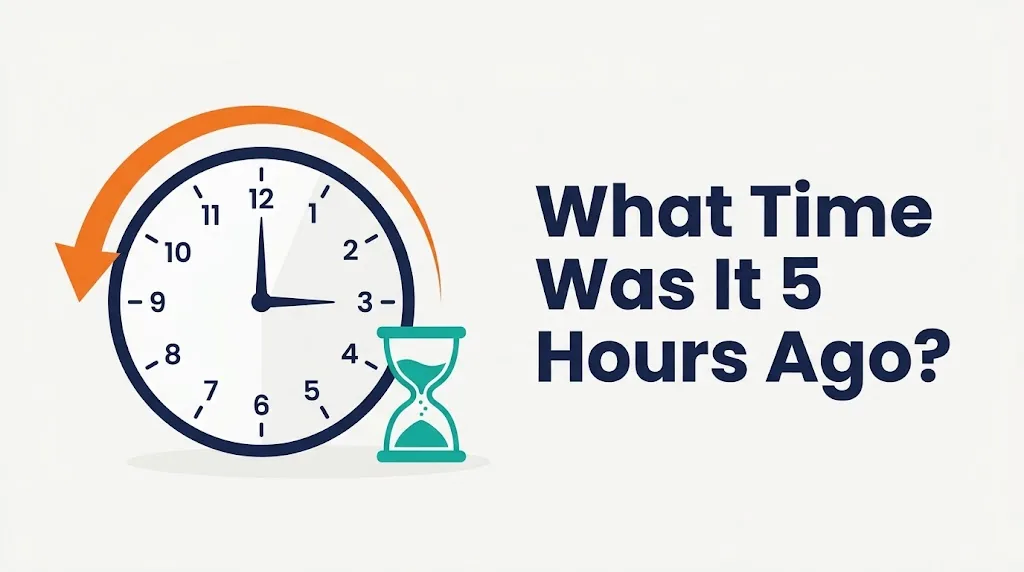
What time was it 5 hours ago? Take the time on your clock and move the hour back by five. If your clock says 1:00 PM, five hours ago it was 8:00 AM. The minutes and seconds stay exactly as they are.
Most of the time, that is all you need. The tricky moments come late at night, around noon, and when two people live in different time zones. Below you will find a live answer for your own clock, a chart for all 24 hours, a free calculator and plenty of worked examples.
Quick answer
Your clock says the current time.
5 hours ago it was your time minus 5 hours (1:00 PM → 8:00 AM)
Shortcut: go back 12 hours (just swap AM and PM), then go forward 7.
- 5 hours ago = current time − 5 hours. Minutes and seconds do not move.
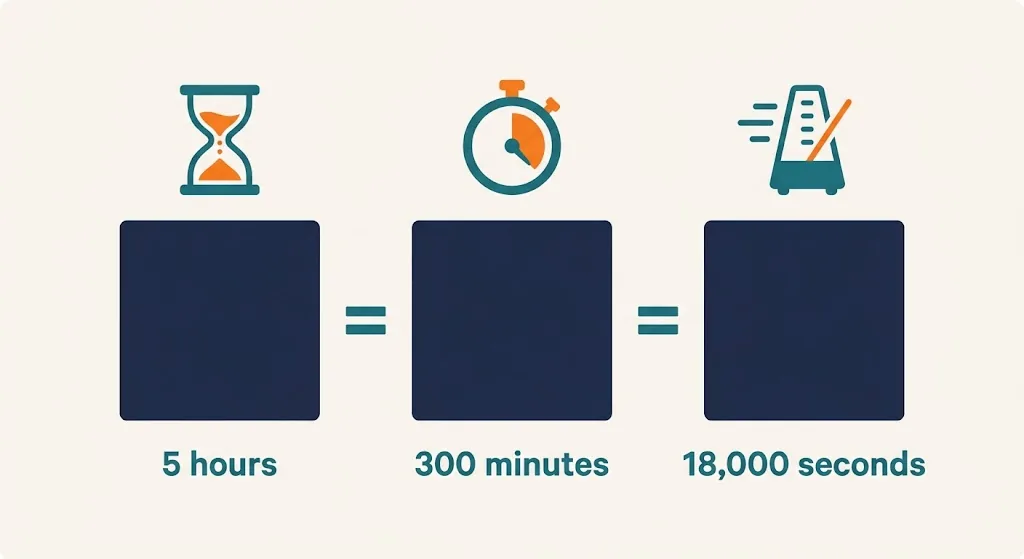
- 5 hours is 300 minutes or 18,000 seconds, a little over one fifth of a day.
- From 12:00 AM to 4:59 AM, the answer lands on yesterday’s date.
- Five hours ago and five hours from now are always 10 hours apart.
Understanding What Time Was It 5 Hours Ago
The phrase “5 hours ago” points to one exact moment in the past. It is the moment that sits five full hours behind the present second. Because the present keeps moving, the answer moves with it, one minute every minute.
In plain words, you rewind the clock. Nothing else changes. If a friend texts you at 5:25:40 PM and says the parcel arrived “five hours ago,” it arrived at 12:25:40 PM. Only the hour changed. The “:25:40” stayed put.
Notice one small detail in that example. Five hours back from 5 PM is 12 PM, which is noon, not midnight. Noon and midnight both show “12,” so it helps to write “noon” or “midnight” when you land on them.
Here are a few quick answers, so you can see the pattern:
- 9:10 AM → 4:10 AM
- 1:00 PM → 8:00 AM
- 5:00 PM → 12:00 PM (noon)
- 11:35 PM → 6:35 PM
- 1:50 AM → 8:50 PM yesterday
How Time Subtraction Actually Works
Clock math is normal subtraction with one twist: the clock wraps around. After 12 comes 1 again on a 12-hour clock, and after 23 comes 0 on a 24-hour clock. So the formula is short, but you have to wrap around when you pass 12 or 0.
Time 5 hours ago = Current time − 5 hours
Try it with 10:50 AM. Take 5 away from 10 and you get 5. Keep the 50 minutes. The answer is 5:50 AM. No wrap was needed, because 10 is bigger than 5.
There is a second way that some people like better: work in minutes. Five hours is 300 minutes. Turn the current time into minutes after midnight, take away 300, then turn it back. At 9:05 PM, that is 21 × 60 + 5 = 1,265 minutes. Take away 300 and you get 965 minutes, which is 16 hours and 5 minutes. That means 4:05 PM. It is slower by hand, but it is exactly how spreadsheets and apps do it.
| Unit | Same as 5 hours |
|---|---|
| Hours | 5 |
| Minutes | 300 |
| Seconds | 18,000 |
| Milliseconds | 18,000,000 |
| Days | ≈ 0.2083 (5/24, about 21% of a day) |
| Weeks | ≈ 0.0298 |
You will use the minutes figure the most. 5 × 60 = 300, so “5 hours ago” and “300 minutes ago” name the same moment. Timers, parking apps and coding tools often ask for minutes or seconds, so it pays to know both numbers.
Why Reverse Time Calculation Matters in Everyday Life
We look backward in time far more often than we notice. A phone says a message came in “5h ago.” A delivery app says the driver left “5 hours ago.” A smart watch says you last stood up hours ago. Each label tells you how long, but not when.
Turning that label into a real clock time helps in many small ways:
- Writing the right time in a work log or a school diary
- Checking when a child last ate or napped
- Finding out when you last charged your phone or car
- Working out when a pet was last fed or walked
- Telling a support agent when an error first showed up
- Matching a bank alert with the shop you visited
- Rebuilding a day for a travel expense report
None of these needs a fancy tool. A clear start time and a five-hour step back are enough. The value is in turning a vague label into a time you can write down and share.
What Time Was It 5 Hours Ago Using the 12-Hour Clock
On the 12-hour clock, the day has two halves. AM runs from midnight to just before noon. PM runs from noon to just before midnight. When you count back five hours, you only need to ask one question: did I pass 12? If yes, AM and PM swap.
Take 2:35 PM. Count back one hour at a time: 1:35 PM, 12:35 PM, 11:35 AM, 10:35 AM, 9:35 AM. You passed 12, so PM became AM. Five hours ago was 9:35 AM.
Counting on your fingers works, but there is a faster trick. Going back 12 hours never changes the digits. It only swaps AM and PM. So go back 12, then forward 7 (because 12 − 5 = 7). From 2:35 PM, going back 12 hours gives 2:35 AM. Forward 7 gives 9:35 AM. Same answer, less counting.
Here is the full chart for every hour of the day. Find your current hour on the left and read across.
| Current time | 5 hours ago | 24-hour format |
|---|---|---|
| 12:00 AM (midnight) | 7:00 PM yesterday | 00:00 → 19:00 |
| 1:00 AM | 8:00 PM yesterday | 01:00 → 20:00 |
| 2:00 AM | 9:00 PM yesterday | 02:00 → 21:00 |
| 3:00 AM | 10:00 PM yesterday | 03:00 → 22:00 |
| 4:00 AM | 11:00 PM yesterday | 04:00 → 23:00 |
| 5:00 AM | 12:00 AM (midnight) | 05:00 → 00:00 |
| 6:00 AM | 1:00 AM | 06:00 → 01:00 |
| 7:00 AM | 2:00 AM | 07:00 → 02:00 |
| 8:00 AM | 3:00 AM | 08:00 → 03:00 |
| 9:00 AM | 4:00 AM | 09:00 → 04:00 |
| 10:00 AM | 5:00 AM | 10:00 → 05:00 |
| 11:00 AM | 6:00 AM | 11:00 → 06:00 |
| 12:00 PM (noon) | 7:00 AM | 12:00 → 07:00 |
| 1:00 PM | 8:00 AM | 13:00 → 08:00 |
| 2:00 PM | 9:00 AM | 14:00 → 09:00 |
| 3:00 PM | 10:00 AM | 15:00 → 10:00 |
| 4:00 PM | 11:00 AM | 16:00 → 11:00 |
| 5:00 PM | 12:00 PM (noon) | 17:00 → 12:00 |
| 6:00 PM | 1:00 PM | 18:00 → 13:00 |
| 7:00 PM | 2:00 PM | 19:00 → 14:00 |
| 8:00 PM | 3:00 PM | 20:00 → 15:00 |
| 9:00 PM | 4:00 PM | 21:00 → 16:00 |
| 10:00 PM | 5:00 PM | 22:00 → 17:00 |
| 11:00 PM | 6:00 PM | 23:00 → 18:00 |
Two rows deserve a second look. At 5:00 AM, the answer is exactly midnight, which is the very start of today. At any time before 5:00 AM, you slip into the evening of the day before.
What Time Was It 5 Hours Ago Using the 24-Hour Clock
The 24-hour clock, often called military time, makes this sum much cleaner. There is no AM or PM to flip. You simply take 5 from the hour.
- 23:05 − 5 hours = 18:05
- 16:40 − 5 hours = 11:40
- 07:30 − 5 hours = 02:30
When the hour is smaller than 5, the result dips below zero. Fix it by adding 24 and moving the date back by one day.
01:50 − 5 = −3:10 → add 24 → 20:50 yesterday
Nurses, pilots, soldiers and train staff use this format for a reason. It removes the AM/PM mix-up completely. If you find yourself unsure about the 12-hour answer, switch to 24-hour time, subtract, then switch back. Any hour from 13 to 23 is PM: take 12 away to get the 12-hour time. So 20:50 is 8:50 PM.
Crossing Midnight: The Most Common Mistake
Midnight is where most people slip. The hour goes back past 12, and it is easy to forget that the date goes back too.
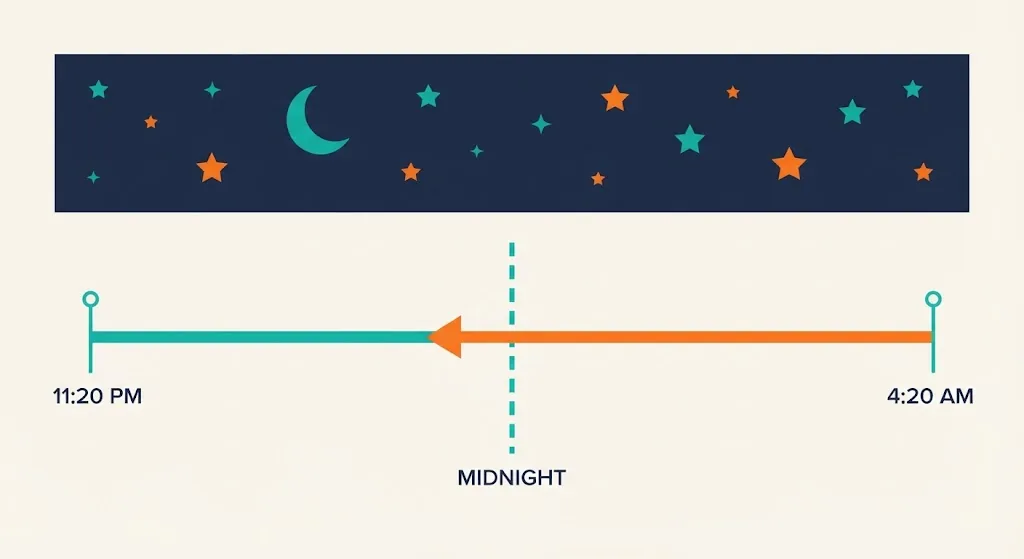
Picture this. It is 4:20 AM on Saturday and you cannot sleep. You wonder when you first got into bed, which was five hours ago. Count back: 3:20, 2:20, 1:20, 12:20, 11:20. The answer is 11:20 PM on Friday, not Saturday.
A simple rule covers every case:
The date also matters at bigger borders. At 2:10 AM on the first day of a month, five hours ago was the last day of the month before. At 3:00 AM on January 1, five hours ago was 10:00 PM on December 31, the year before. Good calculators handle these jumps for you, but it is useful to know why the date changed.
Manual Time Arithmetic Without a Calculator
You can do this in your head in a few seconds. Use these four steps.
- Read the exact time, including AM or PM.
- Take 5 from the hour. Leave the minutes and seconds alone.
- If you passed 12, swap AM and PM.
- If you passed midnight, move the date back one day.
Example 1
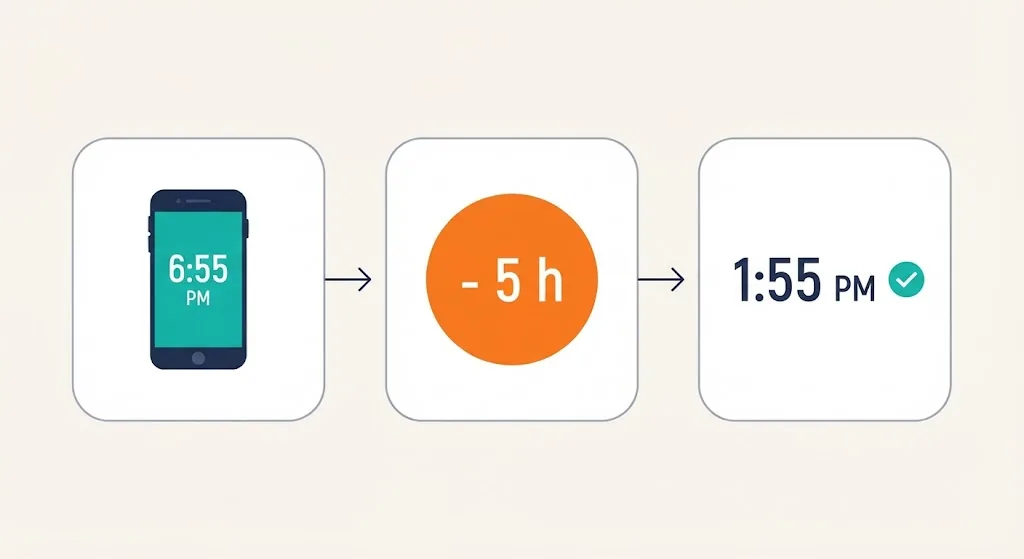
You finish dinner and the oven clock shows 6:55 PM. Take 5 from 6 and you get 1. You did not pass 12 on the way, so it stays PM.
6:55 PM − 5 hours = 1:55 PM
Example 2
It is 12:30 PM, right after noon. Here the hour 12 acts like 0 when you count back. One hour back is 11:30 AM, then 10:30, 9:30, 8:30 and 7:30.
12:30 PM − 5 hours = 7:30 AM
Example 3
A night-shift worker checks the time at 1:05 AM on Wednesday. Counting back passes midnight, so AM becomes PM and the day moves back.
1:05 AM − 5 hours = 8:05 PM on Tuesday
After a few tries, these steps become automatic. For anything you must record, check your answer with the calculator in the next section.
Using Online Time Calculators
A calculator gives you the answer with no mental math at all. The one below reads your device clock, so it shows your local time. You can also type any start date, start time and number of hours.
Hours Ago Calculator
Behind the screen, the math is simpler than you might think. Your device stores time as one long count of seconds since January 1, 1970 (UTC). To find five hours ago, it takes 18,000 seconds off that count. Then it turns the new number back into a local date and time. Midnight, month ends and leap years never trip it up, because it never works on a clock face.
A good time calculator should give you:
- The result in both 12-hour and 24-hour format
- The full date, so you can see a day change
- Seconds, when you need them
- A custom start time, not only “now”
- The “from now” answer next to the “ago” answer
Our calculator above does all five. Change the hours box to any number, like 2.5 or 48, and it still works.
Read also: What Time Was It 6 Hours Ago? Live Calculator, Chart & Easy Steps
Time Zones Make Everything More Interesting
“Five hours ago” is the same moment for everyone on Earth. What changes is the number each person sees on their clock. A call that ended five hours ago ended at one moment, but a friend in another country would write down a different clock time for it.

Here is one moment, 17:00 UTC in winter, and “five hours ago” from it, in four cities:
| City | Offset | Now | 5 hours ago |
|---|---|---|---|
| New York | UTC−5 | 12:00 PM | 7:00 AM |
| London | UTC+0 | 5:00 PM | 12:00 PM |
| New Delhi | UTC+5:30 | 10:30 PM | 5:30 PM |
| Singapore | UTC+8 | 1:00 AM (next day) | 8:00 PM (previous day) |
Look at the first two rows. In winter, London is exactly five hours ahead of New York. So when a Londoner asks what time it was five hours ago, the answer on their clock is the time a New Yorker sees right now. Fun, but also a common source of mix-ups in meetings.
Before you trust a five-hours-back answer that involves another place, check:
- Which time zone the original time uses
- Whether it is saved in UTC (servers often do this)
- Whether daylight saving time has started or ended
- The date on both sides, not just the hour
What Time Will It Be in 5 Hours?
Many readers also want the opposite answer. “Ago” looks back, so you subtract. “From now” looks ahead, so you add.
Time 5 hours from now = Current time + 5 hours
- 9:25 AM + 5 hours = 2:25 PM
- 8:40 PM + 5 hours = 1:40 AM the next day
Here is a handy check. Five hours ago and five hours from now are always 10 hours apart. At 1:00 PM, one is 8:00 AM and the other is 6:00 PM. If your two answers are not 10 hours apart, one of them is wrong.
Read also: What Time Will It Be 8 Hours From Now?
Real-Life Examples of Five-Hour Calculations
Here are everyday moments where a five-hour step back is useful. Each row uses a different part of the day, so you can see how AM, PM and the date behave.
| Situation | Clock now | 5 hours earlier |
|---|---|---|
| Checking when the kids had breakfast | 12:40 PM | 7:40 AM |
| Waiting at school pickup | 3:50 PM | 10:50 AM |
| Starting to cook dinner | 6:20 PM | 1:20 PM |
| Watching a late show | 10:55 PM | 5:55 PM |
| Studying past midnight | 12:40 AM | 7:40 PM yesterday |
| Up before dawn for a flight | 4:05 AM | 11:05 PM yesterday |
The last two rows are the ones to watch. Both start after midnight, so both answers belong to the day before. The next sections look at specific areas where this kind of math shows up.
Medication Timing
Some medicine labels give a gap between doses, such as “every 4 to 6 hours.” If you took a dose at 7:30 AM and it is now 12:30 PM, exactly five hours have passed. Working backward like this can help you fill in a health diary or answer a nurse’s question.
Still, a clock chart is not medical advice. Always follow the label or the instructions from your doctor or pharmacist. If you are unsure whether a dose is due, ask them. A written log with exact times, instead of “about five hours ago,” makes that talk much easier.
Flight Timing
Air travel mixes clock times from different places, which makes backward math harder. Airlines print departure times in the departure city’s local time and arrival times in the arrival city’s local time.
Say your flight lasts five hours and lands at 4:50 PM local time. If both airports share a time zone, you took off at 11:50 AM. But if the airport you left is two hours ahead of the one you land at, its clocks said 1:50 PM when you took off. The flight time is the same. Only the clock labels differ.
To avoid errors on a trip, note for each time:
- Is it local time or UTC?
- Is it the planned time or the actual time?
- Is it for departure or arrival?
Shift Calculation
Five-hour shifts are common in shops, cafés and call centers. If a shift ends at 10:45 PM and lasted five hours, it began at 5:45 PM.
Breaks change the answer. If the worker also had a 30-minute unpaid break, they worked five hours but were on site for five and a half. In that case, the start time was 5:15 PM. Managers who check timesheets should always ask whether breaks are inside or outside the hours.
For pay and legal records, use the official time clock, not a quick sum. The backward math is great for a quick check, but the system record is what counts.
Memory Reconstruction
Our memory tends to store “how long ago,” not exact times. You might think, “I left my umbrella at the café about five hours ago.” If it is 8:40 PM now, that points to about 3:40 PM.
That is a good starting point, but memory drifts. To pin down the real time, look for proof:
- A card payment or receipt from the café
- The time stamp on a photo you took
- A message you sent around then
- Your step or location history
Once you find one solid time, you can build the rest of the day around it. This is the same method people use when they fill in a lost-item form or an insurance claim.
Gaming
Games are full of timers. A daily reward might say “claimed 5h ago,” a raid might say “reset 5 hours ago,” and a friend list might say “online 5h ago.”
If your daily reward resets every 24 hours and you claimed it five hours ago, you still have 19 hours to wait. If it is 11:10 PM now, you claimed it at 6:10 PM, so the next one opens at 6:10 PM tomorrow.
Watch out for server time. Many online games run on UTC or on the time of the company’s home country. The label “5h ago” is still correct, but any exact time shown in the game may not match your wall clock.
Human Perception Versus Digital Precision
Five hours never feels the same twice. Five hours spent watching a great series can seem to vanish. Five hours stuck at an airport gate can feel like a whole day.

That is why “about five hours ago” from memory can be off by an hour or more. Apps round, too. A label that says “5h ago” often means anything from 5 hours to 5 hours and 59 minutes.
Digital clocks do not guess. When you need precision, they keep every second. For example:
1:17:09 PM − 5 hours = 8:17:09 AM
Use relative labels for a quick feel of “how long.” Use exact times, down to the second if needed, for anything you must prove, share or bill.
Tips for Accurate Reverse Time Calculation
These habits will keep your five-hours-back answers right every time:
- Start from a real clock, not from a guess.
- Keep minutes and seconds exactly as they are.
- Ask “did I pass 12?” If yes, swap AM and PM.
- Watch the 12:00–4:59 AM window. Those answers are on yesterday’s date.
- Write “noon” or “midnight” when you land on 12:00, so nobody misreads it.
- Use 24-hour time when AM/PM feels confusing.
- Confirm the time zone of any time you did not read yourself.
- Check with the reverse step. Add 5 hours to your answer. You should get back to the current time.
- Use a calculator for records, bills and anything with a date change.
Tip 8 is the quiet hero. It takes two seconds and catches almost every slip, including the AM/PM swap.
Read also: What Time Was It 9 Hours Ago?
Frequently Asked Questions
What time was it 5 hours ago?
Take five hours off your current time and keep the minutes the same. If it is 1:00 PM now, it was 8:00 AM five hours ago. The live box near the top of this page shows the exact answer for your clock.
How many minutes make up 5 hours?
Five hours make 300 minutes, because 5 × 60 = 300. So “5 hours ago” and “300 minutes ago” point to the same moment.
What is 5 hours in seconds?
It is 18,000 seconds: 5 hours × 60 minutes × 60 seconds.
If it is 10 PM now, what time was it 5 hours earlier?
It was 5:00 PM on the same day. In 24-hour time, 22:00 minus 5 hours is 17:00.
What was the time 5 hours before 3 AM?
It was 10:00 PM on the day before. Counting back from 3:00 AM crosses midnight, so the date moves back by one day.
Can 5 hours ago fall on yesterday’s date?
Yes. If your current time is between 12:00 AM and 4:59 AM, five hours ago was on the previous day. At every other time, it is still today.
How can I work out 5 hours ago by hand?
Take 5 from the hour and leave the minutes and seconds alone. Swap AM and PM if you pass 12, and move back a day if you pass midnight.
How do I write 5 hours ago in 24-hour (military) time?
Subtract 5 from the hour. For example, 19:25 becomes 14:25. If the hour is smaller than 5, add 24 and go back one day, so 02:40 becomes 21:40 yesterday.
Will an online calculator give the exact time 5 hours ago?
Yes. A time calculator reads your device clock, takes off 18,000 seconds, and shows the result with the date. The calculator on this page also lets you enter your own start time.
Do time zones change the answer?
The moment is the same everywhere, but the clock time is not. Each place shows its own local time, so convert a UTC or foreign time to your own zone before you subtract.
How far apart are 5 hours ago and 5 hours from now?
They are always 10 hours apart. At 1:00 PM, five hours ago was 8:00 AM and five hours from now is 6:00 PM.
What time was it 5 hours ago at noon?
At 12:00 PM (noon), five hours ago was 7:00 AM the same morning. In 24-hour time, that is 07:00.
Conclusion
Finding what time it was 5 hours ago comes down to one move: take five hours off the current time. The minutes and seconds stay the same. Swap AM and PM if you pass 12, and step back one day if you start between midnight and 4:59 AM.
For a fast mental answer, use the “back 12, forward 7” trick. For exact records, other time zones or a custom start time, use the calculator on this page. It shows the date and both clock formats in an instant.

Liam Joseph Miller is an experienced writer with 6 years of expertise in creating clear, informative, and reader-friendly content. He specializes in words, phrases, slang, definitions, names, and everyday meanings, helping readers understand language in a simple and practical way.