
What date is 1 day from now? That is simply tomorrow. Take today’s date, add one day, and you land on tomorrow’s calendar square. Most months, that just means the day number goes up by one. Near the end of a month, it rolls the date into the first of the next month instead.
People ask this question more than you might expect. Usually they want to confirm a deadline. It might be a delivery slot, or a booking that starts “tomorrow.” Below is a live answer for today’s calendar. You also get an easy method and a calculator for any start date, not just today.
Quick answer
Today is your current date.
1 day from now (tomorrow) is today plus 1 day (Thursday, September 24, 2026 → Friday, September 25, 2026)
Rule of thumb: add 1 to today’s date. If today is the last day of the month, tomorrow becomes day 1 of the next month.
- 1 day from now = tomorrow = today’s date + 1 day.
- The weekday always moves forward by exactly one day, with no exceptions.
- Near the end of a month, “1 day from now” rolls the date into the next month, or even the next year on December 31.
- The answer changes every day, since it is always measured from today.
Understanding What Date Is 1 Day From Now
“1 day from now” and “tomorrow” mean the same thing. Both point to the single calendar day that follows today. There is no rounding and no ambiguity. Some relative time labels can mean “sometime in the next 24 hours,” but this one does not.
The formula is short:
Date 1 day from now = Today's date + 1 day
Picture today’s square on a calendar. Move your finger one square to the right, and that square is tomorrow. If today’s square sits at the end of a row, tomorrow starts a new row. That row is the first day of the next week. It could also be the first day of the next month.
Most of the time this is a one-second calculation. The only part worth a second check is the month and year edge. We cover that next.
How to Calculate 1 Day From Now (Tomorrow)
Three quick steps confirm tomorrow’s date without any guesswork, even at the edge of a month.
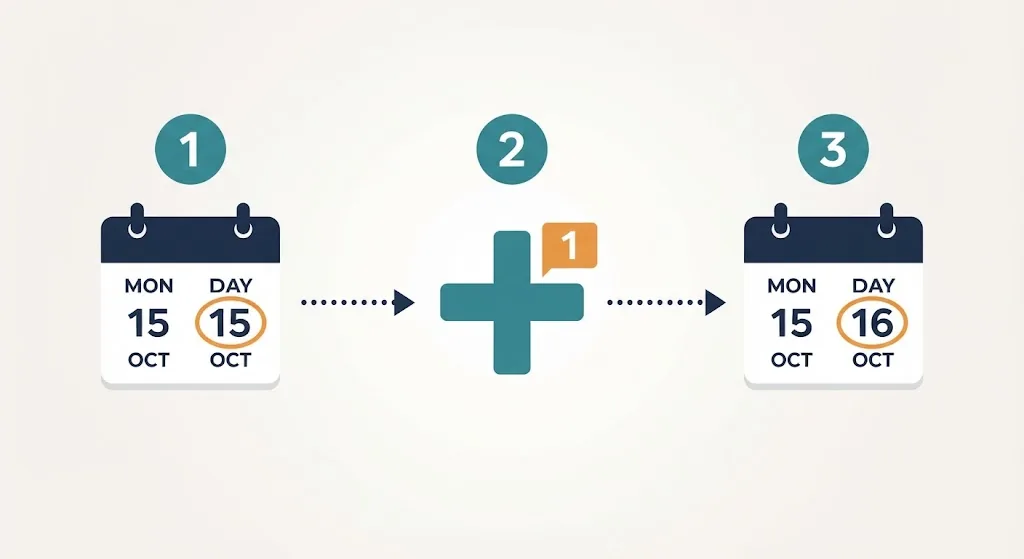
Step 1: Note Today’s Exact Date
Start with today’s full date, weekday included. A phone or computer clock is the most reliable source.
Example: today = Tuesday, August 11, 2026.
Step 2: Add One Day
Add 1 to the day number.
August 11 + 1 day = August 12.
That gives Wednesday, August 12, 2026. The weekday moves forward by one, from Tuesday to Wednesday. A single day always shifts the weekday by one step.
Step 3: Check Whether the Month Rolls Over
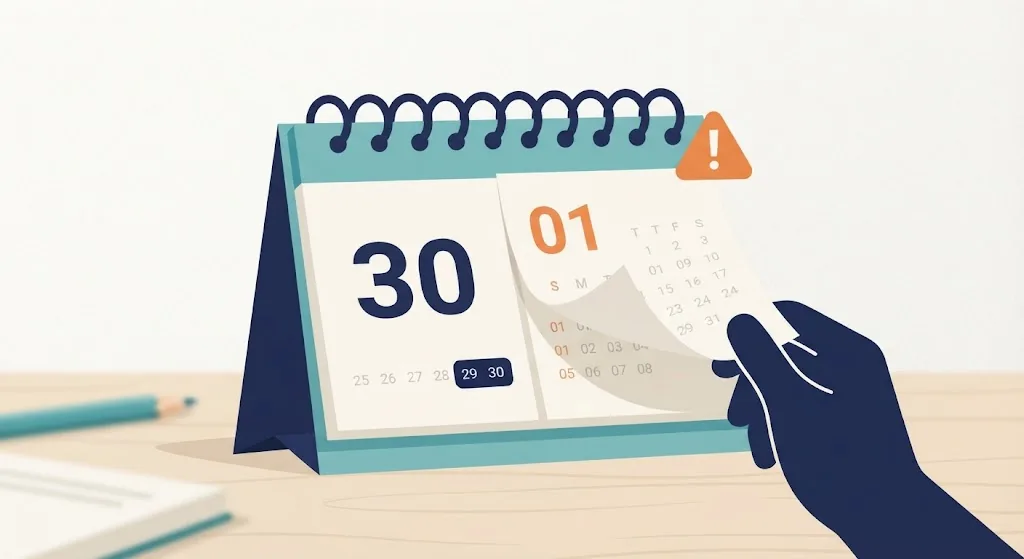
If today is the final day of the month, tomorrow becomes day 1 of the next month. It does not become a bigger number.
Example: Monday, April 30, 2026 + 1 day = Tuesday, May 1, 2026.
On December 31, this same rollover also bumps the year forward by one. That is the one case where forgetting this step causes a real mistake.
Why People Search “1 Day From Now” or “Tomorrow’s Date”
Plenty of everyday tools use “tomorrow” instead of printing a fixed date. That is handy, until you actually need the number for a form or a booking. Common examples include:
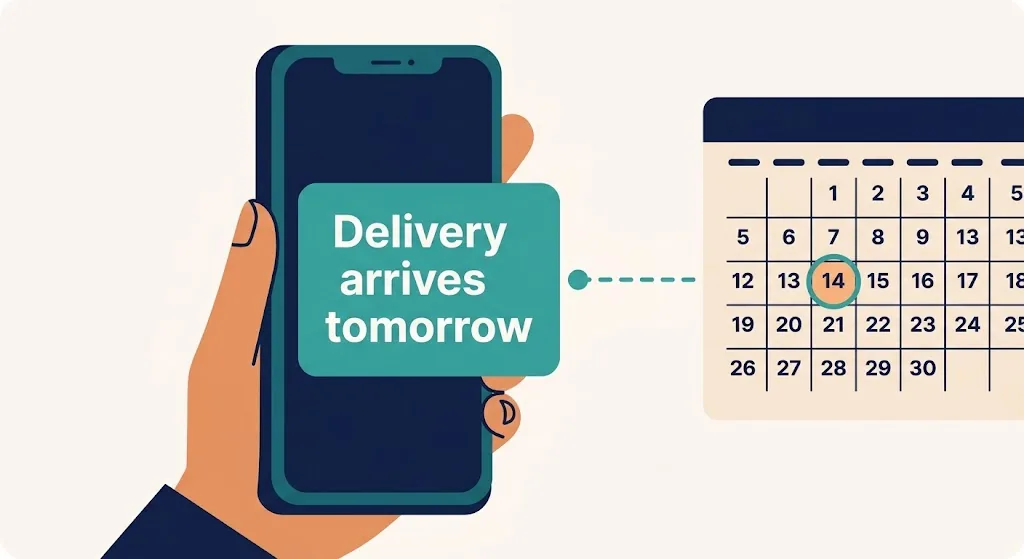
- “Delivery expected tomorrow” on a shipping tracker
- “Appointment starts tomorrow” in a booking confirmation
- “Offer ends tomorrow” on a sale banner
- “Reminder set for tomorrow” in a to-do app
- “Flight departs tomorrow” on a travel itinerary
These labels are easy to read. They are awkward to type into a form field, invite or spreadsheet. Those usually want an exact date. Turning “tomorrow” into a real date takes one addition: today’s date plus one day.
Keep an eye on the time of day too. If a message says “tomorrow” late at night, check what the app means. It could mean the calendar day after today. Or it could mean “within the next 24 hours,” which can be a different date near midnight.
Everyday Situations Where Tomorrow’s Date Matters
Tomorrow is the most common short-term reference point there is. It shows up constantly across work, travel and daily routines.
Next-Day Shipping and Delivery
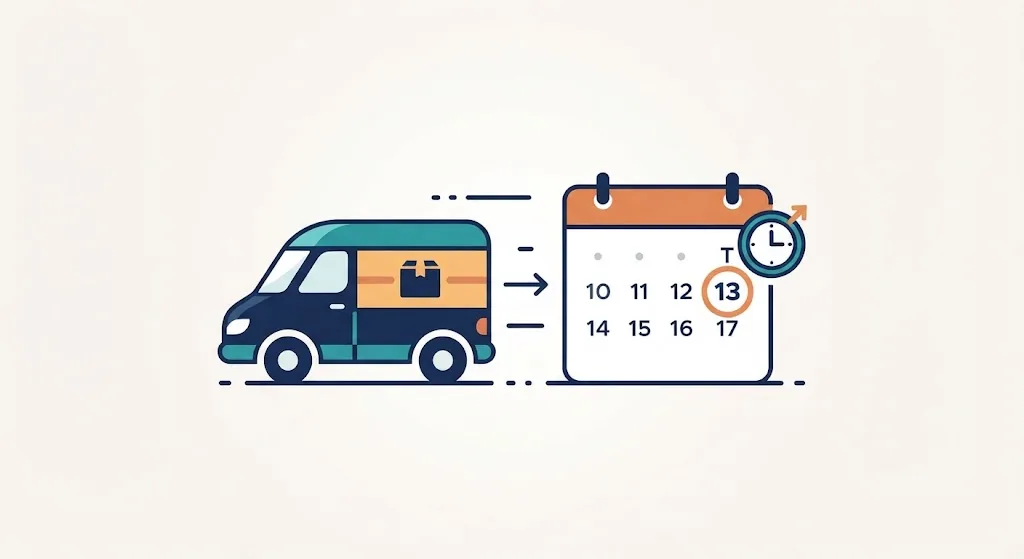
Online stores often promise “arrives tomorrow” for fast shipping options. Knowing the exact date lets a shopper plan ahead. They can be home, or arrange to forward the item, on the correct day.
Same-Day and Next-Day Deadlines
Work tasks marked “due tomorrow” carry real urgency. Confirm the exact date rather than trusting the word alone. That avoids confusion if the task is viewed again a day later, when “tomorrow” means something else entirely.
Appointments and Reservations
Clinics, salons and restaurants often confirm bookings as “see you tomorrow.” Write the exact date on a calendar. This removes any doubt, most of all for early-morning appointments booked late at night.
Travel and Check-In Times
A flight or hotel booking that “starts tomorrow” needs a firm date. Check-in systems, visas and reminders all rely on it. Converting the relative word into an exact date avoids missed connections.
Billing and Renewal Notices
Some services warn “your subscription renews tomorrow.” Knowing the exact date gives you time to spare. You can decide whether to cancel, downgrade or let the renewal go through.
School and Assignment Due Dates
Students and parents often see “assignment due tomorrow” in a school portal. A quick date check confirms which day that is. This matters most over a weekend or public holiday.
Time Arithmetic Made Simple
One day breaks down into familiar smaller units. This is useful when comparing it with an hours-based deadline elsewhere on this site.
| Unit | Equal to 1 day |
|---|---|
| Days | 1 |
| Hours | 24 |
| Minutes | 1,440 |
| Seconds | 86,400 |
| Weeks | ≈ 0.143 (one seventh) |
The 24-hour figure is worth remembering. “1 day from now” and “24 hours from now” usually line up, but not always. If it is 9:00 PM today, 24 hours from now is 9:00 PM tomorrow. But “tomorrow” as a calendar date starts at midnight, just three hours away. The two ideas overlap but are not identical.
Read also: What Time Is 8 Hours From Now?
Examples From Different Start Dates
Here is tomorrow’s date worked out from several different starting points, including two month-end cases.
| Starting date (today) | 1 day from now (tomorrow) |
|---|---|
| Sunday, June 14, 2026 | Monday, June 15, 2026 |
| Tuesday, September 30, 2026 | Wednesday, October 1, 2026 |
| Thursday, December 31, 2026 | Friday, January 1, 2027 |
| Saturday, February 28, 2026 | Sunday, March 1, 2026 |
Notice the December 31 row rolls the year forward. The February 28 row confirms 2026 is not a leap year. March 1 follows directly after February 28.
Comparing “Tomorrow” With “Yesterday”
The reverse question, one day in the past, works the same way but subtracts instead of adding:
Date 1 day ago (yesterday) = Today's date − 1 day
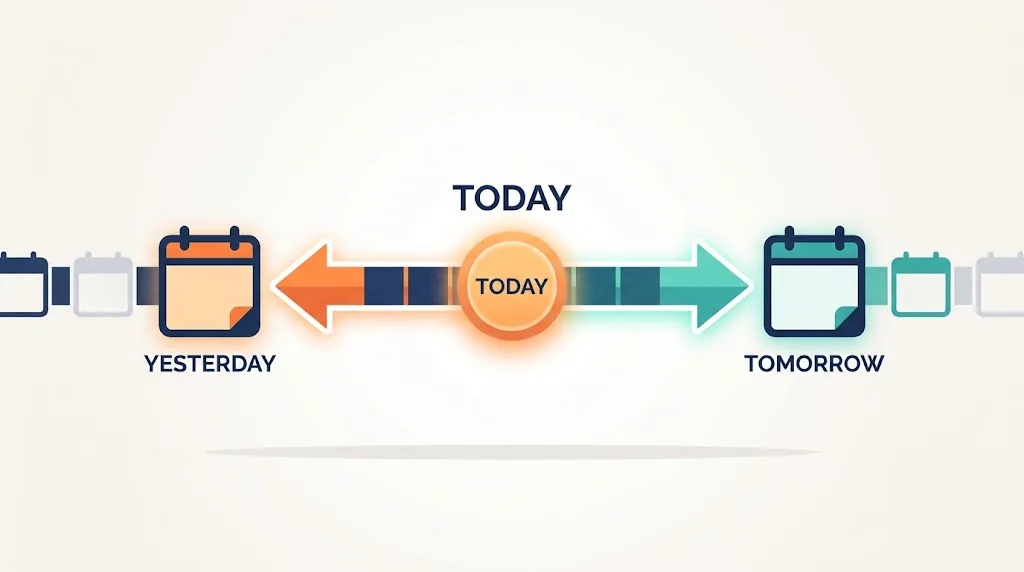
Yesterday and tomorrow always sit two calendar days apart, with today in between. If today is a Wednesday, yesterday was Tuesday and tomorrow is Thursday. That symmetry is a fast way to check either answer.
Read also: What Date Was It 21 Days Ago? Live Calculator, Chart & 3 Steps
Time Zones, Midnight, and Daylight Saving
“Tomorrow” depends on where you are standing. You might call it “tomorrow morning” in one time zone. For someone a few zones away, that same moment can still be “today.” Each place crosses midnight on its own.
For most plans, your own device’s local date and clock are all you need. Time zones matter mainly for calls, flights or deadlines shared across regions.
Using a Days From Now Calculator
A calculator confirms the exact date in an instant. It helps most right at a month or year edge. Try the one below. It defaults to today and 1 day, and you can change either field.
1 Day From Now — Date Calculator
Change the “days to add” field to 2, 7 or 30. You can preview further dates using the same tool. The “same count back” figure shows what the date would be if you subtracted instead. That way, you can compare both directions.
Tomorrow and Nearby Days Chart
The table below lists the next several days from today’s live date. It is useful for planning a short-term schedule at a glance.
| Days from now | Label | Resulting date |
|---|---|---|
| 1 day | Tomorrow | – |
| 2 days | Day after tomorrow | – |
| 3 days | – | – |
| 4 days | – | – |
| 5 days | – | – |
| 6 days | – | – |
| 7 days | One week from today | – |
This chart recalculates against today’s real date every time you load the page. It always shows the correct upcoming week.
Read also: What Date Is 2 Days From Now?
Common Mistakes People Make
Tomorrow’s date sounds impossible to get wrong. Yet a few slips still happen regularly.
Forgetting the Month Rolls Over
On the last day of a month, tomorrow is day 1 of the next month. It is not “day 31” or “day 32.” Typing the wrong month is a common error here.
Missing the Year Change on December 31
Tomorrow after December 31 is January 1 of the following year. It is easy to keep the old year by habit, right after midnight on New Year’s Eve.
Confusing “Tomorrow” With “In 24 Hours”
“Tomorrow” is a calendar date starting at midnight. “24 hours from now” is a fixed clock time. It can land on a different hour of tomorrow. Occasionally it still falls late tonight, depending on the current time.
Using the Wrong Starting Date
If you calculate from yesterday’s date by mistake, “tomorrow” actually becomes today. Always confirm today’s real date first.
Why “Tomorrow” Feels Different From an Exact Date
“Tomorrow” is quick, natural and easy to say. But it is a moving target. It points to a different exact date every single day, because “today” itself keeps sliding forward.
An exact date, once written down, never changes. It stays fixed no matter when someone reads it later. That is why a booking confirmation, invoice or travel ticket should always record the exact date. Everyday conversation can keep using the word “tomorrow.”
Frequently Asked Questions
What date is 1 day from now?
Add 1 day to today’s date. That is simply tomorrow. The live box at the top of this page shows the current answer for today’s real calendar.
Is “1 day from now” the same as “tomorrow”?
Yes. Both phrases point to the same calendar date, the one right after today.
What formula finds tomorrow’s date?
The formula is: date 1 day from now = today’s date + 1 day. If today is the last day, the result is day 1 of the next month.
Does tomorrow’s date ever change the year?
Yes, once a year. If today is December 31, tomorrow is January 1 of the following year.
How many hours is 1 day from now?
One day equals 24 hours. But “24 hours from now” and “tomorrow” are not always the exact same clock moment. Tomorrow begins at midnight, regardless of the current time.
How many minutes and seconds are in 1 day?
One day equals 1,440 minutes or 86,400 seconds.
What is the date 2 days from now?
Two days from now is the day after tomorrow, today’s date plus 2 days. See the linked guide above for a full breakdown.
How is “1 day from now” different from “1 day ago”?
“1 day from now” is tomorrow, so you add a day. “1 day ago” is yesterday, so you subtract a day. Today sits right in the middle of the two.
Does the weekday always change from today to tomorrow?
Yes. Tomorrow is always one weekday ahead of today, with no exceptions. A day is the smallest calendar step there is.
How can I find tomorrow’s date without a calculator?
Add 1 to today’s day number. If today is the last day of the month, tomorrow is day 1 of the next month.
Why does the answer to “1 day from now” keep changing?
Because it is measured from today, and today changes every day. Tomorrow’s date, in turn, moves one day later with it.
Does daylight saving time change tomorrow’s date?
No. Clocks moving forward or back by an hour do not add or remove a calendar day. Tomorrow’s date is unaffected.
Conclusion
Working out tomorrow’s date takes one small step: add one day to today’s date. The weekday always moves forward by one. Near the end of a month, the date rolls into the next month. Near the end of the year, it rolls into the next year.
Use the calculator above whenever you need the exact date confirmed. It helps most around a month or year boundary. It also shows the “day after tomorrow” and the days beyond it.
Read also: What Time Is 12 Hours From Now?

Liam Joseph Miller is an experienced writer with 6 years of expertise in creating clear, informative, and reader-friendly content. He specializes in words, phrases, slang, definitions, names, and everyday meanings, helping readers understand language in a simple and practical way.