
What time was it 10 hours ago? Pull ten hours off your current clock reading and leave the minutes exactly as they are. At 7:35 AM, that lands on 9:35 PM the night before.
Ten hours is close to half a day, roughly the length of a long-haul flight or a full overnight shift. Whenever the current hour on the 24-hour clock is smaller than 10, the answer rolls back to yesterday; anything from 10:00 AM onward stays on today’s date. Below you will find a live answer tuned to your own clock, a complete chart for every starting hour, and a method you can run in your head in seconds.
Quick answer
Right now it is your current time.
10 hours ago it was now minus 10 hours (7:35 AM → 9:35 PM the night before)
Mental trick: go back 12 hours (flip AM/PM), then move forward 2.
- 10 hours ago = the time right now − 10 hours. The minutes never move.
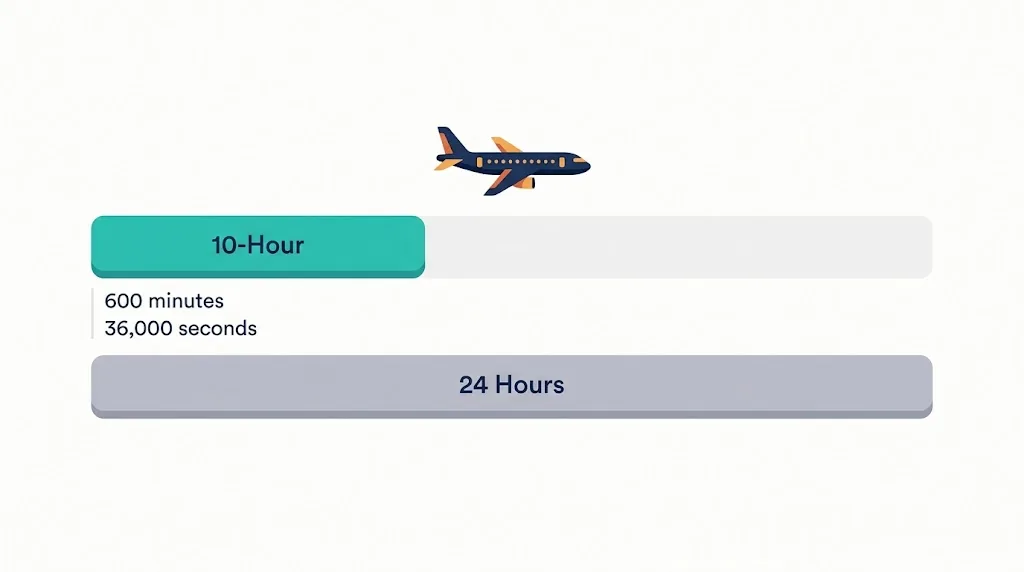
- Ten hours equals 600 minutes, 36,000 seconds, or almost five-twelfths of a day.
- If it is earlier than 10:00 AM, the answer sits on the previous date.
- At exactly 10:00 AM, ten hours ago was midnight, the very start of today.
Understanding What Time Was It 10 Hours Ago
“10 hours ago” points to one fixed moment: ten hours earlier than this exact second. It is not “sometime last night” or “around breakfast.” It is measured back from right now, every time you ask it.
Time 10 hours ago = Current time − 10 hours
Picture the clock at 4:50 PM. Counting back ten hours gives 6:50 AM the same morning. Try 2:10 AM instead: ten hours earlier is 4:10 PM the day before, since the subtraction runs past midnight.
Minutes and seconds ride along unchanged. If the clock shows 11:52:40 AM, ten hours earlier was 1:52:40 AM. The seconds never shift; only the hour, and sometimes the date, moves.
How to Calculate 10 Hours Ago
Ten hours is awkward to subtract in one jump, so most people split it into a friendlier pair of steps instead of counting down one hour at a time.

Step 1: Check the Current Time
Get an exact reading from your phone or watch, AM or PM included. Say it out loud if that helps you lock it in. Example: current time = 7:35 AM.
Step 2: Subtract Ten Hours
Instead of counting back ten one-hour steps, go back 12 hours first, which only flips AM to PM (or the reverse) without touching the digits, then move forward 2 hours to give back the extra you subtracted. From 7:35 AM: back 12 gives 7:35 PM the day before, forward 2 gives 9:35 PM the day before. That matches subtracting ten hours directly.
7:35 AM − 10 hours = 9:35 PM (the previous night)
Step 3: Check Whether the Date Changes
Whenever the current hour on the 24-hour clock is below 10, the result falls on yesterday. From 10:00 AM onward, it stays on today. Example: 10:15 PM − 10 hours = 12:15 PM, the same afternoon, because 22 is well above 10.
The date matters just as much as the clock reading. A flight log, a shift report or a hospital chart that lists only the hour, with no date, can send someone looking at the wrong day entirely.
Why People Search “What Was 10 Hours Ago From Now”
Apps rarely show an exact timestamp up front. Instead you get a rounded gap:
- “Boarded 10 hours ago” in a flight-tracking app
- “Last active 10h” on a messaging profile
- “Order shipped 10 hours ago” on a delivery tracker
- “Posted 10h ago” under a photo or comment
- “Shift started 10 hours ago” on a staff scheduling app
To turn that label into a real clock time, you subtract. If it is 6:00 PM and a tracker says a flight “took off 10 hours ago,” wheels-up was close to 8:00 AM. Because most of these labels round to the nearest hour, treat them as an estimate rather than an exact record whenever precision matters.
Everyday Situations Where Time Ten Hours Earlier Matters
Ten hours shows up constantly in travel, work and daily routines, often without anyone doing the subtraction on purpose.
Long-Haul Flights
Many long-haul routes, such as a transatlantic crossing, sit close to ten hours in the air. A traveler landing at 6:20 AM local time can work out that boarding happened around 8:20 PM the evening before, useful for lining up connecting transport or a hotel check-in.
Overnight Factory and Hospital Shifts
A ten-hour overnight shift is common in manufacturing and healthcare. A nurse finishing at 6:00 AM started the shift at 8:00 PM the night before. Supervisors use the same backward math to confirm handover times and break records.
Intermittent Fasting Windows
Some fasting plans use a ten-hour eating window and a fourteen-hour fast. If someone closes their eating window at 7:00 PM, the window opened ten hours earlier, at 9:00 AM. Counting backward this way helps people check they stayed inside the plan.
Cross-Country Drives
A ten-hour road trip is a familiar benchmark for drivers covering a few hundred miles. Someone arriving at 5:30 PM can work out they left the driveway around 7:30 AM, handy for estimating fuel stops or a return trip.
Customer Support Tickets
A support dashboard might flag a ticket as “opened 10 hours ago.” Subtracting ten hours from the current time gives the agent a real timestamp to reference in a report or an escalation note.
Time Arithmetic Made Simple
Ten hours is almost half a day, close to the length of a long-haul flight, which makes it a useful mental anchor even though it is not a clean fraction of 24.
| Unit | Equal to 10 hours |
|---|---|
| Hours | 10 |
| Minutes | 600 |
| Seconds | 36,000 |
| Milliseconds | 36,000,000 |
| Days | ≈ 0.417 (about 5/12) |
| Weeks | ≈ 0.0595 |
The minute count is worth remembering: 10 × 60 = 600. So “10 hours ago” and “600 minutes ago” are the same moment, which is handy when a tool, timer or spreadsheet works in minutes instead of hours.
Read also: What Time Was It 9 Hours Ago? Live Answer, 24-Hour Chart & Steps
Examples Using Both 12-Hour and 24-Hour Clock
Some readers think in AM and PM, others prefer the 24-hour clock used in logistics, healthcare and the military. The chart below covers every starting hour in both formats.
12-Hour Clock
Rows marked “yesterday” cross midnight going back. Notice the split happens right at 10:00 AM.
| Current time | 10 hours ago | 24-hour format |
|---|---|---|
| 12:00 AM (midnight) | 2:00 PM yesterday | 00:00 → 14:00 |
| 1:00 AM | 3:00 PM yesterday | 01:00 → 15:00 |
| 2:00 AM | 4:00 PM yesterday | 02:00 → 16:00 |
| 3:00 AM | 5:00 PM yesterday | 03:00 → 17:00 |
| 4:00 AM | 6:00 PM yesterday | 04:00 → 18:00 |
| 5:00 AM | 7:00 PM yesterday | 05:00 → 19:00 |
| 6:00 AM | 8:00 PM yesterday | 06:00 → 20:00 |
| 7:00 AM | 9:00 PM yesterday | 07:00 → 21:00 |
| 8:00 AM | 10:00 PM yesterday | 08:00 → 22:00 |
| 9:00 AM | 11:00 PM yesterday | 09:00 → 23:00 |
| 10:00 AM | 12:00 AM (midnight) | 10:00 → 00:00 |
| 11:00 AM | 1:00 AM | 11:00 → 01:00 |
| 12:00 PM (noon) | 2:00 AM | 12:00 → 02:00 |
| 1:00 PM | 3:00 AM | 13:00 → 03:00 |
| 2:00 PM | 4:00 AM | 14:00 → 04:00 |
| 3:00 PM | 5:00 AM | 15:00 → 05:00 |
| 4:00 PM | 6:00 AM | 16:00 → 06:00 |
| 5:00 PM | 7:00 AM | 17:00 → 07:00 |
| 6:00 PM | 8:00 AM | 18:00 → 08:00 |
| 7:00 PM | 9:00 AM | 19:00 → 09:00 |
| 8:00 PM | 10:00 AM | 20:00 → 10:00 |
| 9:00 PM | 11:00 AM | 21:00 → 11:00 |
| 10:00 PM | 12:00 PM (noon) | 22:00 → 12:00 |
| 11:00 PM | 1:00 PM | 23:00 → 13:00 |
Ten of the 24 starting hours land on yesterday, and fourteen stay on today. The cutoff sits at 10:00 AM sharp.
24-Hour Clock
The 24-hour clock removes the AM/PM flip entirely. Just subtract 10 from the hour.
19:20 − 10 hours = 09:20
If the hour drops below zero, add 24 and step the date back one day.
05:10 − 10 = −4:50 → add 24 → 19:10 yesterday
This add-24 rule is exactly what computers do behind the scenes, no matter how large the number of hours.
What Time Will It Be in 10 Hours?
The forward version of the same question adds instead of subtracts:
Time 10 hours from now = Current time + 10 hours

- 9:10 AM + 10 hours = 7:10 PM the same day
- 7:45 PM + 10 hours = 5:45 AM the next day
Ten hours ago and ten hours from now always sit exactly 20 hours apart. At 7:35 AM, one answer is 9:35 PM the night before and the other is 5:35 PM later that same day. If the gap between your two results is not 20 hours, recheck your subtraction.
Read also: What Time Is 10 Hours From Now?
Time Zones Can Change Everything
A ten-hour gap stays ten hours no matter where you stand, but the clock reading attached to each end depends entirely on the local time zone.

Take one shared instant, 12:00 PM UTC, and step back ten hours in four cities (standard time):
| City | Offset | Now | 10 hours ago |
|---|---|---|---|
| New York | UTC−5 | 7:00 AM | 9:00 PM (previous day) |
| London | UTC+0 | 12:00 PM | 2:00 AM (same day) |
| Dubai | UTC+4 | 4:00 PM | 6:00 AM (same day) |
| Tokyo | UTC+9 | 9:00 PM | 11:00 AM (same day) |
Only New York drops back a calendar day here; the other three cities land on today’s date for this particular instant. Pin down the local time, the date, the zone, and whether the original stamp was recorded in UTC before you start subtracting anything.
Technology Depends on Accurate Time Calculation
Flight trackers, ride logs and hospital charting systems never picture a clock face the way a person does. Underneath, they keep a single running tally of seconds counted from January 1, 1970, in UTC, commonly called a Unix timestamp. Finding “ten hours ago” is just subtracting 36,000 from that tally and converting the result back into a readable date and time.
Because the entire sum happens on one unbroken number line, awkward edge cases like a midnight rollover, the last day of a month or a leap year never break the math. A tool that reads your device’s clock will always land on your own local time zone without you setting anything.
Using a 10 Hours Ago Calculator
Punch in a departure time, a shift start, or leave the box on the current moment, and it works out the answer for you in an instant.
Hours Ago Calculator
Reach for it whenever mental math feels risky: a receipt with an odd start time, a shift that did not begin at a round hour, or a case where you want both directions of the answer without solving it twice.
Read also: What Time Was It 13 Hours Ago? Live Answer, Full Chart & Steps
Common Mistakes People Make
A ten-hour gap is wide enough that a handful of small slips show up again and again.
Forgetting the Date
Anything before 10:00 AM rolls back to yesterday. Jot down only “9:35 PM” with no mention of “the night before,” and a flight log or a delivery record can end up a full calendar day out.
Mixing Up AM and PM
Crossing noon or midnight flips the label on you. 4:15 AM − 10 hours = 6:15 PM the day before, not 6:15 AM. Leaning on the back-12-forward-2 trick keeps the label honest.
Changing the Minutes
A whole-hour subtraction never disturbs the minutes. 3:48 PM − 10 hours = 5:48 AM; if your minutes drifted somewhere, walk back through the steps.
Ignoring Time Zones
A timestamp filed in UTC or a partner city’s zone will not line up with your local screen. Convert it to your own zone first, then take away the ten hours.
Confusing Ago With From Now
Looking back means subtracting; looking ahead means adding. Say the rule to yourself once before you start typing, and the mix-up rarely happens.
Why Relative Time Feels Different From Exact Time
A tag such as “10 hours ago” is fast to scan; it tells you roughly how fresh a moment is without asking you to do any arithmetic. A precise reading, like 9:35 PM, needs an extra second while your brain lines it up against right now.
The trouble is that a relative tag never sits still. Something ten hours old this second becomes ten hours and one minute old by the time you glance away and back. A flight log or a support ticket you plan to reference later needs a fixed timestamp sitting quietly under that friendly label, even though the label is what most readers notice first.
Frequently Asked Questions
What time was it 10 hours ago?
Subtract ten hours from your current time and keep the minutes the same. At 7:35 AM, ten hours ago was 9:35 PM the night before. The live box at the top of this page shows the exact answer for your own clock.
How many minutes are in 10 hours?
There are 600 minutes in 10 hours, because 10 × 60 = 600.
How many seconds are in 10 hours?
Ten hours contain 36,000 seconds, which is 10 × 60 × 60.
Is 10 hours ago always on today’s date?
No. If the current time is before 10:00 AM, ten hours ago falls on the previous day. From 10:00 AM onward, it is still today.
What formula finds the time 10 hours ago?
Time 10 hours ago = current time − 10 hours. On a 24-hour clock, if the result is below zero, add 24 and step the date back one day.
How do I work out 10 hours ago in 24-hour time?
Subtract 10 from the hour. For example, 19:20 becomes 09:20, and 05:10 becomes 19:10 the previous day.
How is 10 hours ago different from 10 hours from now?
Ten hours ago is in the past, so you subtract. Ten hours from now is in the future, so you add. The two answers always sit 20 hours apart.
Does my location change the answer?
The ten-hour span itself is fixed anywhere on earth, but the clock reading tied to each end shifts with the local zone. Translate a UTC-stamped time into your own zone before you take anything away from it.
What is a fast way to work out 10 hours ago without writing anything down?
Drop back 12 hours first, which just swaps AM for PM, then nudge forward 2 hours to correct for going too far. Starting from 7:35 AM, that path lands on 7:35 PM, then 9:35 PM.
Why does the “10 hours ago” answer never sit still?
Because it is always anchored to this instant, and this instant never pauses. Each minute that ticks by nudges the ten-hours-ago answer one minute later as well.
What time was it 10 hours ago if it is midnight now?
At 12:00 AM, ten hours ago was 2:00 PM the previous day, or 14:00 in 24-hour time.
Does 10 hours ago always fall on yesterday?
No. It only falls on yesterday when the current time is earlier than 10:00 AM. From 10:00 AM through 11:59 PM, the answer stays on today’s date.
Conclusion
Pinning down what time it was 10 hours ago is a single subtraction: pull ten hours off the current time, leave the minutes alone, and check whether the calendar needs to step back a day. Start earlier than 10:00 AM and you land on yesterday; start at 10:00 AM or later and you stay on today.
The fastest mental shortcut is back 12, forward 2. When a record, a cross-country trip, or an unusual start time is on the line, let the calculator above hand you both clock formats in one pass.
Read also: What Time Was It 14 Hours Ago? Live Answer, Full Chart & Steps

Liam Joseph Miller is an experienced writer with 6 years of expertise in creating clear, informative, and reader-friendly content. He specializes in words, phrases, slang, definitions, names, and everyday meanings, helping readers understand language in a simple and practical way.