
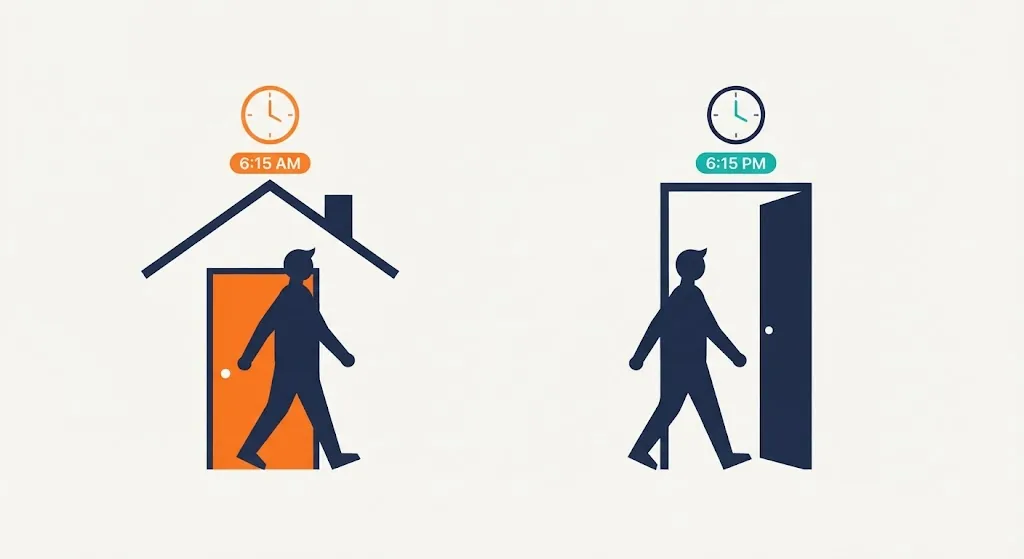
What time was it 12 hours ago? Look at your clock, keep the exact same hour and minutes, and flip AM to PM or PM to AM. At 6:50 AM, the answer is 6:50 PM yesterday.
Twelve hours is the one gap that never changes your clock’s digits, only the half of the day they belong to. That makes it the easiest duration to calculate in your head, but also the easiest one to get wrong when the date is involved. This page gives you the live answer for right now, a complete chart for all 24 starting hours, and a method that keeps the date straight every time.
Quick answer
It is now your current time.
Twelve hours ago it was now minus 12 hours (6:50 AM → 6:50 PM yesterday)
Mental trick: the hour and minutes never move. Only AM and PM swap.
- 12 hours ago always shows the same clock digits as now, just with AM and PM swapped.
- Twelve hours equals 720 minutes, 43,200 seconds, or exactly half of a day.
- If it is earlier than noon, 12 hours ago was yesterday. If it is noon or later, it was today.
- At exactly 12:00 PM (noon), 12 hours ago was 12:00 AM (midnight) at the very start of today.
What Time Was It 12 Hours Ago?
To find the time 12 hours ago, subtract exactly twelve hours from the current time. Because a full day has 24 hours, subtracting 12 lands you on the exact opposite half of the same clock face. The shortcut is simple:
Same hour + same minutes + opposite AM/PM
A few quick examples make the shortcut click. At 2:15 AM, 12 hours ago was 2:15 PM yesterday. At 12:00 PM (noon), 12 hours ago was 12:00 AM (midnight) today. At 8:50 PM, 12 hours ago was 8:50 AM the same day.
Notice that the hour and the minutes never change. The only two things that can move are the AM/PM label and, sometimes, the date.
Understanding the Mathematics Behind Time Calculation
Twelve hours is exactly half of a 24-hour day, so the arithmetic is unusually clean. The formula is:
Time 12 hours ago = Current time − 12 hours
Broken into smaller units, 12 hours equals:
- 12 hours = 720 minutes
- 12 hours = 43,200 seconds
- 12 hours = 43,200,000 milliseconds
Suppose the current time is 9:35 PM. Subtract 12 hours and you land on 9:35 AM, the same day. The minutes stay at 35 because a full 12-hour block never touches them, only the hour label and the half of the day.
What Happens When You Cross Midnight?
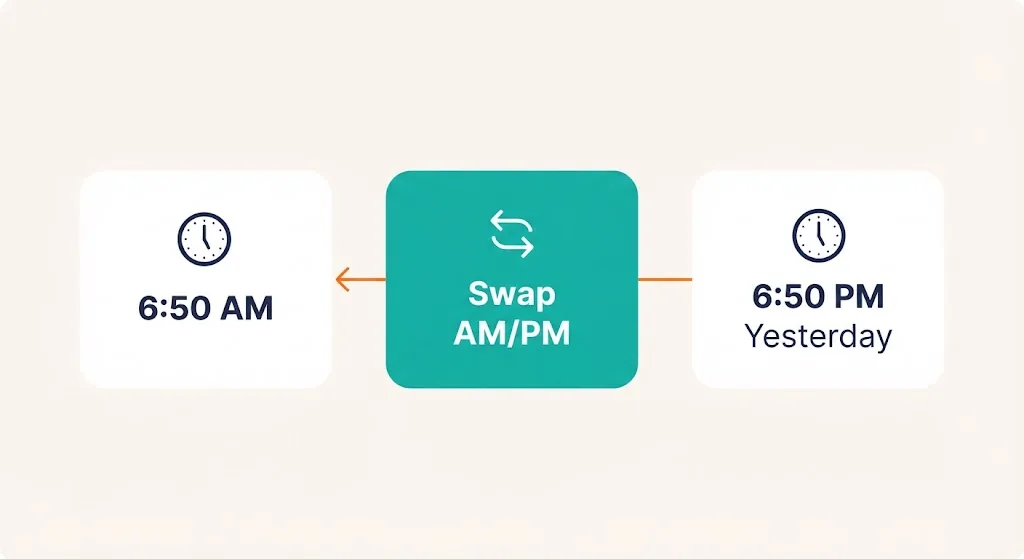
Crossing midnight is the part that trips people up. Take a current time of 4:40 AM. Going back 12 hours gives:
4:40 AM → 4:40 PM yesterday
The result falls on the previous calendar day because midnight sits between the current time and the calculated one. Another case: 10:55 PM − 12 hours = 10:55 AM, still today, because 10:55 PM is already past noon.
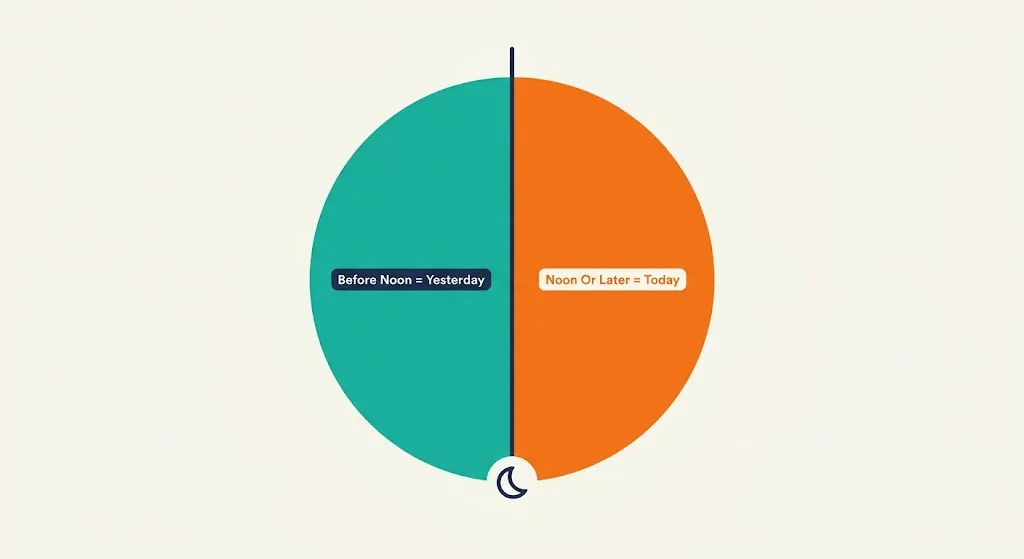
A simple rule covers every case:
- If the current time is before noon (12:00 AM to 11:59 AM), 12 hours ago was yesterday.
- If the current time is noon or later (12:00 PM to 11:59 PM), 12 hours ago was today.
This rule works every single day, because twelve hours is exactly the width of one half of the clock face.
Why AM and PM Switch Every Twelve Hours
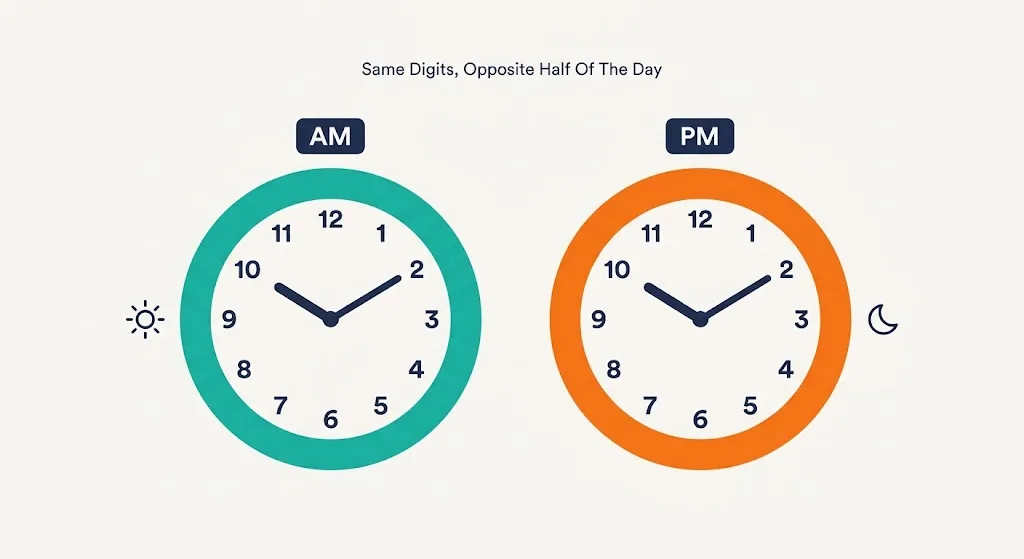
A standard 12-hour clock repeats each number twice in a day. The hour hand passes 7 o’clock once in the morning and again in the evening, for example. Because 12 hours is the exact gap between those two passes, going back 12 hours always lands you on the other pass of the same number.
The pattern is fixed:
- AM, 12 hours back, becomes PM
- PM, 12 hours back, becomes AM
The minutes and seconds are untouched, since the clock hands simply complete one more full loop of six hours short of a day. That is also why 12 hours ago and 12 hours from now always land on the exact same clock time, just on different calendar days in most cases.
What Time Was It 12 Hours Ago: Practical Examples
Five worked examples, covering different parts of the day.
Example One
Current time: 6:50 AM. Subtract 12 hours: 6:50 AM − 12 hours = 6:50 PM yesterday. Because 6:50 AM is before noon, the date rolls back one day.
Example Two
Current time: 2:05 PM. Subtract 12 hours: 2:05 PM − 12 hours = 2:05 AM today. Since 2:05 PM is after noon, the answer stays on the same calendar day.
Example Three
Current time: 12:40 AM. Subtract 12 hours: 12:40 AM − 12 hours = 12:40 PM yesterday. Just after midnight still counts as before noon, so the date moves back.
Example Four
Current time: 11:15 PM. Subtract 12 hours: 11:15 PM − 12 hours = 11:15 AM today. The starting time is already in the evening, well past noon, so the result stays on the same day.
Example Five
Current time: 9:05 AM. Subtract 12 hours: 9:05 AM − 12 hours = 9:05 PM yesterday. Morning hours before noon always send you back to the evening before.
Why People Search “What Was 12 Hours Ago From Now”
Twelve hours is long enough to separate two shifts of a day, yet short enough that people still remember roughly what happened. That mix drives a lot of searches. Common reasons include:
- Lining up a “12h ago” label under a notification with an actual clock time
- Working out when an overnight delivery, flight, or upload actually started
- Checking the start of a half-day shift or an on-call rotation
- Reviewing a workout, fast, or sleep log measured from half a day back
- Matching a bank alert or receipt with something that happened earlier the same day
- Comparing a moment with someone whose day is roughly upside down from yours
For example, if it is 9:20 PM and an app shows “12h,” the event happened close to 9:20 AM that morning. Because the digits repeat, it is tempting to think the event was “9:20,” full stop, and forget which half of the day it fell in.
Read also: What Time Was It 6 Hours Ago? Live Calculator, Chart & Easy Steps
The Role of Time Zones
Twelve hours is always a fixed span of 720 minutes, but the clock label attached to each end depends on where you are standing. A useful case: take one moment, 16:00 UTC, and look at it from four cities.
| City | Offset | Now | 12 hours ago |
|---|---|---|---|
| New York | UTC−4 | 12:00 PM (noon) | 12:00 AM (today) |
| Paris | UTC+2 | 6:00 PM | 6:00 AM (today) |
| Dubai | UTC+4 | 8:00 PM | 8:00 AM (today) |
| Sydney | UTC+10 | 2:00 AM (next day) | 2:00 PM (yesterday) |
Sydney is far enough ahead that its clock has already rolled into the next date, so its “12 hours ago” points at yesterday afternoon while New York’s still points at the start of today. When you compare a timestamp across places, always confirm which clock and which date it belongs to before you subtract.

Using Online Time Calculators
The box below does the subtraction for you. It starts from your device’s own clock and time zone, so the live answer at the top of this page always matches the time on your wall. You can also set any date, time and number of hours by hand.
Hours Ago Calculator
A calculator is worth using when:
- You need the date, not only the time of day
- The starting point is not “now,” such as a stamp pulled from a log file
- You want the seconds to be exact
- You are checking several different starting times in a row
- You want the “12 hours from now” answer sitting next to the “12 hours ago” one
Human Perception of Time
People rarely feel twelve hours pass the way a clock counts them. Half a day of sleep, travel or focused work can feel like it vanished, while twelve hours of waiting for news can feel endless.
The math never changes underneath that feeling: 12 hours = 720 minutes = 43,200 seconds, no matter how quickly or slowly it seemed to go. For anything that needs to be accurate, lean on a timestamp or a calculator rather than a gut feeling about how long ago something happened.
What Time Was It 12 Hours Ago in the 24-Hour Clock?
The 24-hour clock makes 12-hour subtraction almost automatic: just add or remove 12 from the hour number, with no AM/PM label to track. Here is the complete chart for every starting hour of the day, in both 12-hour and 24-hour format.
| Current time | 12 hours ago | 24-hour format |
|---|---|---|
| 12:00 AM (midnight) | 12:00 PM (noon) yesterday | 00:00 → 12:00 |
| 1:00 AM | 1:00 PM yesterday | 01:00 → 13:00 |
| 2:00 AM | 2:00 PM yesterday | 02:00 → 14:00 |
| 3:00 AM | 3:00 PM yesterday | 03:00 → 15:00 |
| 4:00 AM | 4:00 PM yesterday | 04:00 → 16:00 |
| 5:00 AM | 5:00 PM yesterday | 05:00 → 17:00 |
| 6:00 AM | 6:00 PM yesterday | 06:00 → 18:00 |
| 7:00 AM | 7:00 PM yesterday | 07:00 → 19:00 |
| 8:00 AM | 8:00 PM yesterday | 08:00 → 20:00 |
| 9:00 AM | 9:00 PM yesterday | 09:00 → 21:00 |
| 10:00 AM | 10:00 PM yesterday | 10:00 → 22:00 |
| 11:00 AM | 11:00 PM yesterday | 11:00 → 23:00 |
| 12:00 PM (noon) | 12:00 AM (midnight) | 12:00 → 00:00 |
| 1:00 PM | 1:00 AM | 13:00 → 01:00 |
| 2:00 PM | 2:00 AM | 14:00 → 02:00 |
| 3:00 PM | 3:00 AM | 15:00 → 03:00 |
| 4:00 PM | 4:00 AM | 16:00 → 04:00 |
| 5:00 PM | 5:00 AM | 17:00 → 05:00 |
| 6:00 PM | 6:00 AM | 18:00 → 06:00 |
| 7:00 PM | 7:00 AM | 19:00 → 07:00 |
| 8:00 PM | 8:00 AM | 20:00 → 08:00 |
| 9:00 PM | 9:00 AM | 21:00 → 09:00 |
| 10:00 PM | 10:00 AM | 22:00 → 10:00 |
| 11:00 PM | 11:00 AM | 23:00 → 11:00 |
Look down the middle column and you can see the pattern at a glance: the hour number is always identical to the current time, and exactly twelve of the twenty-four rows fall on “yesterday.” That even split is unique to a 12-hour gap; shorter or longer gaps always favor one day over the other.
Common Mistakes People Make When Subtracting 12 Hours
Forgetting the Date Changes
Because the digits stay the same, it is easy to assume the date does too. Any current time before noon sends the answer back to the previous day.
Mixing Up Noon and Midnight
12:00 AM is midnight, the very start of a day. 12:00 PM is noon, the middle of a day. Swapping the two flips the answer to the wrong end of the clock entirely.
Changing the Minutes
When the gap is exactly 12 hours, the minutes never move. 8:27 PM becomes 8:27 AM, not 8:00 AM or any rounded figure.
Ignoring Time Zones
A timestamp from a server, a flight itinerary, or a friend abroad may be stamped in a different zone than your own. Convert it to your local clock first, then subtract twelve hours.
Real-Life Situations Where Knowing 12 Hours Ago Matters
Work Schedules
Twelve-hour shifts are common in hospitals, factories and emergency services. Knowing the start of the previous shift helps with handovers, coverage checks and overtime records.
Travel Planning
Long-haul flights often last close to half a day. Subtracting 12 hours from a landing time gives a rough idea of when boarding happened, though the local time zone at each end still needs checking.
Reviewing Security Footage
Security systems timestamp every clip. If an incident report says “about half a day ago,” converting that to a clock time narrows the search to the right window of footage almost instantly.
Medication Reminders
Many medicines are dosed roughly every 12 hours. Working out the last dose’s clock time can help you track a schedule, though you should always follow the label or a pharmacist’s instructions rather than general time math.
Online Gaming and Events
Livestreams, tournaments and daily reset timers often reference “12 hours ago” or “in 12 hours.” Converting that to an actual clock time makes it easier to plan around, especially for events tied to a different region’s server clock.
Read also: What Time Was It 5 Hours Ago? Live Answer, Full Chart & Examples
A Simple Formula to Remember
The core formula is short:
Time 12 Hours Ago = Current Time − 12 Hours
For a mental shortcut, remember:
Same hour, same minutes, opposite AM/PM
For example:
- 7:10 AM → 7:10 PM yesterday
- 7:10 PM → 7:10 AM today
The one extra step is checking the noon rule to see whether the date moves back.
What Time Will It Be 12 Hours From Now?
The mirror question uses the exact same shortcut, just running forward instead of backward.
Time 12 hours from now = Current time + 12 hours
Because adding 12 hours also lands on the same digits with the opposite AM/PM label, the answer 12 hours ago and the answer 12 hours from now are always identical to each other. At 6:50 AM, both “12 hours ago” and “12 hours from now” read 6:50 PM, one on yesterday’s date and one on today’s. That is a shortcut unique to a 12-hour gap: for any other number of hours, the “ago” and “from now” answers land on different clock times.
Examples Using Everyday Times
A morning batch, all before noon, so all of them roll back to yesterday. 1:30 AM becomes 1:30 PM yesterday. 4:45 AM becomes 4:45 PM yesterday. 8:20 AM becomes 8:20 PM yesterday. 10:10 AM becomes 10:10 PM yesterday.
An afternoon and evening batch, all at noon or later, so all of them stay on today. 12:05 PM becomes 12:05 AM today. 1:55 PM becomes 1:55 AM today. 5:30 PM becomes 5:30 AM today. 9:40 PM becomes 9:40 AM today.
Scan the pattern once more: the hour and minutes are copied straight across every single example, and only the AM/PM label and, for the morning batch, the date, are different.
What About Seconds and Milliseconds?
The same rule applies down to the smallest units. If the current time is 5:18:42 PM, then 12 hours ago it was 5:18:42 AM. The seconds stay at 42, unchanged.
A quick conversions table for the whole 12-hour span:
| Unit | Equal to 12 hours |
|---|---|
| Hours | 12 |
| Minutes | 720 |
| Seconds | 43,200 |
| Milliseconds | 43,200,000 |
| Days | 0.5 (half a day) |
| Weeks | ≈ 0.0714 |
Twelve hours is exactly half of everything a full day measures, which is why it is the only gap that always keeps the clock digits identical.
Why Time Feels Different Than It Really Is
Twelve hours asleep can feel like a blink, while twelve hours stuck in a waiting room can drag on forever. The brain does not track clock time evenly; it fills gaps with impressions of what happened, not precise durations.
Clock time stays objective regardless of how it felt. That gap between memory and measurement is exactly why timestamps, receipts and calculators matter whenever the exact hour needs to be right rather than roughly remembered.
Frequently Asked Questions
What time was it 12 hours ago?
Keep the same hour and minutes and swap AM for PM, or PM for AM. At 6:50 AM, 12 hours ago was 6:50 PM the day before. The live box at the top of this page shows the answer for your own clock right now.
How many minutes are in 12 hours?
Twelve hours equals 720 minutes, because 12 × 60 = 720.
How many seconds are in 12 hours?
Twelve hours equals 43,200 seconds, because 720 × 60 = 43,200.
Does 12 hours ago always mean yesterday?
No. If the current time is before noon, 12 hours ago falls on the previous day. If the current time is noon or later, 12 hours ago is still today.
What was 12 hours before 9 AM?
Twelve hours before 9:00 AM was 9:00 PM the evening before, since 9:00 AM falls before noon.
What was 12 hours before 9 PM?
Twelve hours before 9:00 PM was 9:00 AM the same day, since 9:00 PM falls after noon.
What was 12 hours before midnight?
Twelve hours before 12:00 AM (midnight) was 12:00 PM (noon) on the day before.
What was 12 hours before noon?
Twelve hours before 12:00 PM (noon) was 12:00 AM (midnight) at the very start of the same day.
Do the minutes change when you subtract 12 hours?
No. Because the gap is a whole number of hours, the minutes and seconds stay exactly the same. Only the AM/PM label, and sometimes the date, change.
Does my time zone affect the 12-hour calculation?
The 720-minute length never changes, but the clock label attached to each end depends on the time zone in use. Convert any UTC or foreign timestamp to your own zone before subtracting.
Can I work out 12 hours ago without a calculator?
Yes. Keep the hour and minutes, swap AM and PM, then check the noon rule: before noon means yesterday, noon or later means today.
Is 12 hours exactly half a day?
Yes. A day has 24 hours, so 12 hours is precisely half, which is also why it is the only gap that always leaves the clock digits unchanged.
Why do 12 hours ago and 12 hours from now show the same clock time?
Because adding or subtracting exactly half a day both land on the opposite AM/PM label with identical digits. The dates usually differ, but the time on the clock face is the same.
What is a fast way to check my 12-hour math is right?
Compare the hour and minutes of your answer with the current time. With a 12-hour gap they must match exactly; if they do not, re-check the subtraction.
Conclusion
Finding what time it was 12 hours ago comes down to one clean rule: keep the hour and minutes exactly as they are, and flip AM to PM or PM to AM. The only extra check is the date, which moves back a day whenever the current time is before noon.
For the instant answer, use the live box at the top of this page. For a different starting time, a past date, or exact seconds, the calculator above does the same math for any moment you choose.

Liam Joseph Miller is an experienced writer with 6 years of expertise in creating clear, informative, and reader-friendly content. He specializes in words, phrases, slang, definitions, names, and everyday meanings, helping readers understand language in a simple and practical way.