

What time was it 14 hours ago? Take fourteen hours off your current clock reading and leave the minutes untouched. At 10:50 AM, that lands on 8:50 PM the night before.
Fourteen hours is well over half a day, more than a standard double work shift back to back. Whenever the current hour on the 24-hour clock is smaller than 14, the answer rolls back to yesterday; from 2:00 PM onward it stays on today. Below is a live answer tuned to your own clock, a complete chart for every starting hour, and a shortcut you can run in your head in a few seconds.
Quick answer
Right now it is your current time.
14 hours ago it was now minus 14 hours (10:50 AM → 8:50 PM the night before)
Mental trick: go back 12 hours (flip AM/PM), then subtract 2 more.
- 14 hours ago = the time right now − 14 hours. The minutes never move.
- Fourteen hours equals 840 minutes, 50,400 seconds, or well over half a day.
- If it is earlier than 2:00 PM, the answer sits on the previous date.
- At exactly 2:00 PM, fourteen hours ago was midnight, the very start of today.
Understanding What Time Was It 14 Hours Ago
“14 hours ago” names one exact moment: fourteen hours before this second. It does not mean “sometime last night,” and it is not fixed once you glance at it. Every time you check, it is recalculated from the present.
Time 14 hours ago = Current time − 14 hours
Picture the clock at 11:40 PM. Fourteen hours earlier was 9:40 AM the same day. Now try 3:00 AM: fourteen hours before that was 1:00 PM the day before, because the subtraction runs back past midnight.
Minutes and seconds carry across without changing. If the clock shows 6:14:32 PM, fourteen hours earlier was 4:14:32 AM. Only the hour, and sometimes the date, shifts.
How to Calculate 14 Hours Ago
Fourteen is too large to subtract in one comfortable jump, so split it into two friendlier pieces instead of counting down hour by hour.
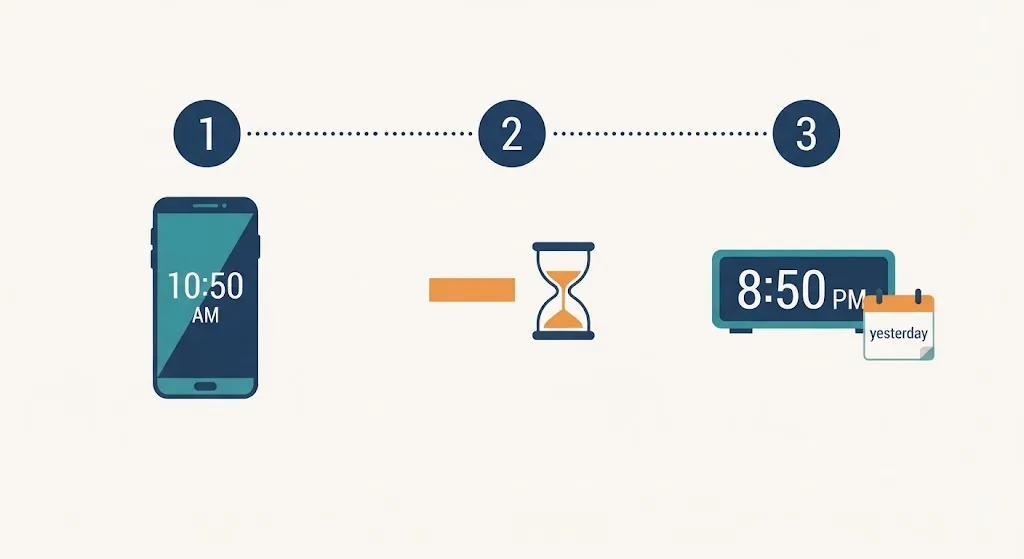
Step 1: Check the Current Time
Read the exact time from your phone or watch, AM or PM included. Example: current time = 10:50 AM.
Step 2: Subtract Fourteen Hours
Go back 12 hours first, which only flips AM to PM (or PM to AM) without touching the digits, then subtract 2 more hours to finish. From 10:50 AM: back 12 gives 10:50 PM the day before, back 2 more gives 8:50 PM the day before. That matches subtracting fourteen hours directly.
10:50 AM − 14 hours = 8:50 PM (the previous night)
Step 3: Check Whether the Date Changes
Whenever the current hour on the 24-hour clock is below 14, the result falls on yesterday. From 2:00 PM onward, it stays on today. Example: 3:00 AM − 14 hours = 1:00 PM the day before, since 3 is well below 14. But at, say, 9:00 PM, the current hour (21) is above 14, so fourteen hours ago stays on today: 9:00 PM − 14 hours = 7:00 AM the same day.
Skipping this step is the easiest way to get the day wrong. A travel log, a detox tracker or a shift report that lists only the hour, with no date, can leave a reader guessing which day it actually refers to.
Why People Search “What Was 14 Hours Ago From Now”
Apps almost always show a rounded gap instead of an exact clock time:
- “Landed 14 hours ago” in a flight-tracking app
- “Fast started 14h ago” in a fasting-tracker app
- “Departed 14 hours ago” on a train or bus status page
- “Shift ended 14h ago” on a payroll dashboard
- “Last backup 14 hours ago” on a cloud storage app
To turn a gap like this into a real clock time, subtract it from the current moment. If it is 5:00 AM and a tracker says a train “departed 14 hours ago,” it left the station close to 3:00 PM the previous afternoon, useful for reconstructing an overnight journey.
Everyday Situations Where Time Fourteen Hours Earlier Matters
A fourteen-hour gap comes up constantly in travel, shift work and health routines.
Transpacific Flights
Many transpacific routes sit close to fourteen hours in the air. A traveler landing at 7:25 PM local time can work out that boarding happened around 5:25 AM that same morning back at the departure airport, useful for lining up a connecting flight or a hotel booking.
Double Work Shifts Back to Back
Covering two consecutive shifts, roughly fourteen hours with a short handover, is common in retail, healthcare and hospitality during a staffing crunch. A worker clocking out at 10:00 PM started the first shift around 8:00 AM that morning.
Extended Fasts or Detox Windows
Some eating plans use a fourteen-hour fasting window. If someone breaks a fast at 10:00 AM, the fast began fourteen hours earlier, at 8:00 PM the night before. Counting backward this way helps people confirm they held the window.
Long Overnight Journeys by Train or Bus
A fourteen-hour overnight train or coach trip is common on longer domestic routes. Someone arriving at 8:15 AM can work out they boarded around 6:15 PM the evening before, handy for planning a return leg.
Video Chat and Message Timestamps
A messaging app might mark a note as “sent 14 hours ago.” Subtracting fourteen hours from the current time gives you a real reference point for a conversation that started across a large time difference.
Time Arithmetic Made Simple
Fourteen hours is well over half a day, more than a standard double work shift, which makes it a useful mental anchor even though it is not a clean fraction of 24.

| Unit | Equal to 14 hours |
|---|---|
| Hours | 14 |
| Minutes | 840 |
| Seconds | 50,400 |
| Milliseconds | 50,400,000 |
| Days | ≈ 0.583 (about 7/12) |
| Weeks | ≈ 0.0833 |
The minute figure is the one worth remembering: 14 × 60 = 840. So “14 hours ago” and “840 minutes ago” point to the exact same moment, useful whenever a timer, spreadsheet or app logs things in minutes rather than hours.
Read also: What Time Was It 15 Hours Ago? Live Answer, Full Chart & Steps
Examples Using Both 12-Hour and 24-Hour Clock
Some people think in AM and PM, others prefer the 24-hour clock used in logistics, aviation and shift scheduling. The chart below covers every starting hour in both formats.
12-Hour Clock
Rows marked “yesterday” cross midnight going back. The split happens right at 2:00 PM.
| Current time | 14 hours ago | 24-hour format |
|---|---|---|
| 12:00 AM (midnight) | 10:00 AM yesterday | 00:00 → 10:00 |
| 1:00 AM | 11:00 AM yesterday | 01:00 → 11:00 |
| 2:00 AM | 12:00 PM (noon) yesterday | 02:00 → 12:00 |
| 3:00 AM | 1:00 PM yesterday | 03:00 → 13:00 |
| 4:00 AM | 2:00 PM yesterday | 04:00 → 14:00 |
| 5:00 AM | 3:00 PM yesterday | 05:00 → 15:00 |
| 6:00 AM | 4:00 PM yesterday | 06:00 → 16:00 |
| 7:00 AM | 5:00 PM yesterday | 07:00 → 17:00 |
| 8:00 AM | 6:00 PM yesterday | 08:00 → 18:00 |
| 9:00 AM | 7:00 PM yesterday | 09:00 → 19:00 |
| 10:00 AM | 8:00 PM yesterday | 10:00 → 20:00 |
| 11:00 AM | 9:00 PM yesterday | 11:00 → 21:00 |
| 12:00 PM (noon) | 10:00 PM yesterday | 12:00 → 22:00 |
| 1:00 PM | 11:00 PM yesterday | 13:00 → 23:00 |
| 2:00 PM | 12:00 AM (midnight) | 14:00 → 00:00 |
| 3:00 PM | 1:00 AM | 15:00 → 01:00 |
| 4:00 PM | 2:00 AM | 16:00 → 02:00 |
| 5:00 PM | 3:00 AM | 17:00 → 03:00 |
| 6:00 PM | 4:00 AM | 18:00 → 04:00 |
| 7:00 PM | 5:00 AM | 19:00 → 05:00 |
| 8:00 PM | 6:00 AM | 20:00 → 06:00 |
| 9:00 PM | 7:00 AM | 21:00 → 07:00 |
| 10:00 PM | 8:00 AM | 22:00 → 08:00 |
| 11:00 PM | 9:00 AM | 23:00 → 09:00 |
Fourteen of the 24 starting hours roll back to yesterday, and ten stay on today. The yesterday block is now the clear majority, since fourteen is well past half of 24.
24-Hour Clock
The 24-hour clock removes the AM/PM flip entirely. Subtract 14 from the hour.
21:10 − 14 hours = 07:10
If the hour drops below zero, add 24 and step the date back one day.
10:50 − 14 = −3:10 → add 24 → 20:50 yesterday
This add-24 rule works no matter how large the hour count is, and it is exactly what computers do behind the scenes.
What Time Will It Be in 14 Hours?
The forward version of the same question adds instead of subtracts:
Time 14 hours from now = Current time + 14 hours
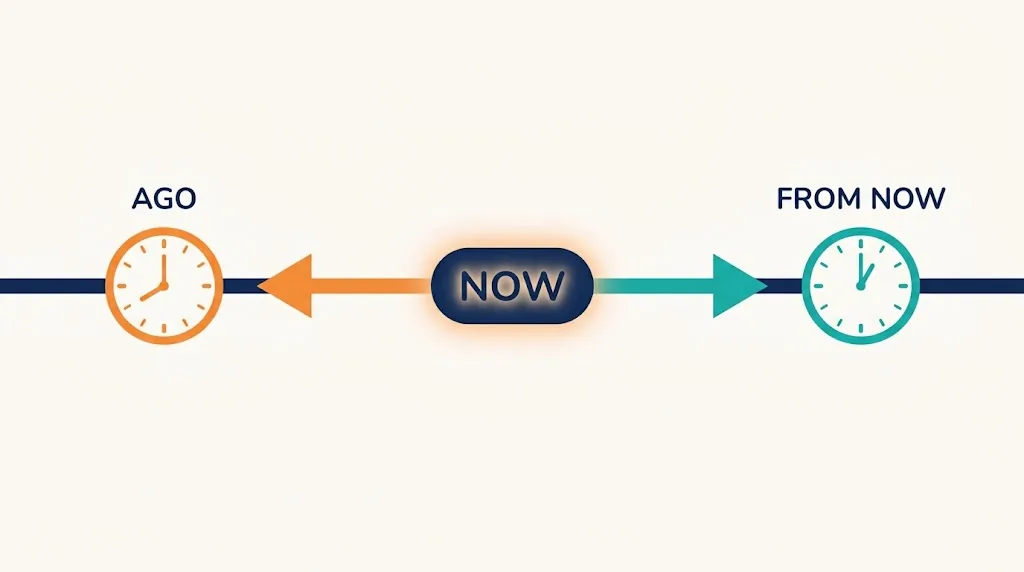
- 8:05 AM + 14 hours = 10:05 PM the same day
- 11:30 PM + 14 hours = 1:30 PM the next day
Fourteen hours ago and fourteen hours from now always sit exactly 28 hours apart. At 10:50 AM, one answer is 8:50 PM the night before and the other is 12:50 AM early the next morning. If your two results are not 28 hours apart, recheck the subtraction.
Read also: What Time Is 8 Hours From Now?
Time Zones Can Change Everything
A fourteen-hour gap is always fourteen hours no matter where you stand, but the clock reading at each end depends entirely on the local time zone.

Take one shared instant, 12:00 PM UTC, and step back fourteen hours in four cities (standard time):
| City | Offset | Now | 14 hours ago |
|---|---|---|---|
| New York | UTC−5 | 7:00 AM | 5:00 PM (previous day) |
| London | UTC+0 | 12:00 PM | 10:00 PM (previous day) |
| Dubai | UTC+4 | 4:00 PM | 2:00 AM (same day) |
| Tokyo | UTC+9 | 9:00 PM | 7:00 AM (same day) |
New York and London both slide back a calendar day for this particular instant, whereas Dubai and Tokyo stay put on today. Pin down the local clock, the date, the zone and whether the original entry was logged in UTC before you touch the subtraction.
Technology Depends on Accurate Time Calculation
A train’s departure board, a fasting app and a booking confirmation email do not hold a picture of a clock face anywhere inside them. What they actually store is a plain number: seconds elapsed since January 1, 1970, in UTC. Ask one of these systems for “fourteen hours ago” and it just deducts 50,400 from that number, then redraws the result as a date and time you can read.
Working from a plain number line sidesteps the messy parts entirely. Passing midnight, reaching the last day of a month, or hitting a leap year would trip up naive clock-face logic, but they cause no trouble at all once time is stored this way. Any tool built on your device’s own clock will land on your local time zone automatically, with nothing to configure.
Using a 14 Hours Ago Calculator
Set the box to a boarding time, the moment a fast began, or simply leave it running on the present, and it returns the subtraction right away.
Hours Ago Calculator
It pays off whenever a quick mental pass feels uncertain: an odd departure minute, a fast that did not begin on the hour, or wanting both the backward and forward answer without solving it twice.
Read also: What Time Was It 13 Hours Ago? Live Answer, Full Chart & Steps
Common Mistakes People Make
A fourteen-hour gap is large enough that a short list of errors keeps coming back.
Forgetting the Date
Anything earlier than 2:00 PM rolls back to yesterday. Note only “8:50 PM” with nothing about “the night before,” and a travel log or a fasting tracker can end up pointing at the wrong day.
Mixing Up AM and PM
Crossing noon or midnight on the way back swaps the label without warning. 1:20 AM − 14 hours = 11:20 AM the day before, not 11:20 PM. The 12-then-2 shortcut heads this off before it happens.
Changing the Minutes
Only whole hours move; the minutes ride along untouched. 5:12 PM − 14 hours = 3:12 AM. A different minute value in your result means a step got skipped somewhere.
Ignoring Time Zones
A note timestamped in UTC or a distant colleague’s zone will not match your own clock until it is converted first.
Assuming It Always Crosses Midnight
It does not. Whenever the current hour on the 24-hour clock reads 14 or higher, such as 9:00 PM, fourteen hours ago stays right on today’s date: 9:00 PM − 14 hours = 7:00 AM the same day.
Why Relative Time Feels Different From Exact Time
Glancing at “14 hours ago” gives you a rough sense of age in an instant, no arithmetic required. Reading 8:50 PM off a clock takes an extra beat, since your mind has to line it up against the present before it means anything.
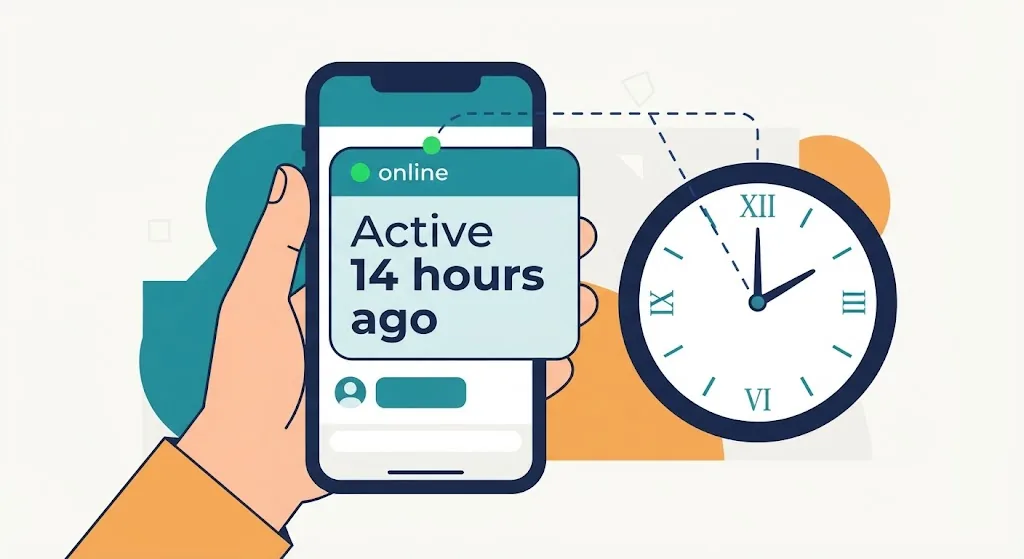
The trouble is that a relative tag never holds still. Something fourteen hours old this second becomes fourteen hours and one minute old the moment you glance away and back. That is why a record meant to last, such as a travel receipt or a shift report, should carry a fixed timestamp underneath the friendly label rather than relying on it alone.
Frequently Asked Questions
What time was it 14 hours ago?
Subtract fourteen hours from your current time and keep the minutes the same. At 10:50 AM, fourteen hours ago was 8:50 PM the night before. The live box at the top of this page shows the exact answer for your own clock.
How many minutes are in 14 hours?
There are 840 minutes in 14 hours, because 14 × 60 = 840.
How many seconds are in 14 hours?
Fourteen hours contain 50,400 seconds, which is 14 × 60 × 60.
Is 14 hours ago always on today’s date?
No. If the current time is before 2:00 PM, fourteen hours ago falls on the previous day. From 2:00 PM onward, it is still today.
What formula finds the time 14 hours ago?
Time 14 hours ago = current time − 14 hours. On a 24-hour clock, if the result is below zero, add 24 and step the date back one day.
How do I work out 14 hours ago in 24-hour time?
Subtract 14 from the hour. For example, 21:10 becomes 07:10, and 10:50 becomes 20:50 the previous day.
How is 14 hours ago different from 14 hours from now?
Fourteen hours ago is in the past, so you subtract. Fourteen hours from now is in the future, so you add. The two answers always sit 28 hours apart.
Does my location change the answer?
The fourteen-hour span itself is fixed anywhere on earth, but the clock reading tied to each end shifts with the local zone. Translate a UTC-stamped time into your own zone before taking anything away from it.
What is the quickest way to work out 14 hours ago in your head?
Flip AM to PM by stepping back 12 hours, then shave 2 more hours off that result. From 10:50 AM, that path runs through 10:50 PM and lands on 8:50 PM.
Why does the “14 hours ago” answer keep shifting?
Because the starting point is always the present second, and the present second never stops moving forward. A minute later, the answer itself has slid a minute later too.
What time was it 14 hours ago if it is midnight now?
At 12:00 AM, fourteen hours ago was 10:00 AM the previous day, or 10:00 in 24-hour time.
Does 14 hours ago always fall on yesterday?
No. It only falls on yesterday when the current time is earlier than 2:00 PM. From 2:00 PM through 11:59 PM, the answer stays on today’s date.
Conclusion
Pinning down what time it was 14 hours ago is a single subtraction: take fourteen hours off the current time, leave the minutes untouched, and check whether the calendar needs to step back a day. Start earlier than 2:00 PM and the answer lands on yesterday; start at 2:00 PM or later and it stays on today.
The quickest mental route is back 12, then back 2 more. When a record, an overnight trip, or an unusual start time is on the line, let the calculator above hand you both clock formats at once.
Read also: What Time Was It 10 Hours Ago? Live Answer, Full Chart & Steps

Liam Joseph Miller is an experienced writer with 6 years of expertise in creating clear, informative, and reader-friendly content. He specializes in words, phrases, slang, definitions, names, and everyday meanings, helping readers understand language in a simple and practical way.