
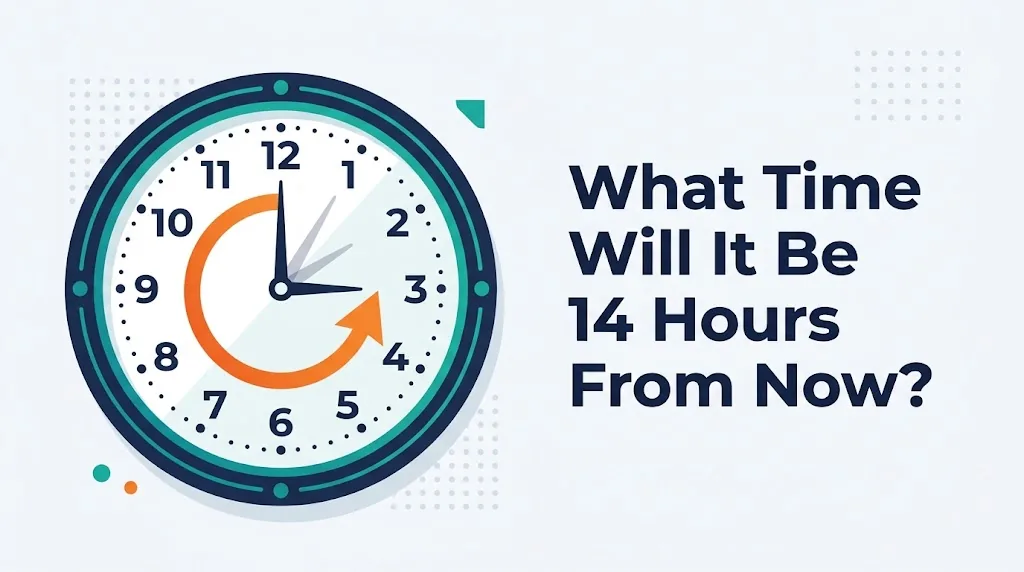
What time will it be 14 hours from now? Add fourteen hours to the time on your clock and leave the minutes untouched. At 5:50 AM, the answer is 7:50 PM the same day.
Clock in for something in the evening and fourteen hours later you’re looking at the following morning — that’s the shape of the freight window a shipment travels through, the length of a back-to-back double work shift, or how long a gaming or streaming marathon can stretch. Below is a live reading tied to your own device, a table covering every possible starting hour, and a conversion routine that keeps working no matter which side of midnight you start counting from.
Quick answer
It is now your current time.
In fourteen hours it will be now plus 14 hours (5:50 AM → 7:50 PM)
Mental trick: jump forward 12 hours (swap AM/PM), then step forward 2 more.
- 14 hours from now = the time now + 14 hours. The minutes stay the same.
- Fourteen hours equals 840 minutes, 50,400 seconds, or just over half a day (0.583).
- If it is later than 10:00 AM, the answer lands on tomorrow’s date.
- At exactly 10:00 AM, fourteen hours from now is midnight, the start of tomorrow.
Understanding How Time Addition Actually Works
Clocks skip the neat base-ten counting a odometer uses — minutes loop back at sixty, and the entire face resets every 24 hours. It’s that looping that trips people up once a sum stretches into the teens.
What matters most: piling on whole hours never disturbs the minute reading. Only the hour digit shifts, and every so often that shift carries the date forward with it.
Time 14 hours from now = Current time + 14 hours
Start from 8:25 AM. Eight plus fourteen equals twenty-two, so on the 24-hour dial that’s 10:00 PM, with the minutes holding steady at 25. Read the ordinary way, that’s 10:25 PM, still today.
Try 6:00 PM next. In 24-hour terms that’s 18, and 18 plus 14 gives 32 — well beyond the 24-hour ceiling, a clear signal the day has turned over. Converted back, the answer is 8:00 AM the next morning. Two reliable ways to catch that overnight flip before it fools you follow next.
Why People Search “What Time Will It Be 14 Hours From Now”
Calendars and shipping apps love to show a countdown or a plain duration, but they stop short of telling you the actual clock time it resolves to — that part is on you.
These are the moments that usually send someone looking for this answer:
- Working out the arrival window on a freight or cargo shipment
- Figuring out when a back-to-back double work shift wraps up
- Timing how late a gaming or streaming marathon will run
- Setting a reminder some fixed number of hours before a task
- Checking when a “shipping in 14 hours” alert actually resolves
- Planning around a promised reply “in 14 hours”
Picture 6:00 PM with a tracking app claiming “arriving in 14 hours” — that shipment shows up close to 8:00 AM. Push the start back to 1:15 AM instead, and the same fourteen-hour wait finishes near 3:15 PM. The wait itself never grows or shrinks; only its place on the clock does.
What Time Is 14 Hours From Now Using the 12-Hour Clock
On a 12-hour clock, fourteen hours is a little more than half a day, so the AM/PM label always flips, plus two extra hours on top.
The fastest trick is forward 12, then forward 2 more. Going forward 12 hours keeps the digits the same and only swaps AM/PM. Then step forward 2, because 14 − 12 = 2. From 5:50 AM: forward 12 is 5:50 PM, forward 2 more is 7:50 PM. Done.
Here is a table of common start times and where fourteen hours forward lands.
| Current time | Add 14 hours | Result |
|---|---|---|
| 1:15 AM | +14 hours | 3:15 PM |
| 5:50 AM | +14 hours | 7:50 PM |
| 8:25 AM | +14 hours | 10:25 PM |
| 12:10 PM | +14 hours | 2:10 AM next day |
| 3:35 PM | +14 hours | 5:35 AM next day |
| 6:00 PM | +14 hours | 8:00 AM next day |
Scan down the minutes column and it never budges — proof that only whole hours are going into the sum.
What Time Is 14 Hours From Now in the 24-Hour Clock
The 24-hour clock keeps this to a simple sum. Just add 14 to the hour:
Future hour = Current hour + 14
For example:
- 01:15 + 14 = 15:15
- 05:50 + 14 = 19:50
- 12:10 + 14 = 26:10 next day
- 15:35 + 14 = 29:35 next day
Whenever that sum reaches 24 or more, peel off 24 and push the date one square forward. Take the last line: 15:35 + 14 hours = 29:35. Since 29 sits above 24, subtract 24: 29:35 minus 24:00 leaves 5:35. So the clock reads 5:35 AM the next day.
Full Chart: Add 14 Hours to Every Start Hour
Other guides tend to stop after a couple of sample times. This table runs through all 24 possible starting hours, so none of them are left for you to guess.
| Current time | 14 hours from now | 24-hour format |
|---|---|---|
| 12:00 AM (midnight) | 2:00 PM | 00:00 → 14:00 |
| 1:00 AM | 3:00 PM | 01:00 → 15:00 |
| 2:00 AM | 4:00 PM | 02:00 → 16:00 |
| 3:00 AM | 5:00 PM | 03:00 → 17:00 |
| 4:00 AM | 6:00 PM | 04:00 → 18:00 |
| 5:00 AM | 7:00 PM | 05:00 → 19:00 |
| 6:00 AM | 8:00 PM | 06:00 → 20:00 |
| 7:00 AM | 9:00 PM | 07:00 → 21:00 |
| 8:00 AM | 10:00 PM | 08:00 → 22:00 |
| 9:00 AM | 11:00 PM | 09:00 → 23:00 |
| 10:00 AM | 12:00 AM (midnight) next day | 10:00 → 00:00 |
| 11:00 AM | 1:00 AM next day | 11:00 → 01:00 |
| 12:00 PM (noon) | 2:00 AM next day | 12:00 → 02:00 |
| 1:00 PM | 3:00 AM next day | 13:00 → 03:00 |
| 2:00 PM | 4:00 AM next day | 14:00 → 04:00 |
| 3:00 PM | 5:00 AM next day | 15:00 → 05:00 |
| 4:00 PM | 6:00 AM next day | 16:00 → 06:00 |
| 5:00 PM | 7:00 AM next day | 17:00 → 07:00 |
| 6:00 PM | 8:00 AM next day | 18:00 → 08:00 |
| 7:00 PM | 9:00 AM next day | 19:00 → 09:00 |
| 8:00 PM | 10:00 AM next day | 20:00 → 10:00 |
| 9:00 PM | 11:00 AM next day | 21:00 → 11:00 |
| 10:00 PM | 12:00 PM (noon) next day | 22:00 → 12:00 |
| 11:00 PM | 1:00 PM next day | 23:00 → 13:00 |
Fourteen of the twenty-four rows land on the next day, well over half of them, each one starting at 10:00 AM or later.
Breaking Fourteen Hours Into Smaller Units
Fourteen hours lands at just over half a day — 0.583 of 24 hours, the same as seven-twelfths of a full day.
| Unit | Equal to 14 hours |
|---|---|
| Hours | 14 |
| Minutes | 840 |
| Seconds | 50,400 |
| Milliseconds | 50,400,000 |
| Days | 0.583 |
| Weeks | ≈ 0.0833 |
One number worth memorizing: 14 × 60 = 840, meaning “840 minutes from now” and “14 hours from now” describe the exact same moment. Hold onto 50,400 as well, since plenty of timers and spreadsheets count in raw seconds instead.
Why Time Zones Matter More Than You Think
Wherever you’re standing on the planet, a fourteen-hour stretch is still fourteen hours long — what shifts is only the label the local clock assigns to its start and finish. You and a colleague overseas, both counting fourteen hours forward, arrive at the identical instant, just wearing different numbers.
Take one instant, 9:00 AM UTC, and add fourteen hours in four places:
| City | Offset | Now | 14 hours from now |
|---|---|---|---|
| Mexico City | UTC-6 | 3:00 AM | 5:00 PM |
| Berlin | UTC+1 | 10:00 AM | 12:00 AM (midnight) next day |
| Doha | UTC+3 | 12:00 PM (noon) | 2:00 AM next day |
| Wellington | UTC+13 | 10:00 PM | 12:00 PM (noon) next day |
Berlin, Doha and Wellington all tip over into the next date, while Mexico City stays within the same afternoon. Whenever a plan crosses more than one city, nail down whose clock a given time is quoted in before you treat it as final.
Using an Hours From Now Calculator
Rather than working it by hand, let this tool do it — it starts from your device’s own clock and time zone, so what it shows lines up with your wall clock, and you’re free to swap in a different date, time or hour count whenever you need to.
Hours From Now Calculator
Lean on it when any of these apply:
- The calendar date matters, not just the clock time
- Your starting point isn’t “right now” — say, a dispatch time on a waybill
- Precision down to the second is what you’re after
- You’re repeating the same sum across a handful of different start times
- Seeing the “ago” figure right beside the “from now” figure is useful
Read also: What Time Was It 11 Hours Ago? Live Calculator, Chart & Easy Steps
Manual Time Arithmetic Isn’t Difficult
Opening an app for this is usually slower than just doing the arithmetic — three short steps get you there.
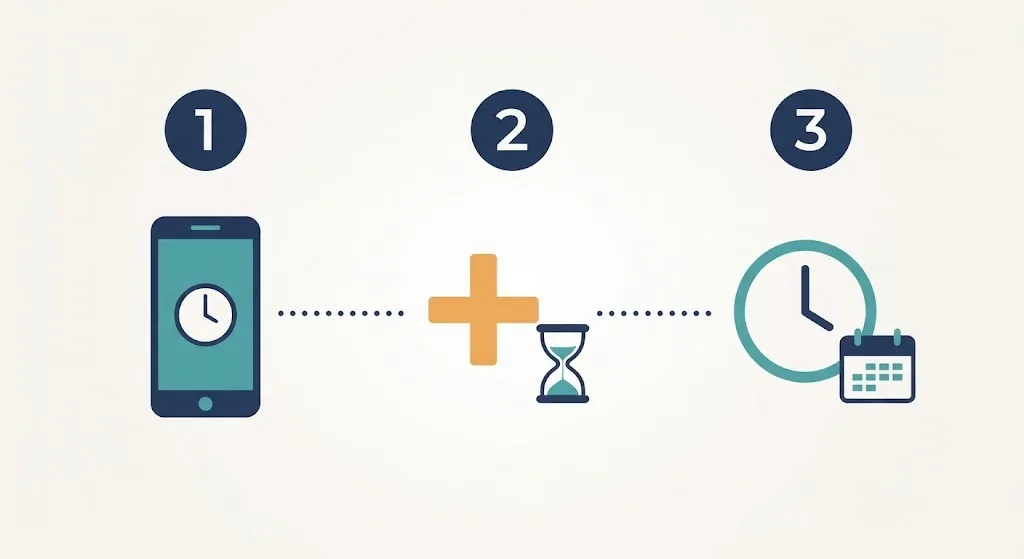
Step 1: Note the Current Time
Read the exact time and switch it to 24-hour form if that helps. Morning hours stay the same; for afternoon and evening hours, add 12. Say it is 5:50 AM on a Saturday. In 24-hour time that is 05:50.
Step 2: Add Fourteen Hours
Add 14 to the hour only: 5 + 14 = 19. Keep the 50 minutes aside. A result under 24 is your answer right away. A result of 24 or more means you crossed midnight, so move to step 3.
Step 3: Convert the Result
19:50 in the 24-hour clock equals 7:50 PM. Put the minutes back and you have the full answer: 5:50 AM + 14 hours = 7:50 PM. If the hour had reached 24 or higher, you would subtract 24 and move the date forward one day.
Everyday Situations Where Fourteen Hours Matters
Because it stretches from one evening well into the next morning, fourteen hours keeps popping up around long shipments, back-to-back shifts and marathon sessions.

A Freight or Cargo Shipping Window
Many freight carriers quote a rough fourteen-hour transit window for regional routes. Cargo dispatched at 6:00 PM often clears the next stop around 8:00 AM.
A Back-to-Back Double Shift
Covering two shifts in a row can add up to close to fourteen hours on the clock. Starting at 5:50 AM means finishing around 7:50 PM, once both shifts are done.
A Long Gaming or Streaming Marathon
Charity streams and gaming marathons sometimes run close to fourteen hours straight. Starting at 8:25 AM would wrap up around 10:25 PM, well into the evening.
Understanding Future Time Calculations
Strip away the details and any future-time question comes down to this: once a fixed wait has run its course, what does the clock read? As a general shape:
Result Clock Time = Starting Clock Time + Length Of Wait
Applied here specifically:
Result Clock Time = Starting Clock Time + 14 Hours
That’s not the same question as asking when an event finishes or what next week looks like on the calendar — this one needs both the starting moment and the wait’s length fixed at once.
Related Time Searches
Get comfortable adding fourteen hours and the same trick applies to nearly any other length of time. From here, people often move on to check:
- What one hour from now looks like on the clock
- The clean halfway-day mark, twelve hours out
- How thirteen hours forward reads on tomorrow’s clock
- How eighteen hours forward reads on tomorrow’s clock
- A full day ahead, landing back on the same clock face
- What the clock showed a full fourteen hours ago
- How much time is left before a fixed target time hits
Nothing about the process itself changes from one of these to the next — only the hour count you feed into it.
Read also: What Time Was It 12 Hours Ago? Live Calculator, Chart & Easy Steps
The Mirror Question: What Time Was It 14 Hours Ago?

Plenty of readers land here asking it backward instead. Looking into the past rather than the future just swaps the addition for a subtraction of the same fourteen hours.
Time 14 hours ago = Current time − 14 hours
- 12:10 PM − 14 hours = 10:10 PM (the previous day)
- 3:35 PM − 14 hours = 1:35 AM (the same day)
These two answers are locked 28 hours apart no matter the starting point — a full day plus four extra hours. Anchored at 3:35 PM, that’s 1:35 AM the same day versus 5:35 AM the next. Anything other than a 28-hour gap between them means one side needs rechecking.
Why Computers Love Milliseconds
Software generally doesn’t bother with clock faces at all under the hood. Servers, apps and databases mostly track a moment as one enormous millisecond count instead, which conveniently never runs into a messy midnight rollover.
Broken down into that raw form, our fourteen-hour stretch reads like this:
Fourteen hours: 50,400 whole seconds, or 50,400,000 milliseconds.
You never actually see that number. The program keeps it tucked away and only surfaces something human-readable, like 7:50 PM, at the very last step.
Common Mistakes When You Add Hours
The math itself is rarely the problem — going too fast usually is. These five errors show up over and over.
Forgetting Midnight
Start at 6:00 PM and add fourteen hours, and the answer isn’t 8:00 PM later that same day — it’s 8:00 AM the following morning.
Mixing AM and PM
Confirm up front whether your starting point sits in the morning half of the day or the evening half. Get that backwards and the final answer is off by a clean 12 hours.
Ignoring the Date
Any sum that tips past midnight carries the calendar date forward with it. Jot down that next-day marker so nobody mistakes the result for today.
Forgetting Time Zones
A time read off your own wall clock carries no meaning for someone in another country. Pin down the relevant zone before locking in a shipment, shift, or stream schedule.
Adding to the Minutes by Mistake
Add exactly fourteen hours and 5:50 AM becomes 7:50 PM — not 8:04 PM. The minutes stay parked at 50 throughout.
Tips for Accurate Time Calculations
These habits keep any future-time sum from going sideways:
- Pin down the exact starting minute, not just the hour.
- Do the hour math before you even glance at AM or PM.
- Switch to 24-hour notation the moment a sum starts feeling messy.
- Stay alert for the point where the total tips past midnight.
- Push the date forward the instant a new day starts.
- Weigh in time zones whenever another country is part of the plan.
- Bring in a calculator once exact seconds or a precise timestamp matter.
Helpful Online Tools
A calculator earns its place once a date change, exact seconds, or a time-zone conversion gets involved. They tend to shine for things like:
- Freight and shipment tracking
- Shift scheduling
- Stream and event planning
- Reminder planning
- Delivery and arrival windows
- Cross-time-zone coordination
For a one-off sum, though, doing it in your head is usually quicker than opening any app.
Frequently Asked Questions
What time will it be 14 hours from now?
Add fourteen hours onto your current local time. Once that crosses midnight, the answer moves onto tomorrow’s date rather than today’s. The live box near the top already runs this conversion for your own clock.
How many minutes does 14 hours contain?
Multiply 14 by 60 and you get 840 minutes.
What is 14 hours in seconds?
Work out 14 × 60 × 60 and the result is 50,400 seconds.
Is 14 hours from now always the same day?
Not every time. Fourteen hours reaches a bit past the halfway mark of a day, so starting at 10:00 AM or later rolls you into tomorrow.
What is 14 hours from 7 AM?
Fourteen hours out from 7:00 AM lands at 9:00 PM, still the same day.
What is 14 hours from 11 AM?
Fourteen hours out from 11:00 AM lands at 1:00 AM the following day.
Does the time zone change the answer?
The fourteen-hour length is fixed no matter where you are, but the specific clock reading it produces depends on which time zone you’re reading it from.
Can I work out 14 hours from now without a calculator?
Yes — add fourteen to the hour, leave the minutes as they are, and adjust the AM/PM tag plus the date if the total runs past midnight.
How far apart are 14 hours ago and 14 hours from now?
Those two figures always sit 28 hours apart, a full day plus four more hours. Starting from 3:35 PM, that’s 1:35 AM earlier today versus 5:35 AM tomorrow.
Do the minutes change when I add 14 hours?
No — whole-hour math leaves minutes and seconds exactly as found, so 5:50 AM becomes 7:50 PM, never 8:04 PM.
What time will it be in 14 hours if it is midnight now?
From 12:00 AM, fourteen hours forward puts you at 2:00 PM the same day.
Why do freight shipments often quote a 14-hour transit window?
Regional trucking and rail routes cover distances that typically take close to that long to travel, once loading and handling time is factored in, so carriers lean on it as a standard planning figure.
Conclusion
Working out what time it will be 14 hours from now comes down to one habit: add fourteen hours to whatever the clock currently shows, then push the date forward a day the moment that sum tips past midnight. Minutes and seconds simply ride along untouched throughout.
Shipment, double shift, marathon session or plain countdown — this evening-to-morning math keeps every one of those plans lined up. When it gets complicated, the live calculator above will confirm your answer in seconds.

Liam Joseph Miller is an experienced writer with 6 years of expertise in creating clear, informative, and reader-friendly content. He specializes in words, phrases, slang, definitions, names, and everyday meanings, helping readers understand language in a simple and practical way.