
What time was it 16 hours ago? Take sixteen hours off the time on your clock and keep the minutes untouched. At 6:10 AM, that lands on 2:10 PM the day before.
Sixteen hours covers two thirds of a full day. So the answer crosses into yesterday far more often than it stays on today’s date. Only times from 4:00 PM onward keep their date. Every earlier hour rolls back. This page gives you the live answer for your own clock. You also get a complete 24-hour chart and a shortcut that skips the guesswork.
Quick answer
It is now your current time.
Sixteen hours ago it was now minus 16 hours (6:10 AM → 2:10 PM the day before)
Mental trick: add 8 hours to the clock, then move the date back one day.
- 16 hours ago = the time now − 16 hours. The minutes never change.
- Sixteen hours equals 960 minutes, or 57,600 seconds — two thirds of a day.
- Any time before 4:00 PM sends the answer back to yesterday.
- At exactly 4:00 PM, sixteen hours ago was midnight, the very start of today.
Why Do People Search for “What Time Was It 16 Hours Ago”?
Screens rarely show a clock time next to old activity. They show a gap instead. A photo says “16h.” A delivery app says “16 hours ago.” A login history says “last seen 16h ago.” That gap tells you how long, but not the actual moment.
Readers turn that gap into a real time for plenty of everyday reasons:
- Working out when a parcel was first scanned at the depot
- Checking when a friend overseas actually sent a text
- Figuring out the last time they ate before a fasting blood test
- Tracking how long a laptop battery has been charging
- Matching a card alert against something bought the day before
- Seeing whether a comment was posted before or after a cut-off
Say it is 9:40 PM and a caption reads “16h.” That post went live at roughly 5:40 AM. If it is 7:25 AM instead, the same label points to about 3:25 PM the previous afternoon. Same label, two very different dates.
How to Calculate 16 Hours Ago
The quickest route is plain subtraction. Suppose the current time is 10:35 PM. Subtract 16 hours:
10:35 PM − 16 hours = 6:35 AM
So sixteen hours ago was 6:35 AM, the same calendar day. Try another: 1:25 PM − 16 hours = 9:25 PM the day before. Minutes and seconds ride along unchanged whenever you subtract a whole number of hours. For example: 4:52 AM − 16 hours = 12:52 PM the day before. Only the hour label and, often, the date move.
Understanding Clock Arithmetic
Clocks do not count in tens the way money does. Minutes and seconds run in cycles of sixty, and the whole day resets every 24 hours. That looping is why clock subtraction can feel odd until you have a system.
A handy trick for sixteen hours is to split it into pieces you already know:
16 hours = 12 hours + 4 hours
Move back 12 hours first, which only swaps AM and PM. Then move back another 4 hours. For example: 9:40 PM − 12 hours = 9:40 AM. Then: 9:40 AM − 4 hours = 5:40 AM. So 9:40 PM − 16 hours = 5:40 AM, the same day.
There is a second shortcut too. A day has 24 hours. So subtracting 16 is the same as adding 8 and stepping the date back one day. Try it on the same example: 9:40 PM + 8 hours = 5:40 AM. Move the date back one day, and you get the identical answer.
Crossing the Midnight Boundary
Midnight is where most mistakes creep in. Take a current time of 1:25 PM. Subtracting 16 hours gives:
1:25 PM − 16 hours = 9:25 PM
But that 9:25 PM belongs to the day before. The clock face looks fine. The date is what shifted.
The rule is simple. If subtracting 16 hours takes you past 12:00 AM, move the date back by one day.
| Current time | 16 hours earlier |
|---|---|
| 7:00 AM | 3:00 PM previous day |
| 9:00 AM | 5:00 PM previous day |
| 11:00 AM | 7:00 PM previous day |
| 1:00 PM | 9:00 PM previous day |
| 3:00 PM | 11:00 PM previous day |
| 5:00 PM | 1:00 AM same day |
| 9:00 PM | 5:00 AM same day |
Getting the date right matters most for three tasks: logging an event, filing a timesheet, and checking a digital record against a calendar.
16 Hours Ago on the 12-Hour Clock vs the 24-Hour Clock
The 12-hour clock uses AM and PM. The 24-hour clock counts straight through from 00:00 to 23:59. For subtracting sixteen hours, the 24-hour version often removes the guesswork.
23:00 − 16 hours = 07:00
Converted back, 07:00 reads as 7:00 AM. Here is a short side-by-side reference:
| 12-Hour Clock | 24-Hour Clock |
|---|---|
| 12:00 AM | 00:00 |
| 4:00 AM | 04:00 |
| 9:00 AM | 09:00 |
| 12:00 PM | 12:00 |
| 4:00 PM | 16:00 |
| 9:00 PM | 21:00 |
| 11:00 PM | 23:00 |
Here is the complete picture for every starting hour of the day. It is worth keeping open in a second tab.
The Full 24-Hour Chart for 16 Hours Ago
| Current time | 16 hours ago | 24-hour format |
|---|---|---|
| 12:00 AM (midnight) | 8:00 AM yesterday | 00:00 → 08:00 |
| 1:00 AM | 9:00 AM yesterday | 01:00 → 09:00 |
| 2:00 AM | 10:00 AM yesterday | 02:00 → 10:00 |
| 3:00 AM | 11:00 AM yesterday | 03:00 → 11:00 |
| 4:00 AM | 12:00 PM yesterday | 04:00 → 12:00 |
| 5:00 AM | 1:00 PM yesterday | 05:00 → 13:00 |
| 6:00 AM | 2:00 PM yesterday | 06:00 → 14:00 |
| 7:00 AM | 3:00 PM yesterday | 07:00 → 15:00 |
| 8:00 AM | 4:00 PM yesterday | 08:00 → 16:00 |
| 9:00 AM | 5:00 PM yesterday | 09:00 → 17:00 |
| 10:00 AM | 6:00 PM yesterday | 10:00 → 18:00 |
| 11:00 AM | 7:00 PM yesterday | 11:00 → 19:00 |
| 12:00 PM (noon) | 8:00 PM yesterday | 12:00 → 20:00 |
| 1:00 PM | 9:00 PM yesterday | 13:00 → 21:00 |
| 2:00 PM | 10:00 PM yesterday | 14:00 → 22:00 |
| 3:00 PM | 11:00 PM yesterday | 15:00 → 23:00 |
| 4:00 PM | 12:00 AM (midnight) | 16:00 → 00:00 |
| 5:00 PM | 1:00 AM | 17:00 → 01:00 |
| 6:00 PM | 2:00 AM | 18:00 → 02:00 |
| 7:00 PM | 3:00 AM | 19:00 → 03:00 |
| 8:00 PM | 4:00 AM | 20:00 → 04:00 |
| 9:00 PM | 5:00 AM | 21:00 → 05:00 |
| 10:00 PM | 6:00 AM | 22:00 → 06:00 |
| 11:00 PM | 7:00 AM | 23:00 → 07:00 |
Count the “yesterday” rows: there are sixteen of them, from midnight through 3:00 PM. Only the last eight hours of the day, from 4:00 PM to 11:00 PM, keep today’s date. That is the widest previous-day window of any short gap on this site.
What Happens Inside a Time Difference Calculator?
A time calculator turns your clock time into a plain number. It subtracts, then turns the result back into something readable. In its simplest form:
Current time − 16 hours = Past time
More capable calculators also track the date change, the minutes and seconds, and even time zones. Many work in a single unit behind the scenes, not separate hours and minutes. Sixteen hours becomes:
16 × 60 = 960 minutes, and 960 × 60 = 57,600 seconds
Working in one steady unit removes the chance of mixing up AM and PM partway through a sum.
Try the Calculator Yourself
The box below reads your device’s clock and time zone automatically, so the live answer matches the clock on your wall. Change the date, time or hour count to check any other moment.
Hours Ago Calculator
Reach for the calculator instead of mental math when:
- You need the exact date, not just the clock time
- The starting point is not “now,” such as a time printed on a receipt
- Seconds matter, not just hours and minutes
- You are checking several different times in a row
- You want the “from now” answer alongside the “ago” answer
Read also: What Time Was It 6 Hours Ago? Live Calculator, Chart & Easy Steps
Local Time and Time Zones Matter More Than You Think
“16 hours ago” is almost always tied to the local clock where you are standing. Two people in different countries can point at the same instant. They can still read different numbers off their own clocks.
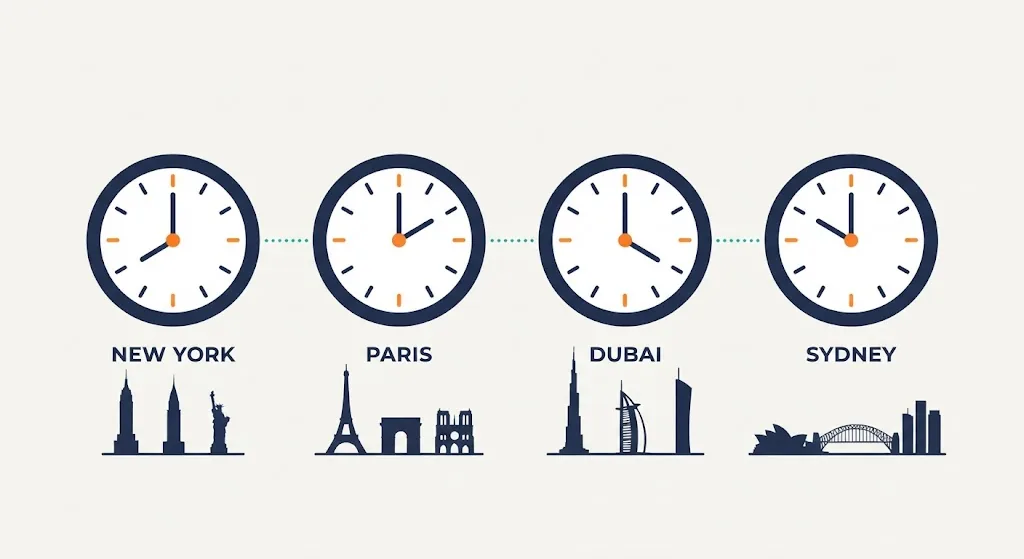
Picture one shared moment, 18:00 UTC, seen from four cities:
| City | Offset | Now | 16 hours ago |
|---|---|---|---|
| New York | UTC−4 | 2:00 PM | 10:00 PM (previous day) |
| Paris | UTC+2 | 8:00 PM | 4:00 AM (same day) |
| Dubai | UTC+4 | 10:00 PM | 6:00 AM (same day) |
| Sydney | UTC+10 | 4:00 AM (next day) | 12:00 PM (previous day) |
Notice that New York and Sydney both land on the previous day while Paris and Dubai land on the same day, even though every city is looking back across the identical sixteen-hour gap. Always check which clock a timestamp belongs to before you subtract.
Situations where the time zone truly matters include:
- Cross-border video calls and meetings
- Flight departure and arrival records
- Remote teams spread across continents
- Server and application logs stamped in UTC
- Messages from friends or family abroad
Real-Life Examples of Calculating 16 Hours Ago
These five worked examples cover different parts of the day, including two that cross midnight and two that do not.
Example 1: Current Time Is 6:10 AM
Subtract 16 hours: 6:10 AM − 16 hours = 2:10 PM. So sixteen hours ago was 2:10 PM on the previous day.
Example 2: Current Time Is 9:40 PM
Subtract 16 hours: 9:40 PM − 16 hours = 5:40 AM. The result stays on the same day.
Example 3: Current Time Is 1:25 PM
Back 12 hours first: 1:25 PM − 12 hours = 1:25 AM. Then back another 4: 1:25 AM − 4 hours = 9:25 PM the day before. So sixteen hours ago was 9:25 PM on the previous day.
Example 4: Current Time Is 11:58 PM
Subtract 16 hours: 11:58 PM − 16 hours = 7:58 AM. Because the current time is already past 4:00 PM, the answer keeps the same day.
Example 5: Current Time Is 3:17 AM
Back 12 hours: 3:17 AM − 12 hours = 3:17 PM the day before. Then back another 4: 3:17 PM − 4 hours = 11:17 AM the day before. So sixteen hours ago was 11:17 AM on the previous day.
Four of these five examples land on the day before. That matches the full chart above: any start time earlier than 4:00 PM sends the result back a date.
Why Human Memory Doesn’t Work Like a Clock
People rarely store events with a precise timestamp attached. Someone might say a call happened “about 16 hours ago.” The real gap could easily be 14 or 18 hours once you check.
Memory bends around sleep, mood, routine and how busy a day felt. A packed afternoon seems to stretch on forever, while a quiet evening can vanish in a blink. That is why a written or logged timestamp beats a guess whenever accuracy actually matters.
If precision counts, find the original timestamp first. Then calculate backward from that fixed point, not from memory alone.
Timeline Reconstruction in Everyday Life
Calculating 16 hours ago is often just one step in rebuilding a bigger timeline. A simple flow looks like this:
Current time → subtract 16 hours → note the past time → check the date
You can then line that result up against other records. Suppose an app shows activity starting at 6:00 AM. Your calculation says sixteen hours ago was roughly 6:00 AM too. The two events likely sit inside the same short window.
This kind of reconstruction helps with:
- Retracing a work shift or commute
- Confirming when a delivery driver picked up a package
- Piecing together app or browser activity
- Double-checking a meeting invite against what actually happened
The Psychology Behind Time Perception
Sixteen hours can feel completely different depending on how it was spent. Someone who slept eight of those hours and relaxed for the rest experiences the stretch as short. Someone who worked a double shift experiences the identical sixteen hours as exhausting and long.

A clock measures elapsed time with perfect consistency. Your sense of that same stretch depends on attention, activity and emotion. That is exactly why “16 hours ago” stays a fixed fact, even when it does not feel that way.
Technology Makes Time Calculations Effortless
Phones, laptops, smartwatches and calendar apps all record timestamps automatically. Most can work out elapsed time in an instant. You rarely need to count on your fingers anymore.
A calculator earns its keep when you want to skip the mental steps entirely. Enter the starting time, choose subtraction, type 16, and the tool hands back a finished answer, date included. For a quick check, mental math is still fine. For anything involving seconds, multiple dates or time zones, a digital tool removes the risk of a slip.
Common Situations Where You Need to Calculate 16 Hours Ago
Work Schedules
Staff on long or rotating shifts often need to trace when an earlier shift began, especially when a handover note only mentions “16 hours ago.”

Sleep Tracking
Sleep apps sometimes report a gap since your last recorded rest. Turning “16 hours ago” into a real clock time helps you see whether your sleep window is drifting.
Social Messaging
Chat apps often label old messages with a rounded gap. Turning that gap into a clock time helps you find the right part of a long conversation fast.
Meeting Time Verification
A colleague might claim something happened “16 hours ago.” Working out the exact clock time lets you check it against a calendar entry or a call log.
Security and Digital Records
Access logs and security systems store exact timestamps. Subtracting 16 hours can help an investigator or admin locate an earlier entry point in a record.
Manual Calculation vs Digital Tools
| Method | Best for | Main advantage |
|---|---|---|
| Mental math | Simple, round times | Instant, no tools needed |
| Paper clock sketch | Visual thinkers | Easy to see the midnight crossing |
| 24-hour format | Detailed sums | Removes AM/PM confusion |
| Digital calculator | Exact results | Handles the date automatically |
| Original timestamp | Verification | Removes guesswork entirely |
For a one-off, round-number question, mental math is usually enough. Once dates, seconds or time zones enter the picture, a digital method is the safer bet.
Practical Tips for Accurate Time Calculations
Follow these steps whenever you calculate 16 hours ago:
- Write down the exact current time, minutes included.
- Keep the minutes fixed while you subtract the whole hours.
- Subtract 12 hours first, then subtract the remaining 4.
- Check whether the result crossed midnight.
- Move the date back one day if it did.
- Confirm the AM or PM label on the final answer.
- Convert time zones before subtracting, not after.
Worked example using these steps, starting at 2:14 AM:
2:14 AM − 12 hours = 2:14 PM the day before. Then: 2:14 PM − 4 hours = 10:14 AM the day before. Therefore, sixteen hours ago was 10:14 AM on the previous day.
Why Understanding Time Matters
Time math looks basic on paper. Yet it shows up constantly, in scheduling, messaging, travel, sleep and digital records. Knowing how to step back 16 hours saves you from misreading a timestamp or logging the wrong date.
The key idea to hold onto is that 16 hours is a moving duration, not a fixed clock time. The answer always depends on the exact moment you start counting from. Once midnight crossings and AM/PM swaps feel natural, this calculation takes only a few seconds.
What Time Will It Be in 16 Hours From Now?
The mirror question comes up just as often. To look ahead instead of back, add sixteen hours rather than subtracting them.
Time 16 hours from now = Current time + 16 hours
- 7:30 AM + 16 hours = 11:30 PM the same day
- 4:50 PM + 16 hours = 8:50 AM the next day
Sixteen hours ago and sixteen hours from now always sit 32 hours apart. At 9:40 PM, one answer is 5:40 AM today and the other is 1:40 PM tomorrow. If your two results are not 32 hours apart, double-check the sum.
Read also: What Time Was It 5 Hours Ago? Live Answer, Full Chart & Examples
Converting 16 Hours to Other Units
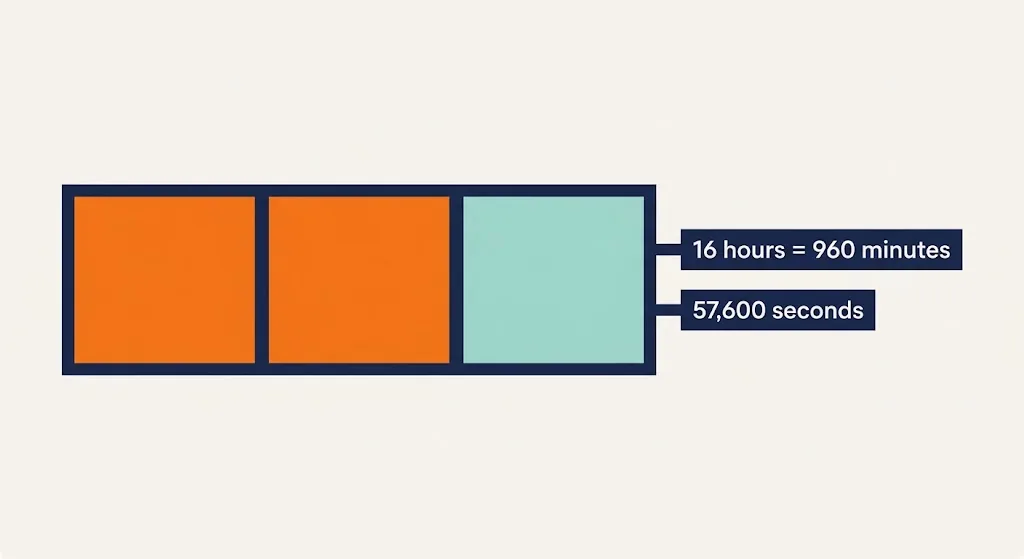
Sixteen hours is exactly two thirds of a day. Cutting a 24-hour day into three equal 8-hour blocks, sixteen hours fills two of those three blocks.
| Unit | Equal to 16 hours |
|---|---|
| Hours | 16 |
| Minutes | 960 |
| Seconds | 57,600 |
| Milliseconds | 57,600,000 |
| Days | 0.667 (2/3) |
| Weeks | ≈ 0.0952 |
The minutes figure is the one people ask for most: 16 × 60 = 960. So “960 minutes ago” means exactly the same moment as “16 hours ago.” Keep 57,600 handy too. Spreadsheets and code usually count in seconds.
How Computers Handle This Calculation
Software rarely deals with a clock face at all. It stores time as one continuous count, typically seconds since January 1, 1970, UTC. Going back 16 hours means subtracting 57,600 from that count. The result is then formatted as a local date and time.
You can run the same logic yourself:
- Excel or Google Sheets:
=NOW()-16/24(one day equals 1, so 16 hours is 16/24) - JavaScript:
new Date(Date.now() - 16*3600*1000) - Python:
datetime.now() - timedelta(hours=16)
Because the underlying count never resets, midnight, month changes and leap years cause no trouble at all for a program. Only the time zone used for display needs to be right.
Frequently Asked Questions
What is meant by “16 hours ago”?
It means exactly 16 elapsed hours before the current moment. The clock time depends entirely on when the calculation is made.
How many minutes make up 16 hours?
Sixteen hours equal 960 minutes, since 16 × 60 = 960.
How many seconds are in 16 hours?
Sixteen hours equal 57,600 seconds, since 16 × 60 × 60 = 57,600.
Could 16 hours ago fall on yesterday’s date?
Yes. Whenever the current time is earlier than 4:00 PM, subtracting 16 hours moves the result back to the previous calendar day.
What’s a fast way to work out 16 hours ago without a calculator?
Split it into 12 hours plus 4 hours, or add 8 hours to the current time and shift the date back one day.
Does the answer change depending on the current time?
Yes. “16 hours ago” is relative to the exact moment you start from. The clock time and date shift continuously throughout the day.
Will a different time zone change the result?
Yes. The same instant shows a different local clock time, and sometimes a different date, in every time zone. Always convert to the relevant zone first.
Does 16 hours ago always land on the previous day?
No. From 4:00 PM through 11:59 PM, sixteen hours ago stays on the same calendar day. Only the earlier two thirds of the day rolls back.
Is 16 hours the same length as 960 minutes?
Yes. One hour holds 60 minutes, so 16 × 60 equals 960 minutes exactly.
What time was it 16 hours ago if it’s 9:40 PM right now?
It was 5:40 AM on the same day. In 24-hour time, 21:40 minus 16 hours is 05:40.
How far apart are “16 hours ago” and “16 hours from now”?
They are always 32 hours apart. At 9:40 PM, one is 5:40 AM today and the other is 1:40 PM tomorrow.
Conclusion
Working out what time it was 16 hours ago comes down to subtracting sixteen hours, or adding eight and moving the date back one day. The part to watch closely is the date, since any start time before 4:00 PM rolls back to yesterday.
For a fast mental answer, split the sixteen into 12 plus 4, or use the add-8 shortcut. For logs, time zones or a starting point other than right now, lean on the calculator above. It shows the exact time and date in both clock formats with a single click.

Liam Joseph Miller is an experienced writer with 6 years of expertise in creating clear, informative, and reader-friendly content. He specializes in words, phrases, slang, definitions, names, and everyday meanings, helping readers understand language in a simple and practical way.