

What time will it be 17 hours from now? Add seventeen hours to the time on your clock and let the minutes ride along unchanged. Starting at 5:50 AM, the answer is 10:50 PM the same day.
Seventeen hours is longer than almost any single activity people plan around, which is exactly why the question shows up: an overnight coach ride, a rest day between gym sessions, a loaf of dough left to prove, or a tournament bracket that runs into the small hours. This page gives you a live answer for your own clock, a complete chart for every starting hour, and a shortcut that never needs guessing.
Quick answer
It is now your current time.
Seventeen hours from now it will be now plus 17 hours (5:50 AM → 10:50 PM)
Mental trick: jump forward 12 hours (swap AM/PM), then push on 5 more.
- 17 hours from now = the time now + 17 hours. The minutes stay exactly the same.
- Seventeen hours equals 1,020 minutes, 61,200 seconds, or a little over seven-tenths of a day.
- If it is 7:00 AM or later right now, the answer falls on tomorrow’s date.
- At exactly 7:00 AM, seventeen hours from now is midnight at the start of tomorrow.
What Time Is 17 Hours From Now?
The rule behind this question stays the same no matter the hour count: take the time on your clock right now and shift it forward by seventeen hours. The minutes hold their ground because only whole hours are being added.
Time 17 hours from now = Current time + 17 hours
Say it is 5:50 AM. Add 17 and the hour becomes 22, which reads 10:50 PM the same evening. Now try 8:25 AM: 8 plus 17 is 25, one past the 24-hour limit, so peel off 24 and you land on 1:25 AM the next day. Since the starting point keeps moving, the live box above gives you the answer tied to this exact second.
Understanding 17 Hours as a Length of Time
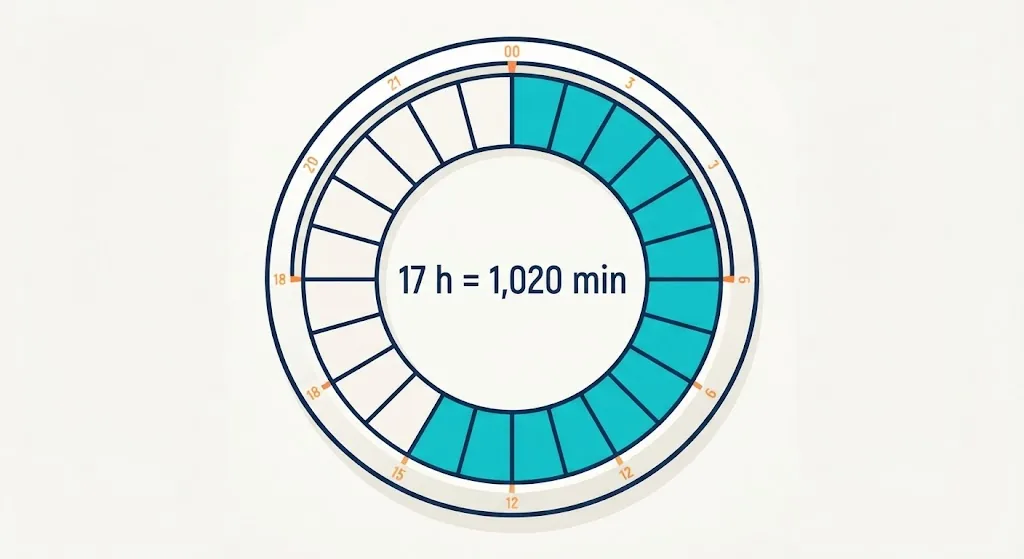
However the clock happens to be written, a seventeen-hour stretch never changes size. It always runs 1,020 minutes, the same as 61,200 seconds, and fills roughly 0.708 of a full day.
| Unit | Value for 17 hours |
|---|---|
| Minutes | 1,020 |
| Seconds | 61,200 |
| Fraction of a day | 17/24 (≈ 0.708) |
| Fraction of a week | ≈ 0.101 |
| Hours, for reference | 17 |
Picture it as seventeen of the twenty-four one-hour slots in a day, leaving only seven behind. You are not stretching the clock face at all; you are simply sliding the hour hand forward seventeen notches while the minute hand stays where it started.
How to Calculate 17 Hours From Now by Hand
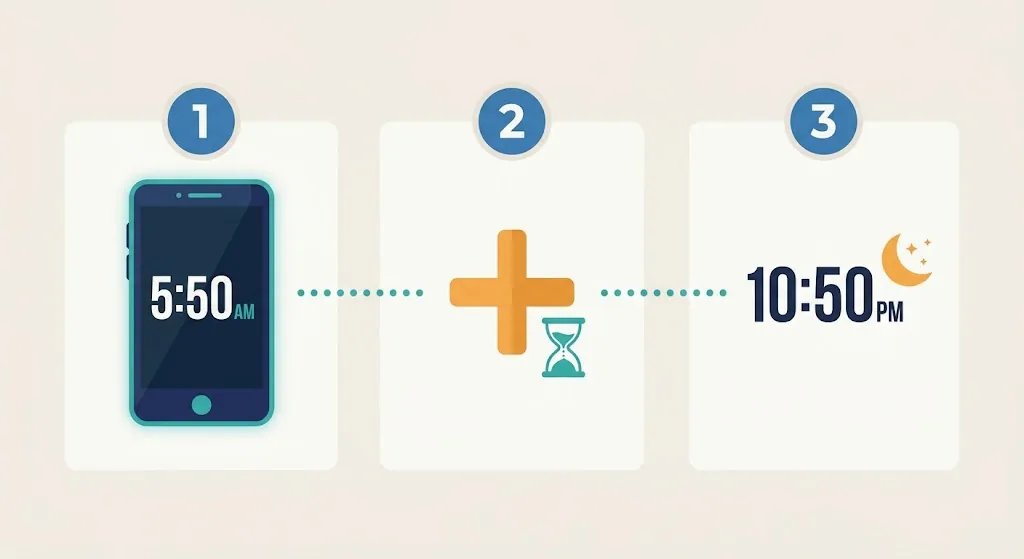
No app is required for this. Three short steps handle every starting point, even the awkward ones just before midnight.
Step One
Look at what your clock reads right now. Say the display shows 5:50 AM.
Step Two
Slide the hour digit forward by 17. 5:50 AM + 17 hours = 10:50 PM. The minutes stay put at 50 because only whole hours moved.
Step Three
Check whether that sum crosses midnight. Anything landing past 11:59 PM belongs to the next calendar day. For example: 8:25 AM + 17 hours = 1:25 AM tomorrow.
This three-step routine is exactly what an hours-from-now calculator runs behind the scenes, just carried out in your head instead of in code.
Examples of 17 Hours From Now
Here are several worked examples covering the full day:
- Current time: 12:15 AM → 17 hours later: 5:15 PM
- Current time: 4:35 AM → 17 hours later: 9:35 PM
- Current time: 8:25 AM → 17 hours later: 1:25 AM the next day
- Current time: 1:10 PM → 17 hours later: 6:10 AM the next day
- Current time: 6:45 PM → 17 hours later: 11:45 AM the next day
Notice how the last three examples all spill into tomorrow. Once the starting point reaches morning, adding a full seventeen hours can no longer stay inside the same date.
What Time Was It 17 Hours Ago?
The reverse question flips the sign. Instead of adding seventeen hours, you subtract them:
Current time − 17 hours = time 17 hours ago
For example: 10:20 PM − 17 hours = 5:20 AM the same day. Or 6:00 AM − 17 hours = 1:00 PM the previous day. “17 hours from now” looks ahead on the calendar, while “17 hours ago” looks back, and mixing the two up is one of the easiest slips to make when a message just says “17h.”
Read also: What Time Was It 17 Hours Ago? Live Calculator, Chart & Examples
17 Hours From Now Across Midnight
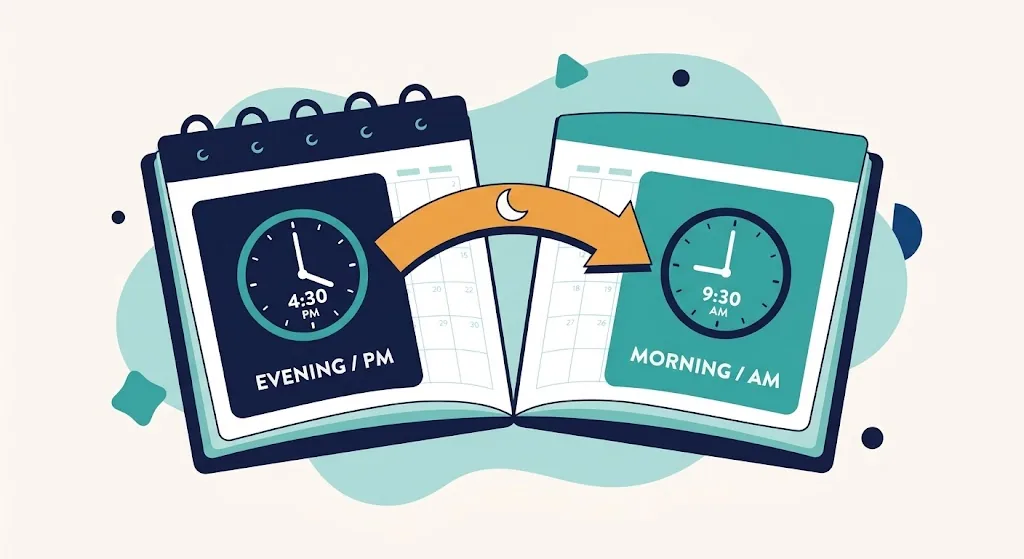
Crossing midnight trips people up more than any other part of this sum. Suppose it is 4:30 PM. Adding 17 hours works in two bites: 4:30 PM + 7 hours 30 minutes = 12:00 AM. Then add the remaining 9 hours 30 minutes: 12:00 AM + 9 hours 30 minutes = 9:30 AM.
Therefore: 4:30 PM + 17 hours = 9:30 AM the next day. The clock face resets to 12 at midnight, but the seventeen hours you are counting flow straight through into the new date regardless.
Time Zones Change the Reading, Not the Length
Time zones matter most when two or more people are lining up on the same plan. A trip billed as “17 hours from now” in one city points to a completely different clock reading for someone across the globe.
Before locking in a future clock reading for people scattered across cities, run through a short mental list:
- What time you are starting from
- Which calendar date that start belongs to
- Which zone your own number is measured in
- Whether either side is currently on daylight saving
- Which zone the other person actually plans around
A seventeen-hour add-on is simple when everyone shares one clock. It gets trickier once several clocks are involved, so name the zone out loud rather than assuming everyone means the same one.

Using a Future Time Calculator
The tool below works out the exact date and clock reading after any number of hours you type in, so you can skip the mental carrying entirely. It starts from your device’s own clock and time zone, so the live answer matches the one on your wall.
Hours From Now Calculator
A calculator earns its keep when:
- You need the date as well as the clock time
- The start time is not “now,” such as a departure printed on a coach ticket
- You want the seconds to line up exactly
- You are repeating the same sum for several different start times
- You want the “ago” answer sitting right next to the “from now” answer
Real-Life Uses of Calculating 17 Hours From Now
Seventeen-hour spans show up constantly once you start looking for them.
Overnight Coach and Bus Journeys
Long-distance coach routes often run close to seventeen hours from departure to arrival. A coach leaving at 5:50 AM on that kind of route pulls in around 10:50 PM the same night, ahead of any stops.
Rest Days Between Training Sessions
Athletes spacing out heavy sessions sometimes leave close to seventeen hours between an evening workout and the next morning’s lighter one, using the gap to judge recovery time.
Bread Proofing and Slow Fermentation
A cold, slow dough proof can run in the same range. Starting the dough at 8:25 AM and leaving it seventeen hours means it is ready around 1:25 AM, which is why many bakers start dough the night before instead.
Gaming and Esports Tournaments
Bracket-style tournaments that begin in the morning and stretch into the early hours of the next day often run close to seventeen hours start to finish, and players convert the schedule into their own local time before signing up.
Remote Team Handoffs
Teams spread across far-apart time zones sometimes structure a “follow the sun” handoff close to seventeen hours after the previous one, so the next region picks up work almost immediately.
Charity and Fundraising Drives
Single-day fundraising pushes are occasionally billed to run seventeen hours, from early morning to well past midnight, and organizers need the exact finish time to plan the closing announcement.
What Booking Apps and Trackers Do Behind the Scenes
A coach-booking site or a parcel tracker does not literally count on its fingers the way you might. It stores a precise timestamp, adds the seventeen-hour duration in one calculation, and outputs a finished date and clock reading, often already converted for daylight saving or a different region.
Leaning on a tool for this rather than doing it purely by memory pays off when you want to rule out:
- A missed AM/PM swap
- A skipped midnight crossing
- An untouched, still-wrong date
- Minutes that quietly shifted
- A time zone nobody accounted for
Reading Seventeen Hours in Both Clock Formats
The seventeen-hour jump looks slightly different depending on whether you are reading a 12-hour dial or a 24-hour timetable.
12-Hour Clock
On a 12-hour face, every reading carries an AM or PM tag. For example: 2:00 AM + 17 hours = 7:00 PM. Once the sum tips past midnight: 9:00 PM + 17 hours = 2:00 PM the next day.
24-Hour Clock
The 24-hour system drops the AM/PM tag and simply runs the hour count from 00 to 23. For example: 02:00 + 17 hours = 19:00. And: 21:00 + 17 hours = 14:00 the next day.
Here is the full chart for every hour of the day, both formats side by side. “Next day” marks the rows where the sum crosses midnight.
| Current time (12h) | 17 hours from now (12h) | 24-hour format |
|---|---|---|
| 12:00 AM | 5:00 PM | 00:00 → 17:00 |
| 1:00 AM | 6:00 PM | 01:00 → 18:00 |
| 2:00 AM | 7:00 PM | 02:00 → 19:00 |
| 3:00 AM | 8:00 PM | 03:00 → 20:00 |
| 4:00 AM | 9:00 PM | 04:00 → 21:00 |
| 5:00 AM | 10:00 PM | 05:00 → 22:00 |
| 6:00 AM | 11:00 PM | 06:00 → 23:00 |
| 7:00 AM | 12:00 AM (midnight) next day | 07:00 → 00:00 next day |
| 8:00 AM | 1:00 AM next day | 08:00 → 01:00 next day |
| 9:00 AM | 2:00 AM next day | 09:00 → 02:00 next day |
| 10:00 AM | 3:00 AM next day | 10:00 → 03:00 next day |
| 11:00 AM | 4:00 AM next day | 11:00 → 04:00 next day |
| 12:00 PM (noon) | 5:00 AM next day | 12:00 → 05:00 next day |
| 1:00 PM | 6:00 AM next day | 13:00 → 06:00 next day |
| 2:00 PM | 7:00 AM next day | 14:00 → 07:00 next day |
| 3:00 PM | 8:00 AM next day | 15:00 → 08:00 next day |
| 4:00 PM | 9:00 AM next day | 16:00 → 09:00 next day |
| 5:00 PM | 10:00 AM next day | 17:00 → 10:00 next day |
| 6:00 PM | 11:00 AM next day | 18:00 → 11:00 next day |
| 7:00 PM | 12:00 PM (noon) next day | 19:00 → 12:00 next day |
| 8:00 PM | 1:00 PM next day | 20:00 → 13:00 next day |
| 9:00 PM | 2:00 PM next day | 21:00 → 14:00 next day |
| 10:00 PM | 3:00 PM next day | 22:00 → 15:00 next day |
| 11:00 PM | 4:00 PM next day | 23:00 → 16:00 next day |
Count the “next day” rows: seventeen of them, starting from 7:00 AM onward. That leaves only seven starting hours, from midnight to 6:59 AM, where the answer stays on today’s date.
Slip-Ups That Throw Off a 17-Hour Sum
A seventeen-hour add-on rarely goes wrong because the math is hard. It goes wrong because a small detail gets skipped along the way.
Leaving Off Tomorrow’s Date
Once the total tips past 12:00 AM, whatever you write down belongs to the following day. A bare clock time with no date attached forces the next person to guess which day you meant.
Reading 12 AM as Noon
12 AM sits at the start of the night, and 12 PM sits in the middle of the day. Flip them by accident and the whole answer drifts a full twelve hours from where it should be.
Letting the Minutes Drift
A full seventeen-hour shift only ever moves the hour figure. 4:35 AM + 17 hours = 9:35 PM, never 9:40 or 9:50.
Skipping the Zone Check
A time worked out for one region will read differently the moment someone in another region looks at it. Settle on the zone before you run the sum, not after.
Swapping “Ago” for “From Now”
These two phrases point in opposite directions, and skimming past the difference turns an addition into a subtraction without anyone noticing. Read the whole phrase before you touch the clock.
Seventeen Hours From Now in Everyday Situations
Seventeen hours stretches across an entire day and well into the next, which is why it maps onto plans that run overnight.

Planning an Overnight Journey
If someone boards a coach at 5:50 AM for a seventeen-hour route, they can expect to arrive around 10:50 PM the same night. Knowing this in advance makes it easier to plan meals and where to sleep once they land.
Setting a Return Reminder
Say a slow cooker or a long download starts at 1:10 PM. Seventeen hours later, at 6:10 AM the next day, it should be ready, so a morning reminder saves you from checking too early.
Estimating a Long Delivery Wait
A parcel scanned at 6:45 PM with a seventeen-hour delivery window should arrive around 11:45 AM the next morning, which is useful for deciding whether to wait in.
Read also: What Time Was It 11 Hours Ago? Live Calculator, Chart & Examples
What a Bare “17h” Tag Really Means
Ticket confirmations, chat apps and tracking pages love a short tag like “17h” instead of spelling out a clock time. That number is usually truncated rather than rounded, so a label reading “17h” could stand for anything between 17 hours flat and just under 18.
Most apps reveal the exact timestamp if you tap or hover over the tag. Without that, treat the label as a rough window rather than an exact figure, and feed your best guess at the true starting time into the calculator above for a firmer answer.
Frequently Asked Questions
What time will it be 17 hours from now?
Add seventeen hours to your current local time. The exact answer depends on the moment you check and, for most of the day, falls on tomorrow’s date. The live box at the top of this page shows the answer for your own clock.
How many minutes are in 17 hours?
17 hours equals 1,020 minutes, because 17 × 60 = 1,020.
How many seconds are in 17 hours?
17 hours equals 61,200 seconds, because 17 × 60 × 60 = 61,200.
What time is 17 hours after 6 AM?
Seventeen hours after 6:00 AM is 11:00 PM on the same day.
What time is 17 hours after 10 PM?
Seventeen hours after 10:00 PM is 3:00 PM the following day.
Does adding 17 hours change the date?
Usually, yes. Starting anywhere from 7:00 AM onward pushes the result onto the next calendar day.
Is 17 hours from now the same moment for everyone?
It is the same instant, but people in different time zones read a different local clock time for it.
What is the difference between 17 hours ago and 17 hours from now?
One looks backward on the clock and one looks forward: subtract seventeen hours to find the past moment, or add seventeen hours to find the future one.
Can I work out 17 hours from now without a calculator?
Yes. Write down the current time, add 17 hours, and move the date forward a day if the sum passes midnight.
How far apart are 17 hours ago and 17 hours from now?
They sit 34 hours apart on the clock. At 5:50 AM, one answer is 7:50 PM the day before and the other is 10:50 PM today.
What is a quick mental shortcut for adding 17 hours?
Jump forward 12 hours, which only swaps AM and PM, then step forward 5 more hours. From 5:50 AM that gives 5:50 PM, then 10:50 PM.
Why does 17 hours from now land on tomorrow so often?
Because seventeen hours covers almost three-quarters of a full day, only starting times in the early morning, before 7:00 AM, keep the answer on today’s date.
Conclusion
To find what time it will be 17 hours from now, add seventeen hours to the current time and keep the minutes unchanged. Watch the AM/PM label, since it flips at least once, and watch the date, since any time from 7:00 AM onward moves the answer to tomorrow.
For a fast mental check, jump forward 12 hours and then step on 5 more. For overnight trips, time zones, or a start time other than right now, use the calculator above. It shows the exact time and date in both clock formats in a single click.

Liam Joseph Miller is an experienced writer with 6 years of expertise in creating clear, informative, and reader-friendly content. He specializes in words, phrases, slang, definitions, names, and everyday meanings, helping readers understand language in a simple and practical way.