
What time was it 17 hours ago? Take seventeen hours off the time on your clock and keep the minutes untouched. At 6:15 AM, that lands on 1:15 PM the day before.
Seventeen hours covers most of a full day, so the answer crosses into yesterday far more often than it stays on today’s date. Only seven hours of the clock face keep you on the same day; the other seventeen send you back one. This page gives you a live answer for your own clock, a chart that covers all 24 starting hours, and a method that works every time.
Quick answer
It is now your current time.
Seventeen hours ago it was now minus 17 hours (6:15 AM → 1:15 PM the day before)
Mental trick: subtract 12 hours (swap AM/PM), then subtract 5 more.
- 17 hours ago = the time now − 17 hours. The minutes stay exactly the same.
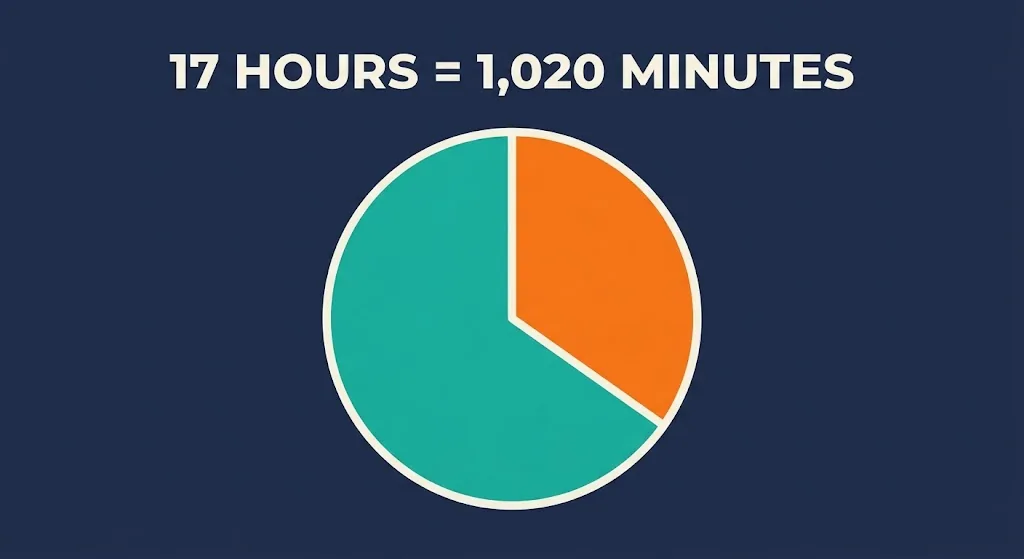
- Seventeen hours equals 1,020 minutes, 61,200 seconds, or about 71% of a day.
- If it is later than 5:00 PM, the answer stays on today. Before 5:00 PM, it falls on yesterday.
- At exactly 5:00 PM, seventeen hours ago was midnight at the start of today.
What Time Was It 17 Hours Ago?
The rule behind this question never changes: take the current time and pull seventeen hours off it, watching the AM/PM label and the calendar date as you go.
Time 17 hours ago = Current time − 17 hours
Say the clock reads 8:40 AM. Subtracting seventeen hours gives 3:40 PM the day before. Now try 9:40 PM: seventeen hours back lands at 4:40 AM, still on today’s date, because the starting hour is late enough that the subtraction never reaches midnight.
That second case is the exception rather than the rule. Because seventeen is such a large number, most starting times send the answer one calendar day back.
Understanding the Logic Behind Time Calculation
A clock resets every 24 hours, so subtracting seventeen hours does not behave like ordinary subtraction. Once the running total drops below zero, you have crossed midnight and the date rolls back.
One shortcut makes this painless: 24 − 17 = 7. Going back seventeen hours gives the identical clock reading as going forward seven hours and moving the date back one day. Take 6:15 AM: add 7 hours and you reach 1:15 PM, then move the date back a day, giving 1:15 PM the day before — the same result as subtracting seventeen hours directly.
A second shortcut splits seventeen into two friendlier pieces: 12 hours + 5 hours. Subtracting 12 hours only flips AM to PM (or the reverse) without changing the digits, so the remaining 5-hour subtraction is easy to do in your head. Both shortcuts are built into the step-by-step method further down this page.
What Time Was It 17 Hours Ago Across Different Examples
Rather than a handful of samples, here is every starting hour on the clock, so you can look up your own situation directly. “Yesterday” marks the rows where the answer falls on the day before.
| Current time | 17 hours ago | 24-hour format |
|---|---|---|
| 12:00 AM (midnight) | 7:00 AM yesterday | 00:00 → 07:00 |
| 1:00 AM | 8:00 AM yesterday | 01:00 → 08:00 |
| 2:00 AM | 9:00 AM yesterday | 02:00 → 09:00 |
| 3:00 AM | 10:00 AM yesterday | 03:00 → 10:00 |
| 4:00 AM | 11:00 AM yesterday | 04:00 → 11:00 |
| 5:00 AM | 12:00 PM yesterday | 05:00 → 12:00 |
| 6:00 AM | 1:00 PM yesterday | 06:00 → 13:00 |
| 7:00 AM | 2:00 PM yesterday | 07:00 → 14:00 |
| 8:00 AM | 3:00 PM yesterday | 08:00 → 15:00 |
| 9:00 AM | 4:00 PM yesterday | 09:00 → 16:00 |
| 10:00 AM | 5:00 PM yesterday | 10:00 → 17:00 |
| 11:00 AM | 6:00 PM yesterday | 11:00 → 18:00 |
| 12:00 PM (noon) | 7:00 PM yesterday | 12:00 → 19:00 |
| 1:00 PM | 8:00 PM yesterday | 13:00 → 20:00 |
| 2:00 PM | 9:00 PM yesterday | 14:00 → 21:00 |
| 3:00 PM | 10:00 PM yesterday | 15:00 → 22:00 |
| 4:00 PM | 11:00 PM yesterday | 16:00 → 23:00 |
| 5:00 PM | 12:00 AM (midnight) | 17:00 → 00:00 |
| 6:00 PM | 1:00 AM | 18:00 → 01:00 |
| 7:00 PM | 2:00 AM | 19:00 → 02:00 |
| 8:00 PM | 3:00 AM | 20:00 → 03:00 |
| 9:00 PM | 4:00 AM | 21:00 → 04:00 |
| 10:00 PM | 5:00 AM | 22:00 → 05:00 |
| 11:00 PM | 6:00 AM | 23:00 → 06:00 |
Count the “yesterday” rows and you get seventeen of them, exactly matching the number of hours you are subtracting. Only the seven rows from 5:00 PM to 11:00 PM keep today’s date.
Why Date Rollover Matters
With a gap this large, forgetting the date is the easiest mistake to make. The clock reading can look perfectly reasonable while the day is completely wrong.
Picture logging into a shared document at 5:05 AM and seeing a note that a colleague edited it “17 hours ago.” The true moment is 12:05 PM the day before, not 12:05 PM today. That single day of drift can send you looking for the wrong version of a file or the wrong meeting on a calendar.
Rollovers also cross month and year boundaries. At 3:00 AM on June 1, seventeen hours ago was 10:00 AM on May 31. At 2:00 AM on January 1, seventeen hours ago was 9:00 AM on December 31 of the previous year.
How AM and PM Affect the Calculation
Because a 12-hour clock repeats its numbers twice a day, subtracting a large gap like seventeen hours usually flips AM to PM or PM to AM along the way.
Take 11:35 AM. Subtracting 12 hours gives 11:35 PM the day before; subtracting the remaining 5 hours gives 6:35 PM the day before. Notice the label changed from AM straight to PM without ever passing back through AM, because two 12-hour flips happened in sequence.
Switching to the 24-hour clock removes this guesswork completely, since the numbers run from 00:00 to 23:59 without ever repeating.
| 12-hour clock | 24-hour clock |
|---|---|
| 12:00 AM | 00:00 |
| 5:00 AM | 05:00 |
| 12:00 PM | 12:00 |
| 4:00 PM | 16:00 |
| 7:00 PM | 19:00 |
| 11:00 PM | 23:00 |
In 24-hour form, 11:35 becomes simple: 11 − 17 = −6, add 24 to get 18, so the answer is 18:35, which is 6:35 PM. Same result, fewer chances to slip up.
Time Zones Can Change the Answer
Seventeen hours is always seventeen hours, no matter where you are standing. What changes between locations is the clock label attached to the start and the end of that gap.
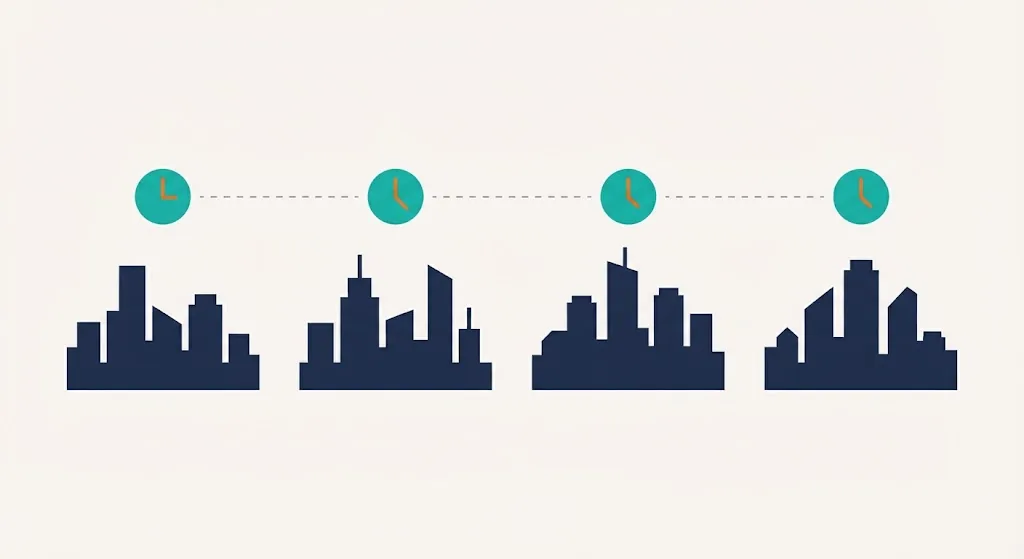
Take one shared instant, 15:00 UTC, and step back seventeen hours in four cities:
| City | Offset | Now | 17 hours ago |
|---|---|---|---|
| New York | UTC−5 | 10:00 AM | 5:00 PM (previous day) |
| Berlin | UTC+1 | 4:00 PM | 11:00 PM (previous day) |
| Dubai | UTC+4 | 7:00 PM | 2:00 AM (same day) |
| Sydney | UTC+11 | 2:00 AM | 9:00 AM (previous day) |
New York and Dubai are looking at the exact same moment, yet one reads “the day before” and the other reads “earlier today.” Whenever a timestamp travels between places, convert it to your own zone before you subtract.
Using an Hours Ago Calculator
The calculator below starts from your device’s own clock and time zone, so the answer matches the time on your wall right now. You can also set a different starting date, time or hour count.
Hours Ago Calculator
Reach for it whenever:
- You need the exact date alongside the time
- The starting point is not “now,” such as a timestamp from a log file
- Seconds need to be precise, not rounded
- You want the “17 hours ago” and “17 hours from now” answers side by side
Read also: What Time Was It 9 Hours Ago? Live Answer, 24-Hour Chart & Steps
What Time Was It 17 Hours Ago in Everyday Life?
A seventeen-hour gap sits right between “yesterday evening” and “the middle of the night,” which makes it a common question for shift work, travel and long deliveries.

Overnight Deliveries
A courier update reads “picked up 17 hours ago” while you check it at 2:20 PM. Counting back gives 9:20 PM the evening before, so the package has likely been traveling overnight rather than just for a couple of hours.
Long-Haul Flights
Some long-haul routes last close to seventeen hours in the air. A traveler landing at 11:10 AM and thinking about takeoff can work out it happened around 6:10 PM the day before, local time at the departure city.
Night Shift Handovers
A factory worker clocking out at 7:30 AM after a night shift might ask what time it was seventeen hours earlier, at the start of the previous shift: 2:30 PM the day before, right as the day crew was finishing up.
The Psychology Behind Looking Back in Time
Seventeen hours is long enough that memory starts to blur the details. Most people can recall what they were doing roughly a day ago, but pinning down the exact clock time takes real effort.
That is where a fixed reference point helps. If you know the exact time seventeen hours ago, you can anchor the rest of the day around it instead of guessing. A receipt, a step count, or a single logged call can turn a vague memory into a precise timeline.
Common Mistakes When Calculating 17 Hours Ago
The arithmetic itself is simple. Most errors come from moving too fast through one of these five spots.
Forgetting the Previous Day
At 9:15 AM, seventeen hours ago was 4:15 PM the day before. Writing down just “4:15 PM” with no date leaves the answer ambiguous.
Mixing Up AM and PM
From 1:50 PM, the answer is 8:50 PM the day before, not 8:50 AM. Check the label every single time, since seventeen hours often flips it twice.
Changing the Minutes
Subtracting whole hours never touches the minutes or seconds. 4:27 PM minus seventeen hours is 11:27 PM the day before, still :27.
Ignoring Time Zones
A timestamp pulled from a server log or an email header is often stamped in UTC or a distant city’s zone. Convert it to your own clock before subtracting anything.
Treating 17 Hours as 17:00
Seventeen hours is a length of time, not a clock reading of 5:00 PM. Confusing a duration with a specific hour is an easy typo to make when reading quickly.
Forgetting Midnight
Remember that 12:00 AM is midnight and 12:00 PM is noon. Mixing those two up shifts every answer by twelve full hours.
Read also: What Time Was It 6 Hours Ago? Live Calculator, Chart & Easy Steps
Manual Time Subtraction Method
This three-step version of the 12 + 5 shortcut works for any starting time, without needing to touch the 24-hour clock at all.
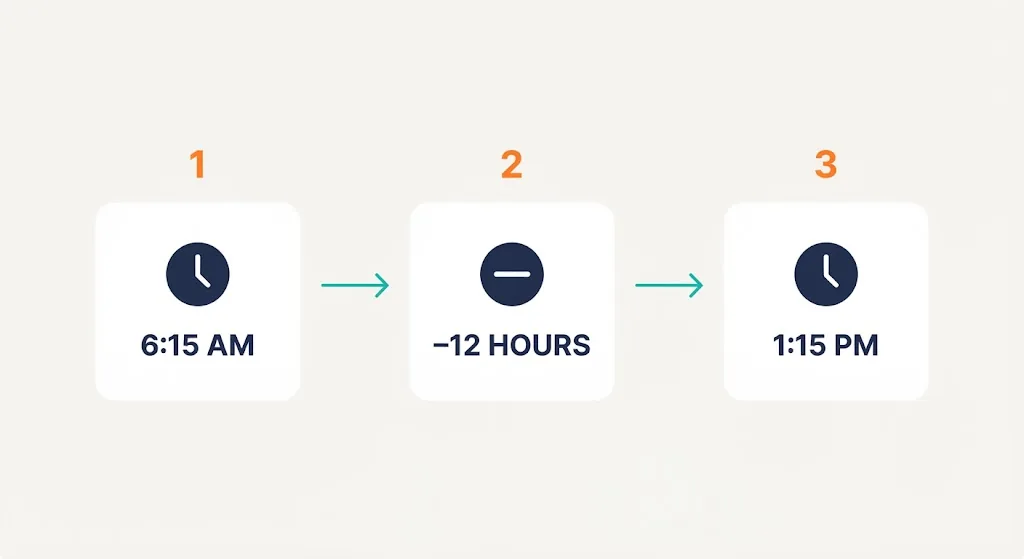
Step 1: Write Down the Current Time
Start with the exact time, minutes included. Say it is 6:15 AM.
Step 2: Subtract 12 Hours
Twelve hours back only flips AM to PM without changing the digits: 6:15 AM − 12 hours = 6:15 PM the day before.
Step 3: Subtract the Remaining 5 Hours
Five hours are still owed, since 12 + 5 = 17: 6:15 PM − 5 hours = 1:15 PM. Because the first step already moved the date back, the final answer is 1:15 PM the day before.
If you prefer the other shortcut, add 7 hours to 6:15 AM to get 1:15 PM, then move the date back one day. Both paths land on the same answer.
Why Accurate Time Computation Matters
A wrong hour or a missed date change is more than a small slip when the timing actually matters. Precise seventeen-hour math supports:
- Reconciling a bank alert with a purchase made the evening before
- Comparing security camera footage against a reported incident
- Verifying when a support ticket or order was actually submitted
- Lining up a remote meeting across a country far ahead or behind you
A single missed date can point an investigation, a schedule, or a bill at the wrong day entirely.
Converting 17 Hours Into Other Units
Seventeen hours is close to three-quarters of a day. Here is the same length of time in every common unit.
| Unit | Equal to 17 hours |
|---|---|
| Hours | 17 |
| Minutes | 1,020 |
| Seconds | 61,200 |
| Milliseconds | 61,200,000 |
| Days | ≈ 0.708 |
| Weeks | ≈ 0.101 |
The minutes figure is the one worth remembering: 17 × 60 = 1,020. In seconds, that is 61,200, a number that shows up often in spreadsheets and server logs that store timestamps as raw seconds.
What Time Will It Be 17 Hours From Now?
The forward version of this question uses the same formula in reverse: add seventeen hours instead of subtracting them.
Time 17 hours from now = Current time + 17 hours
- 5:00 PM + 17 hours = 10:00 AM the next day
- 9:40 PM + 17 hours = 2:40 PM the next day
Seventeen hours ago and seventeen hours from now are always 34 hours apart. At 5:00 PM, one answer is 12:00 AM (midnight) today and the other is 10:00 AM tomorrow. If your two results are not 34 hours apart, double-check your subtraction.

Read also: What Time Was It 5 Hours Ago? Live Answer, Full Chart & Examples
Practical Tips for Calculating Previous Time Quickly
Keep these shortcuts handy the next time you need to work backward seventeen hours.
- Use 12 + 5: flip AM/PM first, then subtract 5 more hours.
- Use 24 − 17 = 7: add 7 hours and move the date back one day.
- Switch to 24-hour time whenever the AM/PM flips get confusing.
- Keep the minutes untouched: only the hour and possibly the date change.
- Check the date last, after you have the clock time sorted out.
Frequently Asked Questions
What time was it 17 hours ago?
Subtract seventeen hours from your current time and keep the minutes as they are. At 6:15 AM, seventeen hours ago was 1:15 PM the day before. The live box at the top of this page shows the answer for your own clock.
Does 17 hours ago always fall on yesterday?
No. It stays on today’s date whenever the current time is 5:00 PM or later. Before 5:00 PM, the answer moves back to the previous day.
How many minutes are in 17 hours?
There are 1,020 minutes in 17 hours, since 17 × 60 = 1,020.
How many seconds are in 17 hours?
There are 61,200 seconds in 17 hours (17 × 60 × 60).
What time was it 17 hours before 9 AM?
It was 4:00 PM the day before, because counting back seventeen hours from 9:00 AM passes midnight.
What time was it 17 hours before 6 PM?
It was 1:00 AM the same day, since 18:00 minus 17 hours equals 01:00.
Do the minutes change when you subtract 17 hours?
No. Subtracting whole hours leaves the minutes and seconds exactly as they were. 4:27 PM becomes 11:27 PM.
Is going back 17 hours the same as going forward 7 hours?
On the clock face, yes. Adding 7 hours and moving the calendar back one day gives the identical clock reading as subtracting 17 hours directly.
Does my time zone change the answer?
The 17-hour length stays fixed everywhere, but each place displays a different clock time for the start and the end. Convert any UTC or foreign timestamp to your own zone before subtracting.
What is a fast mental trick for 17 hours ago?
Subtract 12 hours first, which only swaps AM and PM, then subtract 5 more hours.
How far apart are 17 hours ago and 17 hours from now?
They are always 34 hours apart. At 5:00 PM, one is 12:00 AM today and the other is 10:00 AM tomorrow.
What time was it 17 hours ago at exactly 5 PM?
At 5:00 PM, seventeen hours ago was exactly 12:00 AM, the very start of the same day.
Conclusion
Finding what time it was 17 hours ago comes down to one subtraction, done carefully. Take seventeen hours off the current time, keep the minutes exactly as they are, and watch whether the AM/PM label and the calendar date both need to flip.
For a fast mental answer, subtract 12 hours and then 5 more, or add 7 hours and step the date back one day. When the stakes are higher, such as logs, time zones or a starting point other than “now,” the calculator above gives you the exact time and date in one click.

Liam Joseph Miller is an experienced writer with 6 years of expertise in creating clear, informative, and reader-friendly content. He specializes in words, phrases, slang, definitions, names, and everyday meanings, helping readers understand language in a simple and practical way.