

Trying to find what time was it 18 hours ago? Take your current clock time and pull it back eighteen hours. At 5:20 AM, the answer is 11:20 AM the day before. Eighteen hours is a long stretch, so the date almost always flips, and AM often swaps to PM (or the reverse).
That flip is exactly where people trip up. This guide gives you a live answer tuned to your own clock, a chart covering every hour of the day, and a three-step method you can run in your head in under ten seconds.
Quick answer
Right now it is your current time.
18 hours ago it was that time minus 18 hours (5:20 AM → 11:20 AM the day before)
Rule of thumb: keep the minutes, subtract 6 from the hour, then subtract 12 more (swap AM/PM) to cover the full 18.
- 18 hours ago = current time − 18 hours. The minutes never move.
- 18 hours equals 1,080 minutes, or 64,800 seconds.
- Starting anywhere from 12:00 AM to 5:59 PM sends the result back to yesterday’s date.
- “Ago” always means subtract; “from now” always means add.
Understanding What Time Was It 18 Hours Ago
“18 hours ago” points to one exact moment: eighteen hours before this very second. It is not “sometime yesterday” or “early this morning.” It is a fixed point you can name precisely once you know the current time.
The formula is short:
Time 18 hours ago = Current time − 18 hours
Here is how that plays out:
- Clock right now: 9:10 AM
- Count back 18 hours
- Answer: 3:10 PM the day before
Minutes and seconds always carry over untouched. Say it is 6:52:40 AM. Eighteen hours earlier was 12:52:40 PM the previous day. The “:52:40” part never shifts.
Because 18 hours is more than a half day, the date almost always changes. The only exception is when the current hour is late enough in the evening that 18 hours back still lands on the same calendar day. We cover exactly which hours those are in step 3.
How to Calculate 18 Hours Ago
You do not need an app for this. Three steps get you a correct answer every time, even when the date rolls back.
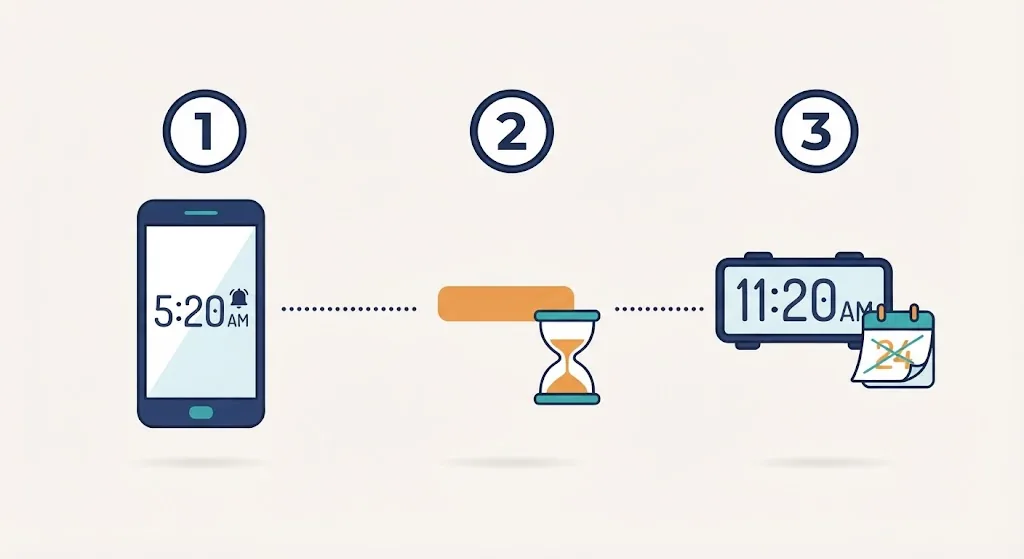
Step 1: Check the Current Time
Grab an exact reading from your phone or watch, including AM or PM. Say it out loud if that helps you remember it while you do the next step.
Example: current time = 5:20 AM.
Step 2: Subtract Eighteen Hours
Take 18 away from the hour and leave the minutes exactly as they are.
5:20 AM − 18 hours = 11:20 AM the day before
A faster route: subtract 12 hours first, which just flips AM to PM (or PM to AM), then subtract 6 more. From 5:20 AM, 12 hours back is 5:20 PM the day before, and 6 more back is 11:20 AM. Two small hops beat one big one.
Step 3: Check Whether the Date Changes
Because eighteen hours covers three quarters of a full day, the date shifts back one day for almost every starting hour. It only stays on the same day when the current time is between 6:00 PM and 11:59 PM.
Example: 8:00 PM − 18 hours = 2:00 AM the same day, because 8 PM is late enough in the evening.
This step is the one people forget. A clock time without a date is only half an answer when you are checking logs, deliveries or messages.
Why People Search “What Was 18 Hours Ago From Now”
Plenty of apps and dashboards show elapsed time instead of a clock reading. You will see phrases like these:
- “Package scanned 18 hours ago” in a shipping tracker
- “Uploaded 18h ago” under a video
- “Last active 18 hours ago” on a profile
- “Flight departed 18 hours ago” in a travel app
- “Backup completed 18 hours ago” in a system log
These labels tell you how much time has gone by, not the actual clock reading. To convert one into a real time, subtract eighteen hours from now. If it is 2:00 PM and a backup “completed 18 hours ago,” it finished at about 8:00 PM the evening before.
Remember that most trackers round to the nearest hour. “18 hours ago” might really mean 18 hours and 40 minutes. For anything you need to prove, open the record and read the full timestamp instead of trusting the label.
Everyday Situations Where Eighteen Hours Earlier Matters
Eighteen hours is long enough to span a full night and most of a day, so it shows up in travel, work and cooking more than you might think.
Long-Haul Flight Jet Lag
A traveler landing after an eighteen-hour journey often wants to know when they actually boarded. If they land at 5:20 AM, boarding was around 11:20 AM the day before, factoring in the flight and any layover.
An Overnight Hackathon
Teams that run an eighteen-hour hackathon often start at breakfast and finish the next dawn. If judging wraps at 11:00 AM, the opening bell rang at 5:00 PM the previous evening.
A Warehouse Overnight Shift
Some warehouse rotations stretch to eighteen hours across two shift blocks. A supervisor checking a clock-out at 3:00 AM can work back to a 9:00 AM start the day before to verify the full window.
A Multi-Leg Road Trip
Drivers covering long distances sometimes log an eighteen-hour trip across two calendar days. If they pulled in at 1:00 AM, they likely left around 7:00 AM the previous morning, minus any stops.
A Slow-Cooker Recipe
Some slow-cooked dishes need eighteen hours in the pot. If dinner is served at 7:00 PM, the pot was switched on at 1:00 AM that same day, or the night before if you count from a later serving time.
A Livestream Marathon
Charity livestreams sometimes run eighteen hours straight. A viewer catching the tail end at 10:00 AM can work out that the stream began at 4:00 PM the day before.
Time Arithmetic Made Simple
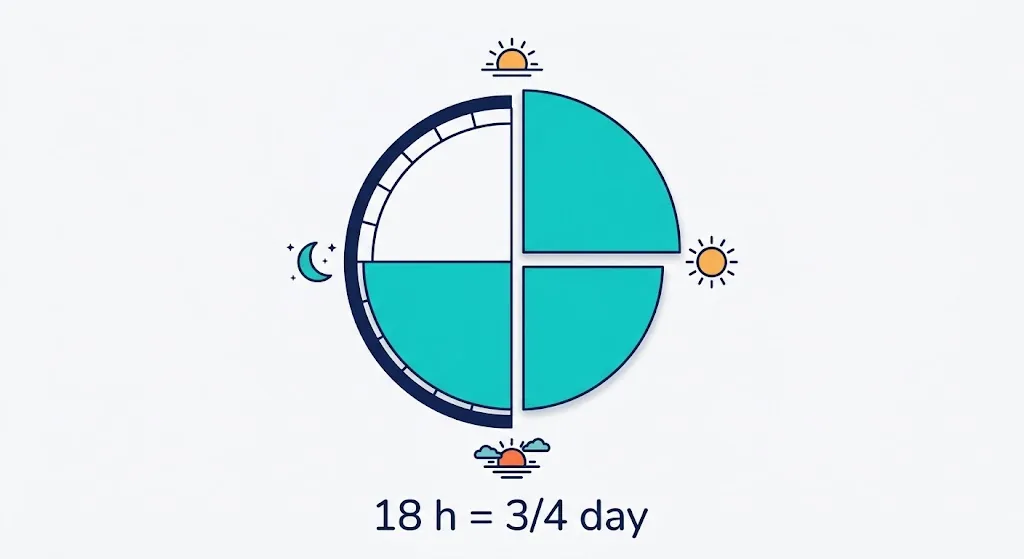
Eighteen hours is exactly three quarters of a 24-hour day, since 18 = 3 × 6. That fact makes the number easy to picture on a clock face.
| Unit | Equal to 18 hours |
|---|---|
| Hours | 18 |
| Minutes | 1,080 |
| Seconds | 64,800 |
| Milliseconds | 64,800,000 |
| Days | 0.75 (three quarters) |
| Weeks | ≈ 0.1071 |
The minute figure is the one you will reach for most. 18 × 60 = 1,080, so eighteen hours ago is exactly 1,080 minutes ago. Many countdown and scheduling tools store durations in minutes, so this conversion saves a step.
Picture the day wheel split into four equal slices of six hours each. Eighteen hours back always means jumping three of those four slices, leaving only one slice of “today” behind. That mental picture beats counting eighteen single hours one at a time.
Read also: What Time Was It 6 Hours Ago? Live Calculator, Chart & Easy Steps
Examples Using Both 12-Hour and 24-Hour Clock
Some readers think in AM and PM, others prefer the 24-hour clock used at work or on transport schedules. The table below covers every hour of the day in both, so you can find your row at a glance.
12-Hour Clock
The 12-hour clock uses AM for the morning and PM for the afternoon and night. Rows marked “yesterday” cross back over midnight.
| Current time | 18 hours ago | 24-hour format |
|---|---|---|
| 12:00 AM (midnight) | 6:00 AM yesterday | 00:00 → 06:00 |
| 1:00 AM | 7:00 AM yesterday | 01:00 → 07:00 |
| 2:00 AM | 8:00 AM yesterday | 02:00 → 08:00 |
| 3:00 AM | 9:00 AM yesterday | 03:00 → 09:00 |
| 4:00 AM | 10:00 AM yesterday | 04:00 → 10:00 |
| 5:00 AM | 11:00 AM yesterday | 05:00 → 11:00 |
| 6:00 AM | 12:00 PM (noon) yesterday | 06:00 → 12:00 |
| 7:00 AM | 1:00 PM yesterday | 07:00 → 13:00 |
| 8:00 AM | 2:00 PM yesterday | 08:00 → 14:00 |
| 9:00 AM | 3:00 PM yesterday | 09:00 → 15:00 |
| 10:00 AM | 4:00 PM yesterday | 10:00 → 16:00 |
| 11:00 AM | 5:00 PM yesterday | 11:00 → 17:00 |
| 12:00 PM (noon) | 6:00 PM yesterday | 12:00 → 18:00 |
| 1:00 PM | 7:00 PM yesterday | 13:00 → 19:00 |
| 2:00 PM | 8:00 PM yesterday | 14:00 → 20:00 |
| 3:00 PM | 9:00 PM yesterday | 15:00 → 21:00 |
| 4:00 PM | 10:00 PM yesterday | 16:00 → 22:00 |
| 5:00 PM | 11:00 PM yesterday | 17:00 → 23:00 |
| 6:00 PM | 12:00 AM (midnight) | 18:00 → 00:00 |
| 7:00 PM | 1:00 AM | 19:00 → 01:00 |
| 8:00 PM | 2:00 AM | 20:00 → 02:00 |
| 9:00 PM | 3:00 AM | 21:00 → 03:00 |
| 10:00 PM | 4:00 AM | 22:00 → 04:00 |
| 11:00 PM | 5:00 AM | 23:00 → 05:00 |
Look at the first eighteen rows. Any start time from midnight through 5:59 PM pushes the answer back to the day before. Only the last six rows, from 6:00 PM to 11:59 PM, stay on today’s date.
24-Hour Clock
The 24-hour clock drops AM and PM entirely, which makes subtraction cleaner once you get used to it. Just take 18 from the hour.
22:10 − 18 hours = 04:10
When the hour is smaller than 18, the result goes below zero. Add 24 and move back to the previous day.
05:20 − 18 = −12:40 → add 24 → 11:20 yesterday
This “add 24” rule works for any hours-ago problem, no matter how large the number gets. It is the same logic your phone’s clock app uses internally.
What Time Will It Be 18 Hours From Now?
The reverse question uses the same numbers, only added instead of subtracted:
Time 18 hours from now = Current time + 18 hours
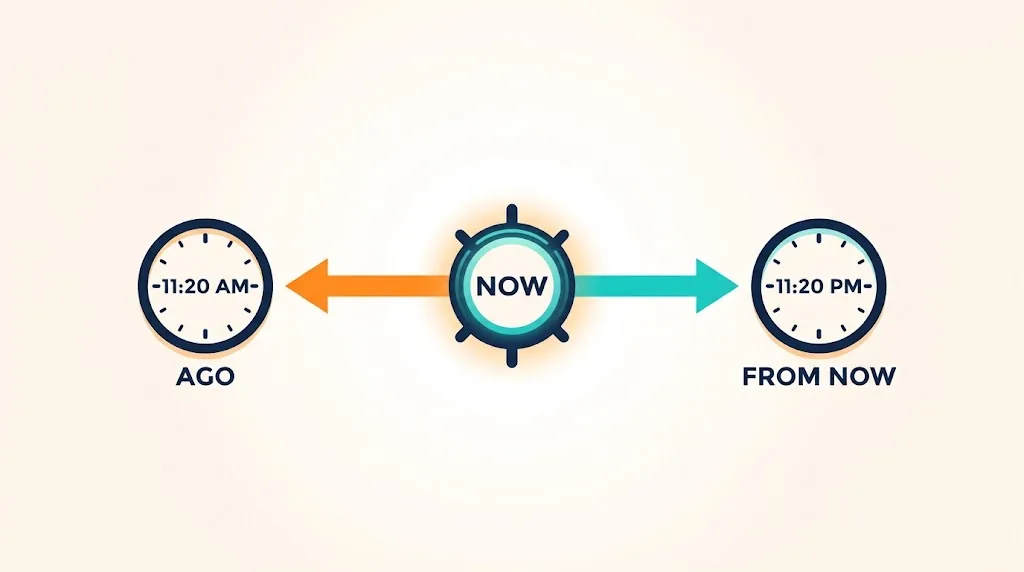
- 9:00 AM + 18 hours = 3:00 AM the next day
- 4:30 PM + 18 hours = 10:30 AM the next day
Here is a handy check. Eighteen hours ago and eighteen hours from now are always exactly six hours apart from being opposite sides of the same twelve-hour mirror point. A simpler way to remember it: eighteen hours in either direction is the same as going twelve hours plus six more, so you can always double-check with two smaller hops instead of one large one.
Read also: What Time Will It Be 18 Hours From Now? Live Answer & Chart
Time Zones Can Change Everything
Eighteen hours ago on your clock is a different label on someone else’s clock, even though it is the same moment for both of you. The instant stays fixed; only the wording changes with the time zone.

Many systems log events in UTC while your device displays local time. Subtract eighteen hours from a UTC timestamp and read the result as your own local time, and you can be several hours off.
Here is the same moment, “18 hours ago from 6:00 AM UTC,” in four cities (standard time):
| City | Offset | Now | 18 hours ago |
|---|---|---|---|
| Los Angeles | UTC−8 | 10:00 PM (prev day) | 4:00 AM (prev day) |
| London | UTC+0 | 6:00 AM | 12:00 PM (prev day) |
| Cairo | UTC+2 | 8:00 AM | 2:00 PM (prev day) |
| Sydney | UTC+10 | 4:00 PM | 10:00 PM (prev day) |
For an accurate answer, always confirm these five things:
- The current local time
- The correct date
- Your own time zone
- Whether the original timestamp is UTC or local
- Whether daylight saving time applies
For everyday use, your device’s local clock is all you need. Time zones only matter when people, servers or flights sit in different places.
Technology Depends on Accurate Time Calculation
Computers and phones do not flip a clock face the way people do. They store time as one running number of seconds since January 1, 1970, in UTC. This number is called a Unix timestamp.
To find eighteen hours ago, a device subtracts 64,800 seconds from that number, then converts the result back to your local date and time. Because everything happens on a single continuous count, midnight crossings, month changes and leap years never trip up the math.
Browser-based tools read your device clock, so their output matches your own time zone automatically. This handles the tricky parts for you:
- Crossing midnight, sometimes more than once
- Rolling over to a new date, month or year
- Exact minutes and seconds
- 12-hour and 24-hour formats
- Time-zone and daylight-saving differences
Using an Hours Ago Calculator
A calculator is the quickest way to get an exact answer without doing the mental hops yourself. Try the one below. It starts from your device clock, but you can change the start time and the number of hours.
Hours Ago Calculator
Most hours-ago calculators follow the same five steps:
- Read the current date and time.
- Take the number of hours you enter.
- Subtract that duration.
- Adjust the date if the result passes midnight.
- Show the result in a clear format.
Good calculators let you set a custom start time, show both clock formats, and give the “from now” answer beside the “ago” answer. That removes the most common slip-ups in one glance.
Common Mistakes People Make
Subtracting eighteen hours looks harder than six, and the same five slips show up again and again.
Forgetting the Date Shift
Because eighteen hours covers most of a day, forgetting to move the date back is the single biggest error. Writing “9:00 AM” without noting “yesterday” can throw off an entire report.
Mixing Up AM and PM
Counting back eighteen hours usually flips AM and PM, sometimes twice. 7:00 AM − 18 hours = 1:00 PM the day before, not 1:00 AM. Use the 12-back, 6-back trick if you are unsure.
Changing the Minutes
Subtracting whole hours never touches the minutes. 4:35 PM − 18 hours = 10:35 PM the day before. If your minutes changed, recheck your math.
Ignoring Time Zones
A timestamp saved in UTC will not line up with your local clock. Convert the zone first, then subtract eighteen hours.
Confusing Eighteen Hours Ago With Eighteen Hours From Now
“Ago” looks backward, so you subtract. “From now” looks forward, so you add. Saying the rule out loud once usually stops the mix-up before it starts.
Why Relative Time Feels Different From Exact Time
Your brain reads relative phrases faster than clock digits. “Eighteen hours ago” tells you instantly that something happened yesterday, roughly. “11:20 AM” makes you pause and compare it with the time now.
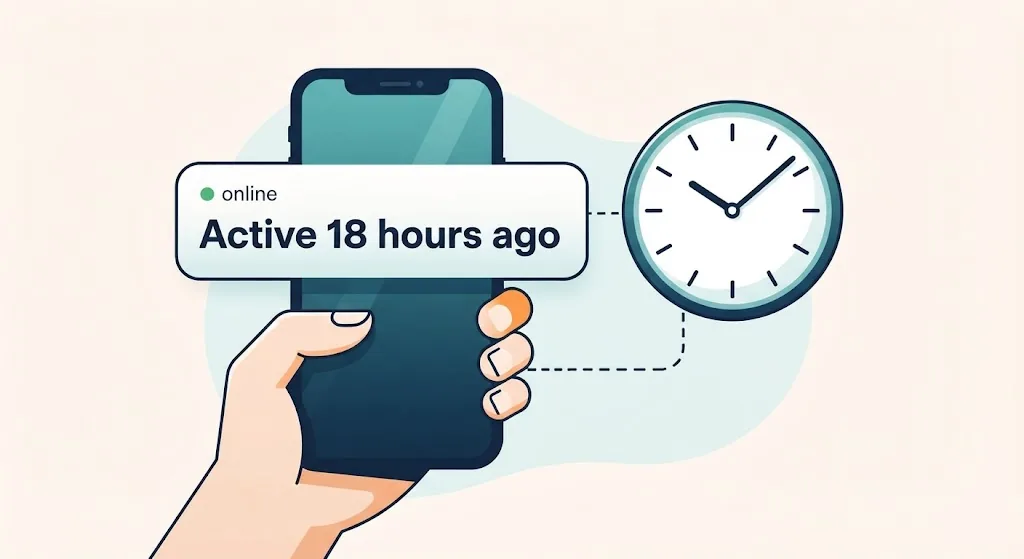
The catch is that relative time never stops moving. Something that happened eighteen hours ago will be eighteen hours and one minute ago a minute from now. The label is only accurate the instant you read it.
That is why apps keep refreshing their timestamps, and why any record you need to keep should use an exact date and time. Use relative labels for a quick feel of “how long ago,” and exact timestamps for anything you might need to prove later.
Frequently Asked Questions
What time was it 18 hours ago?
Subtract eighteen hours from your current time and keep the minutes unchanged. If it is 5:20 AM now, it was 11:20 AM the day before eighteen hours ago. The live box at the top of this page shows the exact answer for your clock.
How many minutes are in 18 hours?
There are 1,080 minutes in 18 hours, because 18 × 60 = 1,080. So “18 hours ago” and “1,080 minutes ago” name the same moment.
How many seconds are in 18 hours?
Eighteen hours contain 64,800 seconds, from 18 × 60 × 60.
Is 18 hours ago always on yesterday’s date?
Not always, but usually. If the current time is between 12:00 AM and 5:59 PM, eighteen hours ago falls on the previous day. Only starting times from 6:00 PM to 11:59 PM keep the answer on today’s date.
What formula finds the time 18 hours ago?
The formula is: time 18 hours ago = current time − 18 hours. On a 24-hour clock, if the result drops below zero, add 24 and step back one day.
How do I work out 18 hours ago in 24-hour time?
Subtract 18 from the hour. For example, 22:10 becomes 04:10, and 06:30 becomes 12:30 the previous day after adding 24.
How is 18 hours ago different from 18 hours from now?
Eighteen hours ago is in the past, so you subtract. Eighteen hours from now is in the future, so you add. Both answers sit on opposite sides of the current moment.
Do time zones affect the result?
Yes. The moment itself is the same everywhere, but the clock label depends on the time zone. Convert a UTC timestamp to your local time before you subtract eighteen hours.
How can I find 18 hours ago in my head?
Split it into two easier hops: go back 12 hours, which just flips AM and PM, then go back 6 more. From 5:20 AM that gives 5:20 PM the day before, then 11:20 AM.
Why does the answer to 18 hours ago keep changing?
Because it is measured from the present moment, which never stops moving. Every minute that passes shifts the “18 hours ago” time forward by one minute too.
What time was it 18 hours ago if it is midnight now?
If it is 12:00 AM now, eighteen hours ago it was 6:00 AM the same calendar day. In 24-hour time, that is 06:00.
What time was it 18 hours ago if it is noon now?
If it is 12:00 PM (noon) now, eighteen hours ago it was 6:00 PM the day before. In 24-hour time, that is 18:00 yesterday.
Conclusion
Working out what time it was 18 hours ago comes down to one move: subtract eighteen hours from the current time. Keep the minutes and seconds fixed, flip AM and PM as you pass noon or midnight, and move the date back a day unless you started in the late evening.
For a fast mental check, split the eighteen hours into twelve plus six and hop twice. For records, time zones or a custom start time, use the calculator above to get the exact date and time in both formats instantly.
Read also: What Time Was It 17 Hours Ago? Live Answer, Full Chart & Steps

Liam Joseph Miller is an experienced writer with 6 years of expertise in creating clear, informative, and reader-friendly content. He specializes in words, phrases, slang, definitions, names, and everyday meanings, helping readers understand language in a simple and practical way.