
Wondering what time was it 3 hours ago? Take the clock in front of you and roll it back three full hours. The minutes never budge. At 9:05 AM, that lands you at 6:05 AM. Three hours covers a morning commute, a nap or a roast in the oven, so this question shows up in plenty of ordinary moments.
Most of the day, the subtraction is painless. The part that catches people off guard is the early hours after midnight, when three hours back can push you into the day before. Below you get a live answer set to your own clock, a full chart covering every hour, and a clear method for the tricky early-morning case.
Quick answer
Right now it is your current time.
3 hours ago it was that time minus 3 hours (9:05 AM → 6:05 AM)
Rule of thumb: keep the minutes, take 3 off the hour, and flip AM/PM if you pass noon or midnight.
- 3 hours ago = current time − 3 hours. The minutes stay exactly the same.
- 3 hours is 180 minutes, 10,800 seconds, or one eighth of a full day.
- Only times between 12:00 AM and 2:59 AM fall on yesterday’s date.
- “Ago” means subtract three hours. “From now” means add three hours.
Understanding What Time Was It 3 Hours Ago
“3 hours ago” names one exact point in time: 180 minutes before this instant. It is not a rough guess about “earlier this morning.” It is a fixed moment, measured back from right now.
The formula is short and stays the same no matter the hour:
Time 3 hours ago = Current time − 3 hours
Here it is with a real clock reading:
- Clock right now: 9:05 AM
- Roll back 3 hours
- Answer: 6:05 AM
Minutes and seconds carry over without change. At 9:05:33 AM, three hours earlier was 6:05:33 AM. Only the hour digit shifts.
The one detail worth checking is the date. If going back three hours pushes you past midnight, the result belongs to the day before. We cover that exact case in step 3 below.
How to Calculate 3 Hours Ago
Three short checks give you a reliable answer, even during the early hours when the date is easy to miss.
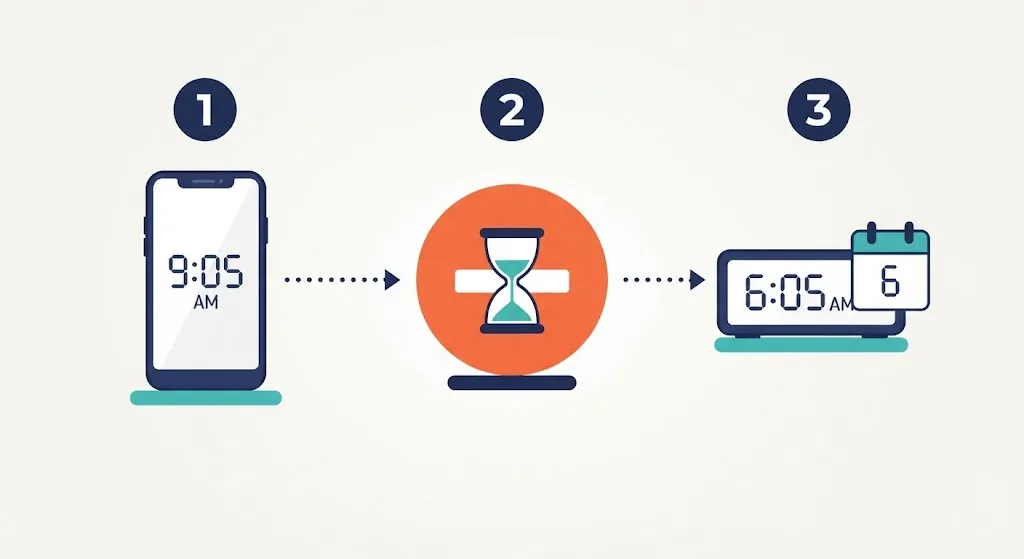
Step 1: Check the Current Time
Read the exact time from your phone, watch or computer, including AM or PM. Skip the rounding. A vague starting point makes every later step unreliable.
Example: current time = 9:05 AM.
Step 2: Subtract Three Hours
Take 3 off the hour and leave the minutes exactly where they are.
9:05 AM − 3 hours = 6:05 AM
AM and PM only flip if the subtraction carries you across noon or midnight. From 9:05 AM, you stay in the morning. From 1:30 AM, three hours back crosses midnight into the previous evening, which the next step covers.
Step 3: Check Whether the Date Changes
If the result crosses midnight, move the date back one day. This happens whenever the current time is between 12:00 AM and 2:59 AM.
Example: 2:20 AM on Wednesday − 3 hours = 11:20 PM on Tuesday.
This step gets skipped more often with three hours than with a shorter gap, simply because the early-morning window is wider. Always glance at the date whenever your starting hour is 12, 1 or 2 in the morning.
Why People Search “What Was 3 Hours Ago From Now”
Most apps skip the exact clock time and show a gap instead. You end up doing the subtraction yourself. Phrases like these show up constantly:
- “Active 3h ago” under a contact’s profile
- “Package scanned 3 hours ago” in a delivery tracker
- “Last updated 3 hours ago” on a weather app
- “Posted 3h” under a forum reply
- “Reservation confirmed 3 hours ago” on a booking site
None of these give you a real clock time on their own. If it is 12:05 PM and a tracking app says a package was “scanned 3 hours ago,” it happened at about 9:05 AM.
Remember that these labels usually round to the nearest hour, so “3 hours ago” can mean anywhere from a little over two hours to nearly four hours earlier. That is fine for a quick glance, but for anything you need to confirm, open the record and look for the exact timestamp.
Everyday Situations Where Time Three Hours Earlier Matters
Three hours is a substantial slice of the day. It shows up in commutes, sleep, cooking and study more often than people realize.
A Morning Commute
Some commutes, door to desk, stretch close to three hours when you count the walk, the transfer and the wait. If you left home three hours ago, you have likely settled into your first task of the day by now.
An Afternoon Nap
A longer weekend nap can run close to three hours without you noticing. If you woke up and want to know when you actually dozed off, counting back three hours from now gives you a solid estimate, even with the grogginess still setting in.
A Roast or Slow-Cook Cooking Time
Many roasts and slow-cooked dishes need about three hours in the oven or slow cooker. If dinner just came out and it took three hours, working backward tells you exactly when it went in, which is handy for planning the next one.
A Study Session Block
Focused study sessions, especially before an exam, often run in three-hour blocks with a short break in the middle. If you just closed your books after three hours, counting back tells you when the session actually started.
Time Arithmetic Made Simple
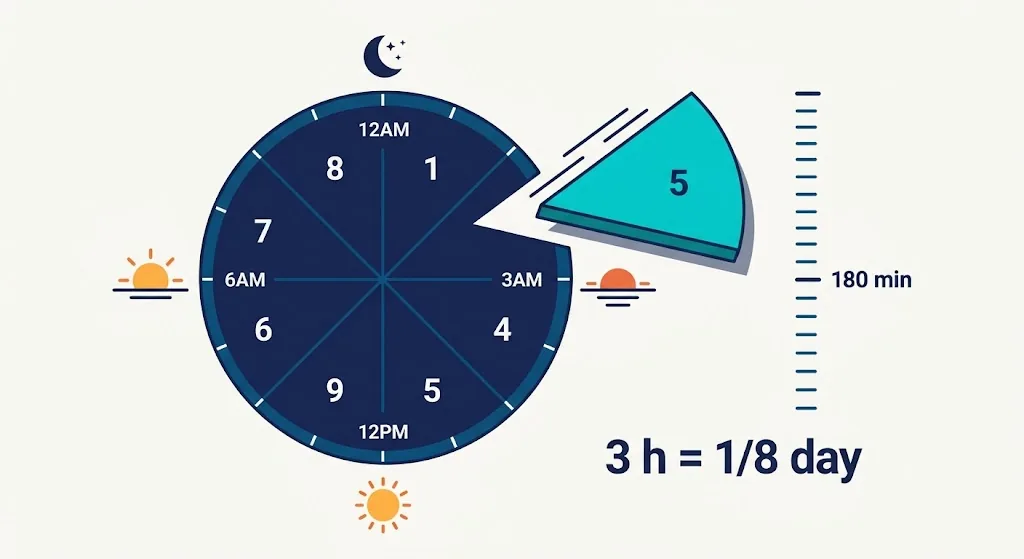
Three hours is exactly one eighth of a 24-hour day. Holding onto that single fact makes the rest of the numbers easy to recall.
| Unit | Equal to 3 hours |
|---|---|
| Hours | 3 |
| Minutes | 180 |
| Seconds | 10,800 |
| Milliseconds | 10,800,000 |
| Days | 0.125 (one eighth) |
| Weeks | ≈ 0.0179 |
The minute figure comes in handy most often. 3 × 60 = 180, so three hours ago and 180 minutes ago point to the exact same instant. Cooking timers, study apps and parking systems often work in minutes, so this conversion earns its keep.
The eighth-of-a-day idea also works as a quick sanity check. Split the clock face into eight equal wedges, one for every three hours. Stepping back three hours always moves you exactly one wedge around the dial.
Read also: What Time Was It 1 Hour Ago? Live Calculator, Chart & Easy Steps
Examples Using Both 12-Hour and 24-Hour Clock
Some readers think in AM and PM, others prefer the 24-hour clock used at work or on transit schedules. The chart below covers every hour of the day in both formats.
12-Hour Clock
The 12-hour clock uses AM for the morning and PM for the afternoon and evening. Rows marked “yesterday” cross midnight.
| Current time | 3 hours ago | 24-hour format |
|---|---|---|
| 12:00 AM (midnight) | 9:00 PM yesterday | 00:00 → 21:00 |
| 1:00 AM | 10:00 PM yesterday | 01:00 → 22:00 |
| 2:00 AM | 11:00 PM yesterday | 02:00 → 23:00 |
| 3:00 AM | 12:00 AM (midnight) | 03:00 → 00:00 |
| 4:00 AM | 1:00 AM | 04:00 → 01:00 |
| 5:00 AM | 2:00 AM | 05:00 → 02:00 |
| 6:00 AM | 3:00 AM | 06:00 → 03:00 |
| 7:00 AM | 4:00 AM | 07:00 → 04:00 |
| 8:00 AM | 5:00 AM | 08:00 → 05:00 |
| 9:00 AM | 6:00 AM | 09:00 → 06:00 |
| 10:00 AM | 7:00 AM | 10:00 → 07:00 |
| 11:00 AM | 8:00 AM | 11:00 → 08:00 |
| 12:00 PM (noon) | 9:00 AM | 12:00 → 09:00 |
| 1:00 PM | 10:00 AM | 13:00 → 10:00 |
| 2:00 PM | 11:00 AM | 14:00 → 11:00 |
| 3:00 PM | 12:00 PM (noon) | 15:00 → 12:00 |
| 4:00 PM | 1:00 PM | 16:00 → 13:00 |
| 5:00 PM | 2:00 PM | 17:00 → 14:00 |
| 6:00 PM | 3:00 PM | 18:00 → 15:00 |
| 7:00 PM | 4:00 PM | 19:00 → 16:00 |
| 8:00 PM | 5:00 PM | 20:00 → 17:00 |
| 9:00 PM | 6:00 PM | 21:00 → 18:00 |
| 10:00 PM | 7:00 PM | 22:00 → 19:00 |
| 11:00 PM | 8:00 PM | 23:00 → 20:00 |
Look at the first three rows. Midnight, 1:00 AM and 2:00 AM all send you back to the evening before. Every other hour of the day stays on today’s date.
24-Hour Clock
The 24-hour clock drops AM and PM entirely, so the subtraction reads even cleaner. Just take 3 from the hour.
16:40 − 3 hours = 13:40
When the hour is smaller than 3, the result dips below zero. Add 24 and step back one day.
01:15 − 3 = −1:45 → add 24 → 22:15 yesterday
This “add 24” rule is the same one every digital clock and calendar app runs behind the scenes.
What Time Will It Be in 3 Hours?
The reverse question swaps subtraction for addition:
Time 3 hours from now = Current time + 3 hours
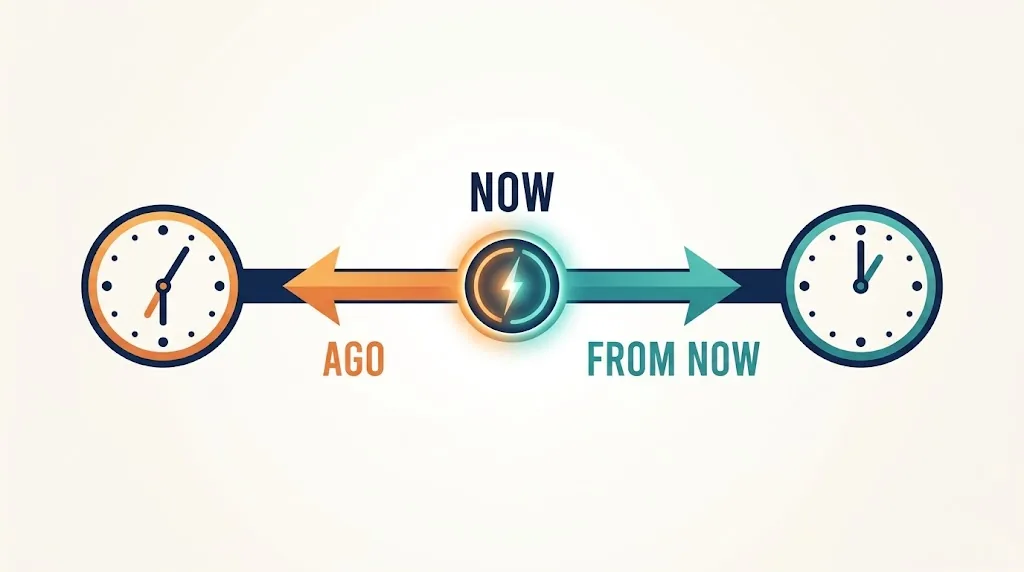
- 7:50 AM + 3 hours = 10:50 AM
- 10:40 PM + 3 hours = 1:40 AM the next day
Here is a useful fact: three hours ago and three hours from now are always exactly six hours apart. At 9:05 AM, one is 6:05 AM and the other is 12:05 PM. That gap gives you a quick way to check either answer.
Read also: What Time Was It 12 Hours Ago?
Time Zones Can Change Everything
Say “three hours ago” to a friend in another country, and their clock will not agree with yours. The instant is identical for both of you, but each local dial names it differently.
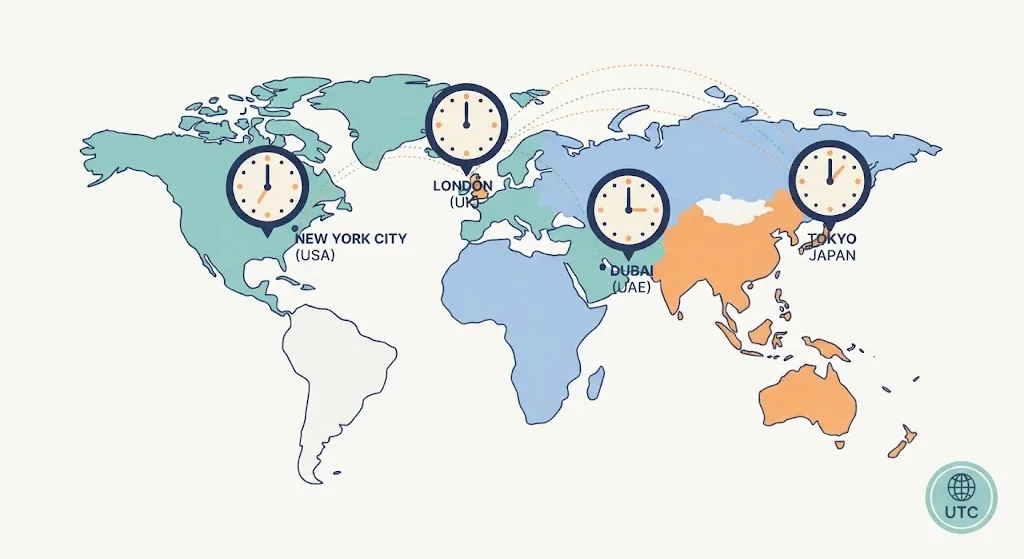
Servers and apps frequently store events in UTC (Coordinated Universal Time) even though your screen shows local time. Treat a UTC timestamp as if it were already local, subtract three hours, and your answer can be wrong by hours, not minutes.
Picture the instant “3 hours ago from 12:00 PM UTC” landing in four cities at once (standard time):
| City | Offset | Now | 3 hours ago |
|---|---|---|---|
| New York | UTC−5 | 7:00 AM | 4:00 AM |
| London | UTC+0 | 12:00 PM | 9:00 AM |
| Dubai | UTC+4 | 4:00 PM | 1:00 PM |
| Tokyo | UTC+9 | 9:00 PM | 6:00 PM |
Before you lean on any cross-border answer, run through this short checklist:
- Your own local time, right now
- Today’s actual date
- Which time zone you are sitting in
- Whether the source timestamp was recorded in UTC or local time
- Whether daylight saving is currently in effect
For ordinary daily questions, the clock in your pocket is enough. Zones only start to matter once the people, servers or events involved are scattered across the map.
Technology Depends on Accurate Time Calculation
Your phone has no concept of a clock face ticking backward. Underneath the screen, it keeps a single ever-growing number: seconds elapsed since January 1, 1970, in UTC. Engineers call that number a Unix timestamp.
Finding three hours ago just means pulling 10,800 off that number, then translating the result back into a date and clock time you can read. Because the whole calculation happens on one unbroken counter, midnight, the end of a month and leap years never trip it up.
A calculator running in your browser already knows your local clock, so its output lines up with your zone automatically. Under the hood it is quietly solving all of this for you:
- The jump across midnight
- A rollover into a new date, month or year
- Minutes and seconds, kept exact
- Switching between 12-hour and 24-hour display
- Gaps caused by time zones or daylight saving
Using a 3 Hours Ago Calculator
Skip the mental arithmetic and let a tool give you the precise moment. The box below starts from your device’s own clock, and you are free to swap in a different date, time or hour count.
Hours Ago Calculator
Behind the buttons, this tool and most others like it work through the same short routine:
- Grab the current date and time.
- Note how many hours you typed in.
- Subtract that many hours from the start point.
- Roll the date back a day if midnight was crossed.
- Print the result in a format you can read at a glance.
Look for a calculator that also accepts a custom start point, displays both the 12-hour and 24-hour figure together, and throws in the “from now” result for free. That combination covers almost everything you would otherwise have to look up twice.
Common Mistakes People Make
A three-hour subtraction seems foolproof, yet the same handful of slip-ups reappear over and over.
Forgetting the Date
Start the clock anywhere between midnight and 2:59 AM, and the true answer sits on yesterday’s date. Jot down “11:20 PM” without the word “yesterday” attached, and a log can end up a full day off.
Mixing Up AM and PM
Crossing noon or midnight during the subtraction swaps AM for PM. 1:30 AM − 3 hours = 10:30 PM the day before, never 10:30 AM. Treat any starting hour of 12, 1 or 2 in the morning as a signal to double-check.
Changing the Minutes
A whole-hour subtraction leaves the minutes exactly as they were. 8:15 PM − 3 hours = 5:15 PM. Spot a different minute value in your result, and something upstream went wrong.
Ignoring Time Zones
A UTC timestamp, or one logged in a distant city, will not match what your own clock reads. Sort out the zone conversion first, then run the subtraction.
Confusing Three Hours Ago With Three Hours From Now
Looking backward means subtracting; looking forward means adding. Say which direction you actually mean before you start doing the math, and the two never get swapped.
Why Relative Time Feels Different From Exact Time
A relative label lands faster in the brain than a raw clock digit does. Read “3 hours ago” and you instantly gauge how fresh something is. Read “6:05 AM” instead, and you have to stop and measure the gap yourself.
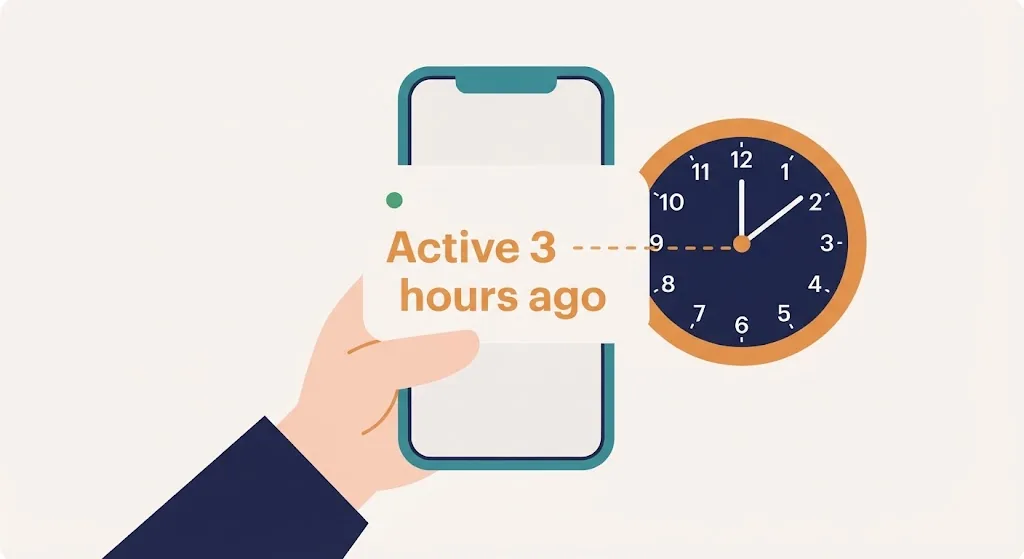
There is a catch, though: a relative label never freezes. What reads as three hours ago this second reads as three hours and one minute ago the next. It only holds true for the instant you glance at it.
That is exactly why apps quietly rewrite these labels on a timer, and why any record worth keeping needs a fixed timestamp behind the friendly text. Save the relative phrase for a quick read on freshness, and reach for the exact time whenever proof matters.
Frequently Asked Questions
What time was it 3 hours ago?
Subtract three hours from your current time and keep the minutes the same. If it is 9:05 AM now, it was 6:05 AM three hours ago. The live box at the top of this page shows the exact answer for your own clock.
How many minutes is 3 hours?
There are 180 minutes in 3 hours, since 3 × 60 = 180.
How many seconds is 3 hours?
Three hours contain 10,800 seconds, which is 3 × 60 × 60.
Is 3 hours ago always on today’s date?
Not quite. Start anywhere from 12:00 AM through 2:59 AM and the answer lands on yesterday instead. Outside that early window, the date never moves.
What formula finds the time 3 hours ago?
Time 3 hours ago = current time − 3 hours. Working in 24-hour notation, a result under zero just needs 24 added back in, with the date pushed one day earlier.
How do I work out 3 hours ago in military (24-hour) time?
Take 3 off the hour figure. 18:20 turns into 15:20, and 04:10 turns into 01:10. Starting from 02:00, you land on 23:00 the day before.
How is 3 hours ago different from 3 hours from now?
“Ago” looks backward, so subtract. “From now” looks forward, so add. Line them both up on the clock and they are always six hours apart, no exceptions.
Do time zones affect the result?
They do. One single moment in time carries a different label in every zone. Translate a UTC timestamp into your own local time before running the subtraction.
How can I find 3 hours ago in my head?
It is quick once you know the trick: drop 3 from the hour, leave the minutes untouched, and only pause to flip AM/PM or roll the date back if the hour dips under zero.
Why does the answer to 3 hours ago keep changing?
Because “now” itself is a moving target. As each minute ticks by, the moment three hours behind it ticks forward right along with it.
What time was it 3 hours ago if it is midnight now?
Starting from 12:00 AM, three hours earlier lands at 9:00 PM the day before — 21:00 on the 24-hour clock.
What time was it 3 hours ago if it is noon now?
Starting from 12:00 PM, three hours earlier lands at 9:00 AM that same morning — 09:00 on the 24-hour clock.
Conclusion
Three hours ago boils down to a single move: take three hours off the current time. The minutes and seconds ride along untouched, AM flips to PM (or back) only when you cross noon or midnight, and the date slides back a day for any start before 3:00 AM.
For a snap mental check, picture the hour hand sliding back three ticks on the dial. When you need proof, a different time zone, or a custom starting point, the calculator above hands you both formats and the exact date in an instant.
Read also: What Time Was It 2 Hours Ago? Live Calculator, Chart & Easy Steps

Liam Joseph Miller is an experienced writer with 6 years of expertise in creating clear, informative, and reader-friendly content. He specializes in words, phrases, slang, definitions, names, and everyday meanings, helping readers understand language in a simple and practical way.