
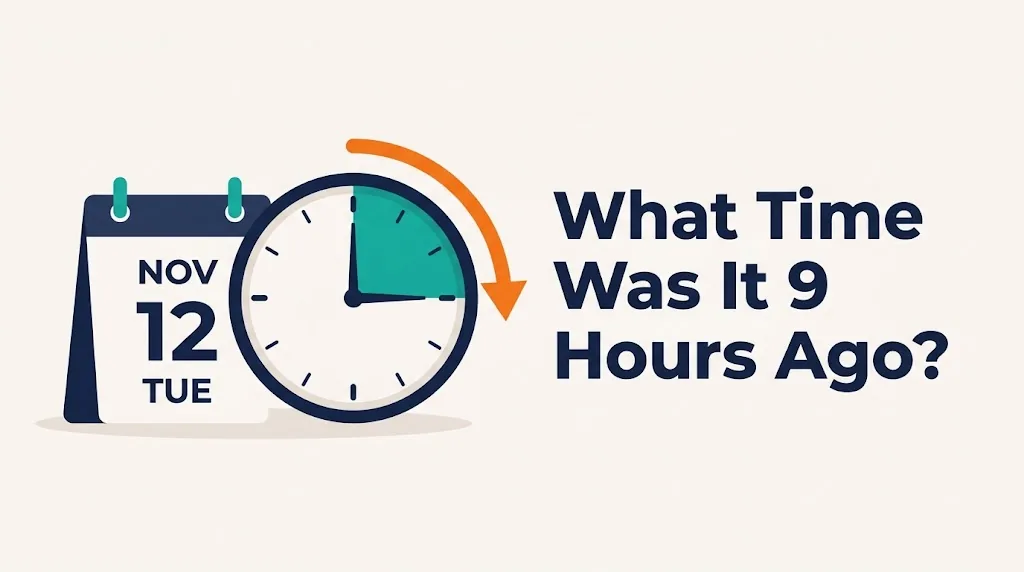
What time was it 9 hours ago? Subtract nine hours from the time on your clock and leave the minutes as they are. At 7:25 PM, the answer is 10:25 AM the same day.
Nine hours is a big jump. It is longer than a full night’s sleep and close to a whole working day. That is why the answer often lands on yesterday: any time before 9:00 AM sends you back to the evening before. This page gives you the live answer, a chart for every hour, and a simple method that never fails.
Quick answer
It is now your current time.
Nine hours ago it was now minus 9 hours (7:25 PM → 10:25 AM)
Mental trick: jump back 12 hours (swap AM/PM), then add 3.
- 9 hours ago = the time now − 9 hours. The minutes stay the same.
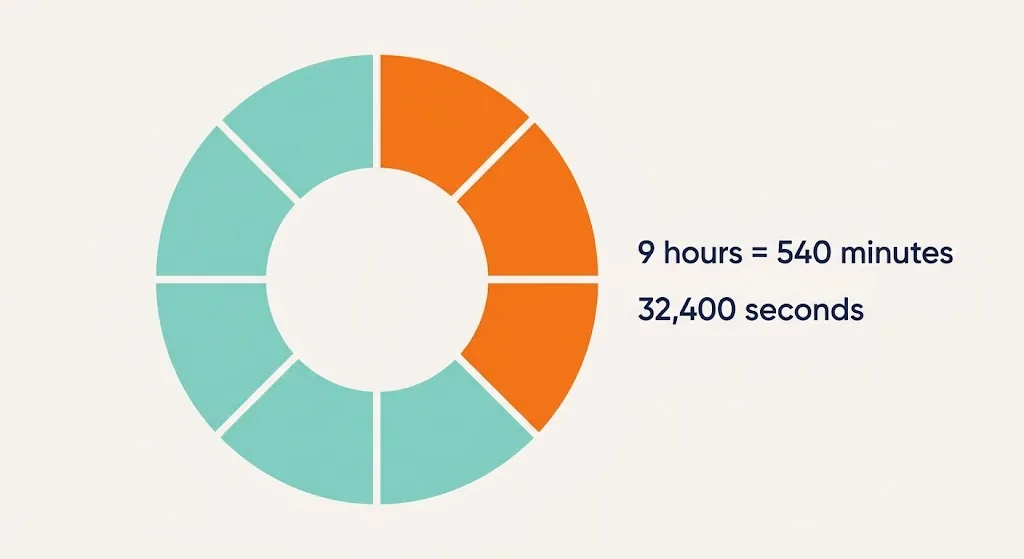
- Nine hours equals 540 minutes, 32,400 seconds, or 3/8 of a day.
- If it is earlier than 9:00 AM, the answer falls on the day before.
- At exactly 9:00 AM, nine hours ago was midnight at the start of today.
Why Do People Search “What Time Was It 9 Hours Ago”?
Most apps do not show clock times. They show gaps. You see “9h” next to a post, “9 hours ago” under an email, or “last active 9h ago” on a profile. That tells you how long, but not when.
People turn that gap into a real time for all sorts of reasons:
- Finding the moment a package was scanned or a ride was booked
- Checking when a colleague abroad sent a message
- Working out when they last ate before a blood test
- Logging how long a phone or laptop has been charging
- Matching a bank alert with a purchase from earlier in the day
- Seeing whether a post went up before or after a deadline
For example, if it is 10:05 PM and a voice note says “9h,” it arrived at about 1:05 PM. If it is 6:40 AM, the same label means about 9:40 PM last night. Same label, different day.
Understanding Time Arithmetic
Time does not count in tens like money. It counts in sixties for minutes and seconds, and it resets every 24 hours for the day. That is why clock sums can feel strange at first.
The good news: when you subtract whole hours, you never touch the minutes. Only the hour changes, and maybe the date.
Time 9 hours ago = Current time − 9 hours
Try it with 11:48 PM. Take 9 from 11 and you get 2. The minutes stay at 48. The answer is 2:48 PM, same day, still PM.
Now try 1:20 PM. Take 9 from 1 and you get a negative number. That tells you the clock has rolled back past noon. The answer is 4:20 AM. In the next sections you will see two easy ways to deal with that roll-back without any guesswork.
What Time Was It 9 Hours Ago Using the 12-Hour Clock
On a 12-hour clock, nine hours back almost always flips AM to PM or PM to AM. The only times it does not flip are from 9:00 to 11:59, in the morning or the evening. From 11:48 PM you stay in PM. From 10:00 AM you stay in AM.
The fastest trick is back 12, forward 3. Going back 12 hours keeps the digits and only swaps AM/PM. Then add 3, because 12 − 9 = 3. From 7:25 PM: back 12 is 7:25 AM, forward 3 is 10:25 AM. Done.
Here is the full chart for all 24 hours. “Yesterday” marks the rows that cross midnight.
| Current time | 9 hours ago | 24-hour format |
|---|---|---|
| 12:00 AM (midnight) | 3:00 PM yesterday | 00:00 → 15:00 |
| 1:00 AM | 4:00 PM yesterday | 01:00 → 16:00 |
| 2:00 AM | 5:00 PM yesterday | 02:00 → 17:00 |
| 3:00 AM | 6:00 PM yesterday | 03:00 → 18:00 |
| 4:00 AM | 7:00 PM yesterday | 04:00 → 19:00 |
| 5:00 AM | 8:00 PM yesterday | 05:00 → 20:00 |
| 6:00 AM | 9:00 PM yesterday | 06:00 → 21:00 |
| 7:00 AM | 10:00 PM yesterday | 07:00 → 22:00 |
| 8:00 AM | 11:00 PM yesterday | 08:00 → 23:00 |
| 9:00 AM | 12:00 AM (midnight) | 09:00 → 00:00 |
| 10:00 AM | 1:00 AM | 10:00 → 01:00 |
| 11:00 AM | 2:00 AM | 11:00 → 02:00 |
| 12:00 PM (noon) | 3:00 AM | 12:00 → 03:00 |
| 1:00 PM | 4:00 AM | 13:00 → 04:00 |
| 2:00 PM | 5:00 AM | 14:00 → 05:00 |
| 3:00 PM | 6:00 AM | 15:00 → 06:00 |
| 4:00 PM | 7:00 AM | 16:00 → 07:00 |
| 5:00 PM | 8:00 AM | 17:00 → 08:00 |
| 6:00 PM | 9:00 AM | 18:00 → 09:00 |
| 7:00 PM | 10:00 AM | 19:00 → 10:00 |
| 8:00 PM | 11:00 AM | 20:00 → 11:00 |
| 9:00 PM | 12:00 PM (noon) | 21:00 → 12:00 |
| 10:00 PM | 1:00 PM | 22:00 → 13:00 |
| 11:00 PM | 2:00 PM | 23:00 → 14:00 |
Count the “yesterday” rows: there are nine of them. More than a third of the day sends you back to the previous date. That is far more than with shorter gaps like five or six hours.
How to Calculate 9 Hours Ago Without a Calculator
This three-step method uses the 24-hour clock. It works for every time of day, including the awkward early-morning hours.
Step 1: Identify the Current Time
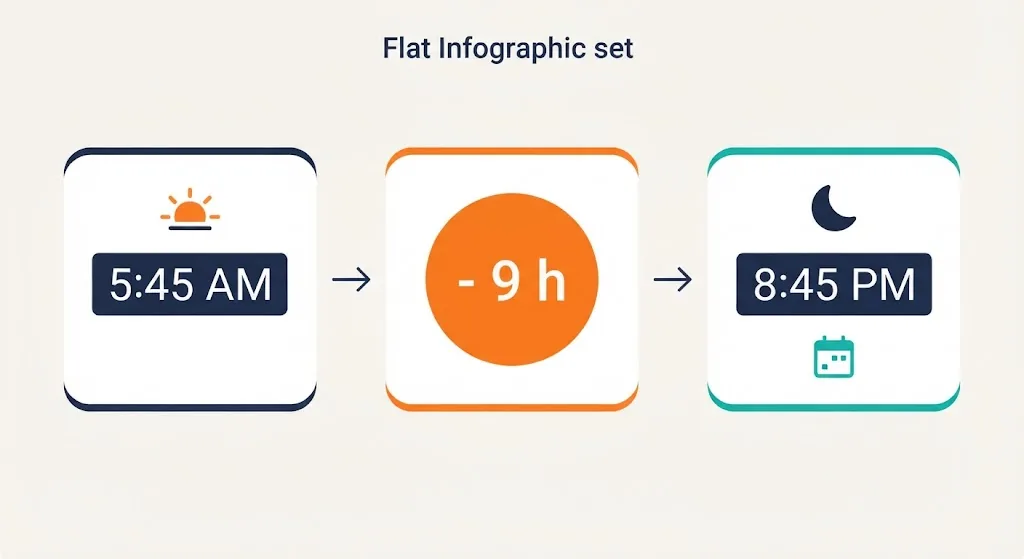
Read the exact time and turn it into 24-hour form. Morning hours stay the same. For afternoon and evening hours, add 12. Say it is 5:45 AM on Monday. In 24-hour time that is 05:45.
Step 2: Subtract Nine Hours
Take 9 away from the hour only: 5 − 9 = −4. Keep the 45 minutes aside. A result of zero or more is your answer right away. A negative result means you went past midnight, so go to step 3.
Step 3: Add 24 Hours
Add 24 to the negative hour: −4 + 24 = 20. Put the minutes back to get 20:45, which is 8:45 PM. Because you crossed midnight, the date moves back too. The answer is 8:45 PM on Sunday.
Adding 24 is not a trick. A day has 24 hours, so going back 9 hours from early morning is the same as going forward 15 hours from the same time yesterday.
When the Previous Day Matters
With nine hours, the date change is not a rare edge case. It happens for every start time from 12:00 AM to 8:59 AM. That covers the whole night and most of the morning commute.
Here is a real case. You wake at 8:30 AM on Friday and want to know when a late email came in “9 hours ago.” The answer is 11:30 PM on Thursday. If you log it as “11:30 PM Friday,” your record is a full day off.
The date can also jump across months and years. At 7:00 AM on March 1, nine hours ago was 10:00 PM on the last day of February. That day is the 28th, or the 29th in a leap year. At 4:00 AM on January 1, nine hours ago was 7:00 PM on New Year’s Eve.
Breaking Down 9 Hours
Nine hours is exactly three eighths of a day. If you cut a 24-hour day into eight equal slices of three hours, nine hours fills three of them.
| Unit | Equal to 9 hours |
|---|---|
| Hours | 9 |
| Minutes | 540 |
| Seconds | 32,400 |
| Milliseconds | 32,400,000 |
| Days | 0.375 (3/8) |
| Weeks | ≈ 0.0536 |
The minutes figure comes up most: 9 × 60 = 540. So “540 minutes ago” is just another way to say “9 hours ago.” Keep 32,400 in mind too, because code and spreadsheets often work in seconds.
Using a Time Calculator
The box below does the whole job for you. It starts with your device’s clock and time zone, so the answer matches the clock on your wall. You can also type in any date, time and number of hours.
Hours Ago Calculator
A calculator earns its place when:
- You need the date as well as the time
- The start time is not “now,” such as a time from a receipt
- You want seconds to be exact
- You need to repeat the sum for many times in a row
- You want the “from now” answer next to the “ago” answer
Read also: What Time Was It 5 Hours Ago? Live Answer, Full Chart & Examples
What Happens Across Different Time Zones?
The length of nine hours never changes. What changes is the label each clock puts on the start and the end. If you and a friend in another country both look back nine hours, you point at the same moment but read different clock times.
Take one moment, 14:00 UTC in winter, and go back nine hours in four places:
| City | Offset | Now | 9 hours ago |
|---|---|---|---|
| Los Angeles | UTC−8 | 6:00 AM | 9:00 PM (previous day) |
| London | UTC+0 | 2:00 PM | 5:00 AM |
| Cairo | UTC+2 | 4:00 PM | 7:00 AM |
| Tokyo | UTC+9 | 11:00 PM | 2:00 PM |
In Los Angeles the answer is on yesterday’s date, while in Tokyo it is still the same afternoon. When a moment involves two places, always ask which clock the time belongs to.
What Time Will It Be in 9 Hours?
The mirror question is common too. To look ahead, add nine hours instead of taking them away.
Time 9 hours from now = Current time + 9 hours
- 8:10 AM + 9 hours = 5:10 PM (a typical workday)
- 6:35 PM + 9 hours = 3:35 AM the next day
Nine hours ago and nine hours from now are always 18 hours apart. At 7:25 PM, one is 10:25 AM today and the other is 4:25 AM tomorrow. If your two answers are not 18 hours apart, check them again.
What Time Was It 9 Hours Ago in Everyday Life
Nine hours lines up neatly with two big parts of life: a long night’s sleep and a full workday. That makes it one of the most practical gaps to know.
Tracking Sleep
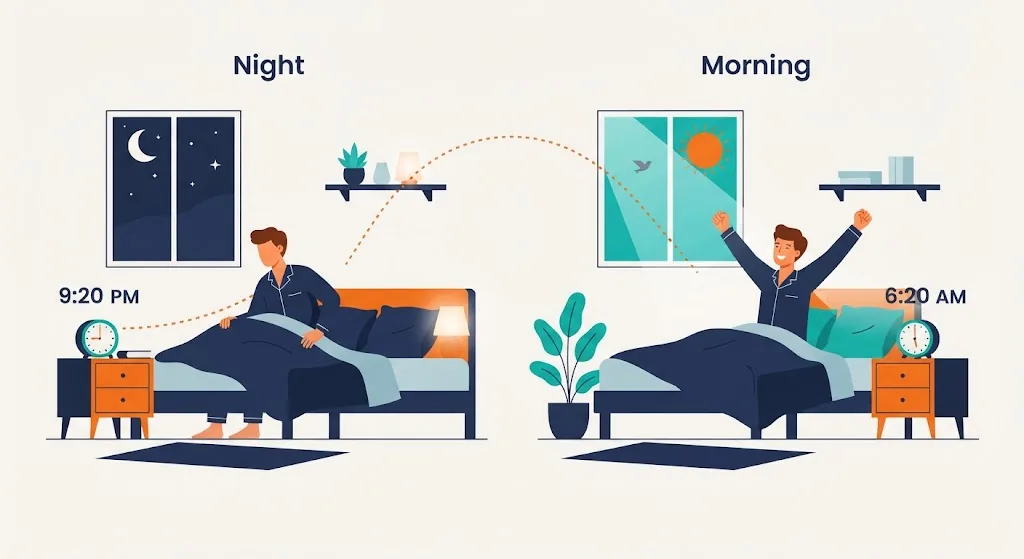
Health guides often suggest 7 to 9 hours of sleep for adults. If you wake at 6:20 AM and want a full nine hours, you should have been asleep by 9:20 PM the night before. Working backward from your alarm is the easiest way to plan a bedtime.
Remembering Conversations
Someone says, “I told you about it nine hours ago.” If it is 10:05 PM now, that talk happened around 1:05 PM, likely over lunch. Knowing the clock time helps you scroll straight to the right part of a chat instead of reading the whole day.
Medication Reminders
Some medicines are taken twice a day, roughly every 12 hours. If you took a dose at 8:15 PM and it is 5:15 AM, nine hours have passed and about three remain. That is a helpful check, but it is not advice. Always follow your prescription label, and ask a pharmacist if you are unsure.
Work Shifts
A nine-hour day with a one-hour lunch is a common full-time pattern. If you left work at 5:40 PM after nine hours on site, you arrived at 8:40 AM. That quick check is handy when filling in a timesheet from memory.
Common Mistakes When You Subtract 9 Hours
The math is easy. The slips come from rushing. These four are the most common.
Forgetting Midnight
At 7:50 AM, nine hours ago was 10:50 PM yesterday. Writing just “10:50 PM” leaves the reader to guess the day, and many will guess wrong.
Mixing Up AM and PM
From 1:20 PM, the answer is 4:20 AM, not 4:20 PM. Nine hours back flips AM and PM for most start times, so check the label every time.
Ignoring Time Zones
A server log in UTC or a message stamped in a colleague’s city will not match your clock. Convert it to your own time zone first, then subtract nine hours.
Subtracting From the Wrong Hour
People often round the start first, then subtract. At 3:52 PM, rounding to 4:00 PM gives 7:00 AM, but the true answer is 6:52 AM. Always start from the exact time, minutes included.
Read also: What Time Was It 6 Hours Ago? Live Calculator, Chart & Easy Steps
Reverse Time Calculation Made Simple
If you like to see each step, walk the clock back one hour at a time. Start at 11:00 AM:
10 AM (1) → 9 AM (2) → 8 AM (3) → 7 AM (4) → 6 AM (5) → 5 AM (6) → 4 AM (7) → 3 AM (8) → 2 AM (9)
So nine hours before 11:00 AM is 2:00 AM the same day.
Counting works, but nine steps is a lot. A shorter path is to split nine into easy pieces. Go back 10 hours, then forward 1. From 11:00 AM, back 10 is 1:00 AM and forward 1 is 2:00 AM. Or use “back 12, forward 3.” Pick whichever feels natural to you.
Why Online Time Calculators Are So Popular
People reach for calculators because they remove the three things that cause errors: AM/PM flips, date changes and seconds. You type or tap, and the tool shows a clean result.
Seconds are a good example. They carry through unchanged when you subtract whole hours:
8:52:36 AM − 9 hours = 11:52:36 PM yesterday
Doing that in your head is possible, but it is easy to drop the date. A calculator shows the time, the date and both clock formats at once. That is why so many people use one even for simple sums.
Example Calculations
Here are eight worked examples from all parts of the day. Use them to test yourself before you look at the answer column.
| Current time | 9 hours ago | Same day? |
|---|---|---|
| 12:15 AM | 3:15 PM | No, yesterday |
| 5:40 AM | 8:40 PM | No, yesterday |
| 9:55 AM | 12:55 AM | Yes |
| 12:05 PM | 3:05 AM | Yes |
| 2:25 PM | 5:25 AM | Yes |
| 6:10 PM | 9:10 AM | Yes |
| 9:35 PM | 12:35 PM | Yes |
| 11:50 PM | 2:50 PM | Yes |
Notice the 9:55 AM row. It lands just after midnight, at 12:55 AM, so it is still the same date. Only times before 9:00 AM roll back to yesterday.
Human Memory and Time
Nine hours is long enough for memory to blur. Most of us remember what happened this morning, but not when. “It was before coffee” or “sometime after the school run” is the best we can do.
That is normal. The brain stores events in order, not with clock stamps. To fix the gap, look for traces that do have times: a photo, a card payment, a step count, a call log. One solid time lets you rebuild the rest of the morning around it.
If you only have a relative clue, like “about nine hours ago,” treat it as a range. Nine hours could easily mean eight and a half or nine and a half.
Digital Messages and Time Stamps
Apps love short labels such as “9h” or “9 hours ago.” These are rounded down. A post marked “9h” could be anywhere from 9 hours to 9 hours and 59 minutes old. Tap or hover on it and most apps will show the full date and time.

Email is a little different. The full header shows the sender’s time and an offset such as “+0900” or “−0500.” That offset tells you how far that clock is from UTC. Your mail app then converts it to your local time. If a time looks odd, the offset is usually the reason.
Time Zones Around the World
The world has about 38 local time offsets in use. Most are whole hours from UTC, but some are not. India is UTC+5:30 and Nepal is UTC+5:45. With those, “nine hours ago” on the other side can land on a half-hour or even a :15 mark.
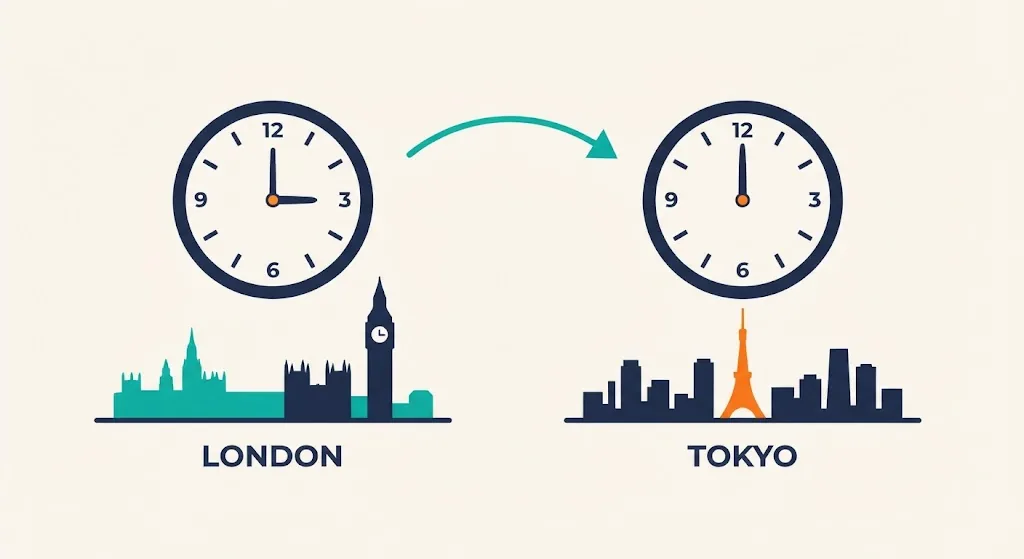
Here is a fun link to this topic. In winter, Tokyo is exactly nine hours ahead of London. So when it is midnight in Tokyo, it is 3:00 PM in London. In other words, a Tokyo resident asking “what time was it 9 hours ago?” gets the time a Londoner sees right now. In summer, when London moves its clocks forward, the gap shrinks to eight hours.
Alaska sits at UTC−9 in winter, so it is nine hours behind London. Keep examples like these in mind when you work with people across the world.
How Computers Perform Time Difference Calculation
Computers skip the clock face completely. They count time as one long number, often the seconds since January 1, 1970, UTC. To go back nine hours, they take away 32,400 from that number and then format the result as a local date and time.
You can do the same yourself in common tools:
- Excel or Google Sheets:
=NOW()-9/24(a day is 1, so 9 hours is 9/24) - JavaScript:
new Date(Date.now() - 9*3600*1000) - Python:
datetime.now() - timedelta(hours=9)
Because the math runs on one steady count, midnight, month ends and leap years never cause trouble. The only thing a program needs from you is the right time zone for the output.
Manual Formula
If you want one rule to keep in your head, use this:
Hour 9 hours ago = Current hour − 9 (if below 0, add 24 and go back one day)
Two quick tests in 24-hour time:
- 21:35 → 21 − 9 = 12 → 12:35 (12:35 PM, same day)
- 02:50 → 2 − 9 = −7 → −7 + 24 = 17 → 17:50 (5:50 PM, yesterday)
For the 12-hour clock, the “back 12, forward 3” shortcut does the same job. Use whichever rule you trust more, then check with the calculator when the result really matters.
Read also: What Time Was It 11 Hours Ago?
Frequently Asked Questions
What time was it 9 hours ago?
Take nine hours off your current time and keep the minutes. At 7:25 PM, nine hours ago was 10:25 AM. The live box at the top of this page shows the answer for your own clock.
How many minutes does 9 hours contain?
Nine hours contain 540 minutes, because 9 × 60 = 540.
What is 9 hours in seconds?
It is 32,400 seconds (9 × 60 × 60).
If the clock shows 5 PM, what time was it 9 hours earlier?
It was 8:00 AM the same day. In 24-hour time, 17:00 minus 9 hours is 08:00.
What was the time 9 hours before 6 AM?
It was 9:00 PM on the previous evening, because counting back from 6:00 AM passes midnight.
When does 9 hours ago land on the previous day?
Whenever the current time is between 12:00 AM and 8:59 AM. At 9:00 AM exactly, nine hours ago was midnight at the start of today.
Do the minutes change when you go back 9 hours?
No. Subtracting whole hours leaves the minutes and seconds as they are. 3:52 PM becomes 6:52 AM.
Does my time zone change the answer?
The moment is the same everywhere, but each place shows a different clock time for it. Convert any UTC or foreign time to your own zone before you subtract.
What is a quick mental trick for 9 hours ago?
Go back 12 hours, which only swaps AM and PM, then add 3 hours. From 7:25 PM that gives 7:25 AM, then 10:25 AM.
How far apart are 9 hours ago and 9 hours from now?
They are always 18 hours apart. At 7:25 PM, one is 10:25 AM today and the other is 4:25 AM tomorrow.
What time was it 9 hours ago at 9 AM?
At 9:00 AM, nine hours ago was exactly 12:00 AM, which is midnight at the very start of the same day.
Conclusion
To find what time it was 9 hours ago, take nine hours off the current time and keep the minutes. Watch the AM/PM label, because it flips for most start times. Watch the date as well, because any time before 9:00 AM takes you back to yesterday.
For a quick answer in your head, go back 12 hours and forward 3. For logs, time zones or a start time other than now, use the calculator above. It shows the exact time and date in both formats in one click.

Liam Joseph Miller is an experienced writer with 6 years of expertise in creating clear, informative, and reader-friendly content. He specializes in words, phrases, slang, definitions, names, and everyday meanings, helping readers understand language in a simple and practical way.