
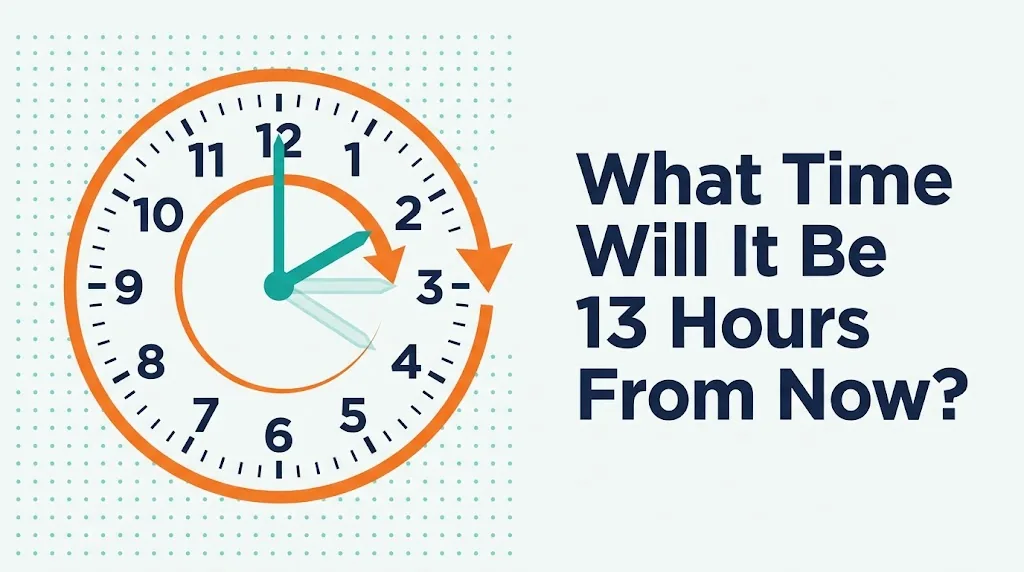
What time will it be 13 hours from now? Add thirteen hours to the time on your clock and leave the minutes untouched. At 6:05 AM, the answer is 7:05 PM the same day.
Start the count before sunrise and thirteen hours later you land in mid-afternoon; start it once late morning has already passed and that same span carries you clean into the middle of tomorrow’s night. That overnight-into-afternoon swing is roughly what a transpacific flight covers, or the window a family might use for a video call across oceans, or an early-morning deadline that’s due the same evening. Below you’ll find a live reading for your own device, every one of the 24 starting hours mapped out, and a rollover rule that holds no matter which side of midnight you begin on.
Quick answer
It is now your current time.
In thirteen hours it will be now plus 13 hours (6:05 AM → 7:05 PM)
Mental trick: jump forward 12 hours (swap AM/PM), then step forward 1 more.
- 13 hours from now = the time now + 13 hours. The minutes stay the same.
- Thirteen hours equals 780 minutes, 46,800 seconds, or just over half a day.
- If it is later than 11:00 AM, the answer lands on tomorrow’s date.
- At exactly 11:00 AM, thirteen hours from now is midnight, the start of tomorrow.
Understanding How Time Addition Actually Works
Clocks don’t count in round tens the way a ruler does. Minutes wrap back to zero every sixty, and the whole face resets every 24 hours — which is exactly why a sum in the low teens starts to feel confusing.
The good news: tacking on whole hours never disturbs the minutes at all. Only the hour digit moves, and once in a while it drags the calendar date along with it.
Time 13 hours from now = Current time + 13 hours
Take 9:50 AM as a starting point. Nine plus thirteen is twenty-two, so on the 24-hour dial that lands at 10:00 PM, minutes untouched at 50. Written the familiar way, that’s 10:50 PM the same day.
Now push off from 7:45 PM instead. In 24-hour form that’s 19, and 19 plus 13 is 32 — a number that overshoots the 24-hour ceiling, which is the tell-tale sign the day has flipped. Converted back, that reads 8:45 AM the next morning. Two dependable ways to spot that flip before it catches you out follow below.
Why People Search “What Time Will It Be 13 Hours From Now”
Apps and calendars are happy to show a countdown or a bare duration, but rarely spell out what that turns into on an actual clock face — that last step is left to you.
Here’s where that gap usually shows up:
- Working out the local landing time of a transpacific flight
- Lining up a family video call with someone many time zones away
- Confirming a same-day deadline that started early in the morning
- Setting a reminder a set number of hours before an event
- Figuring out when a “shipping in 13 hours” alert actually arrives
- Planning around a reply that’s promised “in 13 hours”
Say it’s 7:45 PM and a tracking app promises “landing in 13 hours” — touchdown is roughly 8:45 AM. Start that same thirteen-hour wait at 2:40 AM instead, and it wraps up around 3:40 PM. Same length of wait, completely different part of the day at the end of it.
What Time Is 13 Hours From Now Using the 12-Hour Clock
On a 12-hour clock, thirteen hours is slightly more than half a day, so the AM/PM label always flips, plus one extra hour on top.
The fastest trick is forward 12, then forward 1 more. Going forward 12 hours keeps the digits the same and only swaps AM/PM. Then step forward 1, because 13 − 12 = 1. From 6:05 AM: forward 12 is 6:05 PM, forward 1 more is 7:05 PM. Done.
Here is a table of common start times and where thirteen hours forward lands.
| Current time | Add 13 hours | Result |
|---|---|---|
| 2:40 AM | +13 hours | 3:40 PM |
| 6:05 AM | +13 hours | 7:05 PM |
| 9:50 AM | +13 hours | 10:50 PM |
| 12:35 PM | +13 hours | 1:35 AM next day |
| 4:20 PM | +13 hours | 5:20 AM next day |
| 7:45 PM | +13 hours | 8:45 AM next day |
Notice the minutes column never moves down the whole table — that’s the signature of adding whole hours only.
What Time Is 13 Hours From Now in the 24-Hour Clock
The 24-hour clock keeps this to a simple sum. Just add 13 to the hour:
Future hour = Current hour + 13
For example:
- 02:40 + 13 = 15:40
- 06:05 + 13 = 19:05
- 12:35 + 13 = 25:35 next day
- 16:20 + 13 = 29:20 next day
Whenever that sum reaches 24 or more, peel off 24 and push the date one square forward. Take the last line: 16:20 + 13 hours = 29:20. Since 29 sits above 24, subtract 24: 29:20 minus 24:00 leaves 5:20. So the clock reads 5:20 AM the next day.
Full Chart: Add 13 Hours to Every Start Hour
Most rival pages stop at a handful of sample times. Here every one of the 24 possible starting hours gets its own row, so there’s nothing left to guess at.
| Current time | 13 hours from now | 24-hour format |
|---|---|---|
| 12:00 AM (midnight) | 1:00 PM | 00:00 → 13:00 |
| 1:00 AM | 2:00 PM | 01:00 → 14:00 |
| 2:00 AM | 3:00 PM | 02:00 → 15:00 |
| 3:00 AM | 4:00 PM | 03:00 → 16:00 |
| 4:00 AM | 5:00 PM | 04:00 → 17:00 |
| 5:00 AM | 6:00 PM | 05:00 → 18:00 |
| 6:00 AM | 7:00 PM | 06:00 → 19:00 |
| 7:00 AM | 8:00 PM | 07:00 → 20:00 |
| 8:00 AM | 9:00 PM | 08:00 → 21:00 |
| 9:00 AM | 10:00 PM | 09:00 → 22:00 |
| 10:00 AM | 11:00 PM | 10:00 → 23:00 |
| 11:00 AM | 12:00 AM (midnight) next day | 11:00 → 00:00 |
| 12:00 PM (noon) | 1:00 AM next day | 12:00 → 01:00 |
| 1:00 PM | 2:00 AM next day | 13:00 → 02:00 |
| 2:00 PM | 3:00 AM next day | 14:00 → 03:00 |
| 3:00 PM | 4:00 AM next day | 15:00 → 04:00 |
| 4:00 PM | 5:00 AM next day | 16:00 → 05:00 |
| 5:00 PM | 6:00 AM next day | 17:00 → 06:00 |
| 6:00 PM | 7:00 AM next day | 18:00 → 07:00 |
| 7:00 PM | 8:00 AM next day | 19:00 → 08:00 |
| 8:00 PM | 9:00 AM next day | 20:00 → 09:00 |
| 9:00 PM | 10:00 AM next day | 21:00 → 10:00 |
| 10:00 PM | 11:00 AM next day | 22:00 → 11:00 |
| 11:00 PM | 12:00 PM (noon) next day | 23:00 → 12:00 |
Count the rows that spill into tomorrow: thirteen out of twenty-four, just over half the day, all starting at 11:00 AM or later.
Breaking Thirteen Hours Into Smaller Units
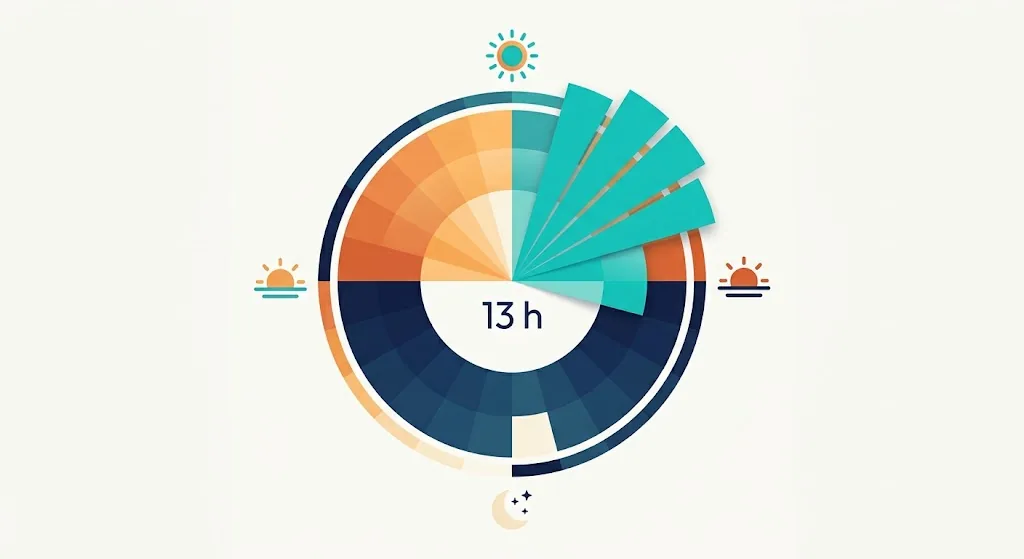
Thirteen hours comes out to just over half a day — 0.542 of 24 hours, one clock-hour past the exact midpoint.
| Unit | Equal to 13 hours |
|---|---|
| Hours | 13 |
| Minutes | 780 |
| Seconds | 46,800 |
| Milliseconds | 46,800,000 |
| Days | 0.542 |
| Weeks | ≈ 0.0774 |
Worth filing away: 13 × 60 = 780, so a countdown reading “780 minutes” is saying exactly the same thing as “13 hours.” Hang onto 46,800 as well — spreadsheets and countdown timers often store durations in raw seconds.
Why Time Zones Matter More Than You Think
A thirteen-hour stretch stays a thirteen-hour stretch no matter which side of the globe you’re standing on. What changes is purely the label a local clock puts on where it starts and stops. Two travelers, oceans apart, both counting thirteen hours ahead, are actually pointing at the very same instant — they just name it differently.

Take one instant, 11:00 PM UTC, and add thirteen hours in four places:
| City | Offset | Now | 13 hours from now |
|---|---|---|---|
| Honolulu | UTC-10 | 1:00 PM | 2:00 AM next day |
| Rome | UTC+1 | 12:00 AM (midnight) | 1:00 PM |
| Nairobi | UTC+3 | 2:00 AM | 3:00 PM |
| Auckland | UTC+12 | 11:00 AM | 12:00 AM (midnight) next day |
Honolulu and Auckland both flip over into the next date, while Rome stays put in the early afternoon. Any time a plan touches more than one city, pin down whose clock a stated time actually belongs to before you commit to it.
Using an Hours From Now Calculator
Skip the mental math and let the box below handle it — it pulls your device’s own clock and time zone automatically, so what you see matches your wall clock, and any field can be overridden if you’d rather test a different date, time or hour count.
Hours From Now Calculator
It earns its keep in cases like:
- Getting the resulting calendar date, not only the clock time
- Starting from something other than right now, like a scheduled call
- Needing the seconds pinned down exactly
- Running the same sum for several different starting points in a row
- Wanting the “ago” figure shown side by side with the “from now” one
Read also: What Time Was It 9 Hours Ago? Live Calculator, Chart & Easy Steps
Manual Time Arithmetic Isn’t Difficult
You rarely need a screen for a thirteen-hour sum — three short steps get you the answer just as fast.

Step 1: Note the Current Time
Read the exact time and switch it to 24-hour form if that helps. Morning hours stay the same; for afternoon and evening hours, add 12. Say it is 6:05 AM on a Thursday. In 24-hour time that is 06:05.
Step 2: Add Thirteen Hours
Add 13 to the hour only: 6 + 13 = 19. Keep the 5 minutes aside. A result under 24 is your answer right away. A result of 24 or more means you crossed midnight, so move to step 3.
Step 3: Convert the Result
19:05 in the 24-hour clock equals 7:05 PM. Put the minutes back and you have the full answer: 6:05 AM + 13 hours = 7:05 PM. If the hour had reached 24 or higher, you would subtract 24 and move the date forward one day.
Everyday Situations Where Thirteen Hours Matters
Because it noses just past the midpoint of a day, thirteen hours keeps turning up in the kind of planning that starts before dawn and finishes well into the afternoon or evening.

A Transpacific Flight
Some of the longest scheduled routes cross an ocean in close to thirteen hours. Taking off at 2:40 AM puts the estimated arrival around 3:40 PM, before any time-zone correction.
A Family Video Call Across Time Zones
Families spread across far-apart countries often need to count thirteen hours to find a moment that works for both. Calling at 9:50 AM your time can mean 10:50 PM for the other end.
A Same-Day Work Deadline
Some deadlines are set thirteen hours after an early start, covering a long working day. Beginning the task at 6:05 AM gives you until 7:05 PM to finish and submit it.
Understanding Future Time Calculations
Peel it back far enough and every future-time question boils down to the same thing: once a stretch of waiting is over, what does the clock say? As a general rule:
Result Clock Time = Starting Clock Time + Length Of Wait
For this page specifically:
Result Clock Time = Starting Clock Time + 13 Hours
It’s a separate question from “when does this end” or “what date is next week,” since here you need both the starting instant and the size of the gap pinned down at the same time.
Related Time Searches
Once the add-thirteen-hours habit sinks in, the same logic carries over to basically any stretch you care to name. Visitors here often branch off to look up:
- Where the clock lands just one hour ahead
- The exact halfway point, twelve hours out
- What fourteen hours from now works out to
- What eighteen hours from now works out to
- A full day forward, which circles back to the same clock face
- What the clock showed a full thirteen hours in the past
- The countdown remaining until a fixed target time arrives
The method stays fixed throughout — swap in a different hour count and the same three steps still carry you to the answer.
Read also: What Time Is 18 Hours From Now? Live Calculator & Full Chart
The Mirror Question: What Time Was It 13 Hours Ago?

People ask this one nearly as often as the forward version. Looking backward instead of ahead just means subtracting thirteen hours in place of adding them.
Time 13 hours ago = Current time − 13 hours
- 12:35 PM − 13 hours = 11:35 PM (the previous day)
- 4:20 PM − 13 hours = 3:20 AM (the same day)
Whatever time you pick, the “ago” answer and the “from now” answer sit 26 hours apart — a full day, plus two. Starting from 4:20 PM, that’s 3:20 AM earlier today against 5:20 AM tomorrow. A gap other than 26 hours between the two is a sign to recheck your arithmetic.
Why Computers Love Milliseconds
Under the hood, most software doesn’t picture a clock face at all. Servers and databases tend to log a moment as one massive millisecond count instead, sidestepping any awkward midnight math entirely.
In that raw form, our thirteen-hour stretch looks like this:
Thirteen hours: 46,800 whole seconds, or 46,800,000 milliseconds.
You never actually see that figure. It stays buried in the background and only gets converted into something a person can read, like 7:05 PM, right at the final step.
Common Mistakes When You Add Hours
None of this arithmetic is genuinely hard — slip-ups almost always trace back to moving too fast. Watch for these five in particular.
Forgetting Midnight
Starting at 7:45 PM and adding thirteen hours does not give you 8:45 PM later that same day. The real answer is 8:45 AM the next day.
Mixing AM and PM
Pin down whether your starting point falls before or after noon before you do anything else. Flip that label by mistake and the whole answer is off by 12 hours.
Ignoring the Date
Crossing midnight always drags the calendar date along with it. Flag the next-day label clearly, or whoever reads your answer later will assume it’s still today.
Forgetting Time Zones
The clock on your own wall doesn’t travel with you across a border. Nail down the relevant time zone before locking in a flight, call, or deadline that spans countries.
Adding to the Minutes by Mistake
Add exactly thirteen hours and 6:05 AM turns into 7:05 PM — not 7:18 PM. The minutes sit at 05 from start to finish.
Tips for Accurate Time Calculations
A few small habits keep this kind of math reliable every time:
- Note the exact starting minute, not just the hour.
- Settle the hour math first; save the AM/PM label for last.
- Drop into 24-hour notation whenever a sum feels murky.
- Ask yourself plainly: did this cross midnight or not?
- Bump the calendar date the instant it changes.
- Don’t forget time zones once a border is involved.
- Bring in a calculator when exact seconds or a timestamp matter.
Helpful Online Tools
A calculator starts to pull its weight once a date rollover, precise seconds, or a time-zone swap enters the picture. They’re particularly handy for:
- Long-haul flight planning
- International family calls
- Work deadline tracking
- Reminder planning
- Delivery and arrival windows
- Cross-time-zone coordination
For a single quick sum, though, doing it by hand usually beats opening an app.
Frequently Asked Questions
What time will it be 13 hours from now?
Tack thirteen hours onto your current local time. If that pushes past midnight, the answer belongs to tomorrow’s date rather than today’s. The live box near the top of this page already handles that conversion for your own clock.
How many minutes does 13 hours contain?
Since 13 × 60 = 780, thirteen hours works out to 780 minutes.
What is 13 hours in seconds?
Multiply out 13 × 60 × 60 and you get 46,800 seconds.
Is 13 hours from now always the same day?
Not always. Thirteen hours runs just past the halfway mark of a day, so anything starting at 11:00 AM or later rolls over into tomorrow.
What is 13 hours from 6 AM?
Count thirteen hours on from 6:00 AM and you land on 7:00 PM that same day.
What is 13 hours from 2 PM?
Count thirteen hours on from 2:00 PM and you land on 3:00 AM the following day.
Does the time zone change the answer?
The thirteen-hour length itself is fixed everywhere, but which clock reading it lands on depends entirely on the time zone you’re checking it against.
Can I work out 13 hours from now without a calculator?
You can. Add thirteen to the hour, leave the minutes alone, then flip the AM/PM tag and bump the date only if the sum runs past midnight.
How far apart are 13 hours ago and 13 hours from now?
Those two answers sit a fixed 26 hours apart — a day plus two extra hours. From 4:20 PM, that’s 3:20 AM earlier today versus 5:20 AM tomorrow.
Do the minutes change when I add 13 hours?
They don’t. A whole-hour shift leaves minutes and seconds untouched, so 6:05 AM turns into 7:05 PM, never 7:18 PM.
What time will it be in 13 hours if it is midnight now?
Starting from 12:00 AM, adding thirteen hours brings you to 1:00 PM later that same day.
Why is 13 hours a common time-zone gap for family calls?
Places on roughly opposite sides of the planet tend to sit somewhere around 12 to 14 hours apart, so households split between spots like the US West Coast and parts of Asia often end up working around a gap close to thirteen hours.
Conclusion
Answering what time it will be 13 hours from now comes down to one habit: tack thirteen hours onto the current time, then bump the date one day forward whenever that sum crosses midnight. Minutes and seconds simply ride along unchanged.
Flight, family call, deadline or countdown — this same overnight-into-afternoon math keeps every one of those plans on schedule. When the numbers get messy, lean on the live calculator above to confirm the answer in seconds.

Liam Joseph Miller is an experienced writer with 6 years of expertise in creating clear, informative, and reader-friendly content. He specializes in words, phrases, slang, definitions, names, and everyday meanings, helping readers understand language in a simple and practical way.